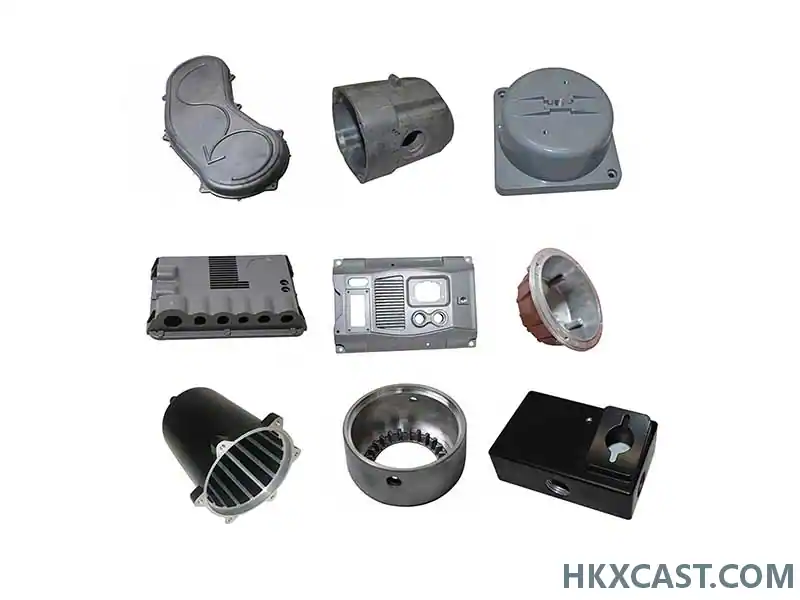
Understanding Aluminum Die Casting: Alloys, Process, and Applications
07/31/2025
What is Aluminum Die Casting? Aluminum die casting is a metal manufacturing process where molten aluminum is injected under high pressure into a mold to form precise shapes—similar to plastic injection molding. However, it involves more complex systems, such as cores (for internal features), cooling channels, and ejection mechanisms. In simple terms, the process works by forcing liquid metal through a central injection port into a pre-designed cavity, where it solidifies into the desired part. It’s a high-efficiency method for producing strong, lightweight metal components.This article explores the fundamentals of aluminum die casting, including material selection, key technologies, and diverse applications across industries. Aluminum die-castings 1. Aluminum Die Casting Alloys and Material Composition The performance of die-cast aluminum products heavily depends on the alloy composition. Common aluminum die casting alloys like ADC12 and A380 are formulated with elements such as silicon, copper, and magnesium. These elements enhance properties like fluidity during casting, mechanical strength, and corrosion resistance. For instance, higher silicon content improves casting performance, while magnesium boosts structural integrity. Aluminum die-casting alloys can be divided into four main types based on their composition: These alloys are chosen based on required properties like strength, corrosion resistance, heat resistance, and castability. Selecting the right aluminum die cast material is critical. Factors like part complexity, intended use (e.g., structural components or heat-resistant cookware), and post-processing requirements influence the choice of die cast aluminum alloys. 2. The Aluminum Die Casting Process Explained The aluminum die casting process involves injecting molten alloy into a steel mold under high pressure. This method, known as high-pressure aluminum die casting, ensures precise filling of intricate molds, resulting in components with tight tolerances and smooth surfaces. Aluminum Die Casting Production Process Key equipment includes aluminum die casting machines, which control injection speed and pressure, and durable aluminum casting dies designed to withstand repeated thermal cycles. Advanced cooling systems within the…

Die casting: Design, Materials and processes
07/20/2025
Introduction This article covers die casting technology and its applications. You will learn about: What Is Die Casting? Die casting is a metal casting process. It works by melting metal and forcing it into a mold under high pressure and speed. The metal cools and hardens, then the mold opens, and the finished part is pushed out. The specific sequence we run is described in what the HKX die casting process is. Parts made with this method have a smooth surface finish (Ra 3.2 to 6.3 μm) and precise dimensions (Grade T11 to T13). Common metals used include aluminum, zinc, magnesium, lead, and tin.Depending on the metal, the process is called: This method is ideal for mass production due to its high efficiency and consistency. How Die Casting Works ? 1.Mold Preparation Each product has its own unique shape and structure. When designing a mold, key considerations include the number of cavities and the required press tonnage. Based on the product layout, molds can be categorized into: Single-cavity mold: The simplest type, producing only one product per casting cycle. Multi-cavity mold: More complex than single-cavity molds, with variations like double-cavity, triple-cavity, etc. Each cycle produces multiple identical products, making it ideal for high-volume production. Unit mold : Contains at least two different product types, producing one of each per cycle. Often used for matching product sets. Combination mold: A hybrid of family and multi-cavity molds, capable of producing multiple products (same or different types) in a single cycle. Suitable for mixed-quantity or large-scale production. Under the same press tonnage: Multi-cavity mold cost > Single-cavity mold cost Multi-cavity product cost < Single-cavity product cost Multi-cavity mold cost < (Single-cavity mold cost × 2) After manufacturing, molds must be cleaned, oiled, and treated for rust prevention to avoid corrosion, ensuring product accuracy and mold longevity. Before each production run, inspection and preheating are…