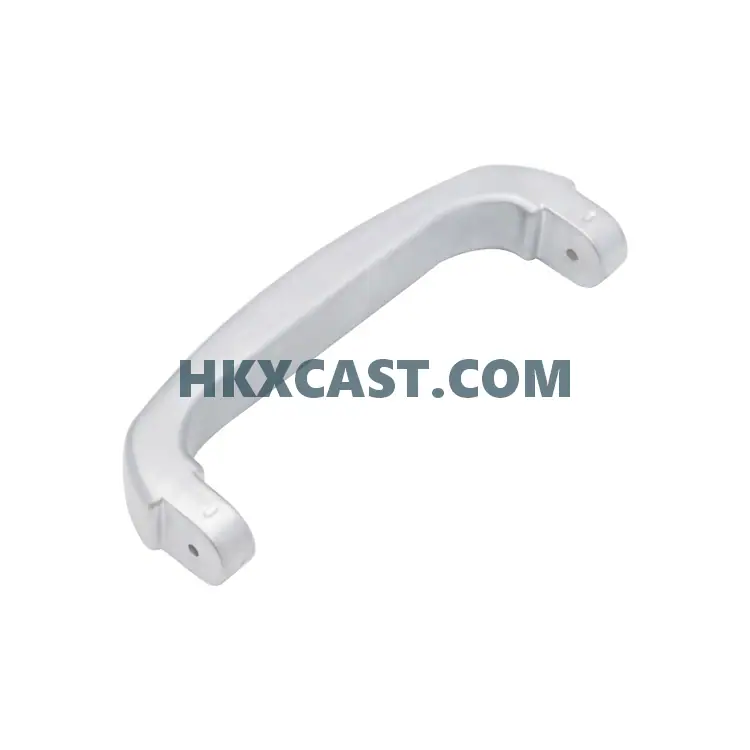
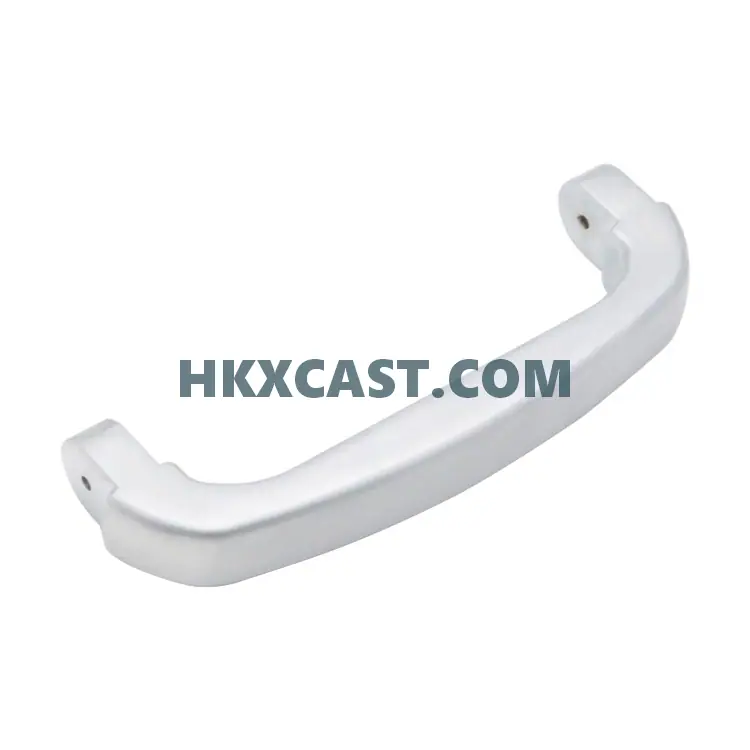
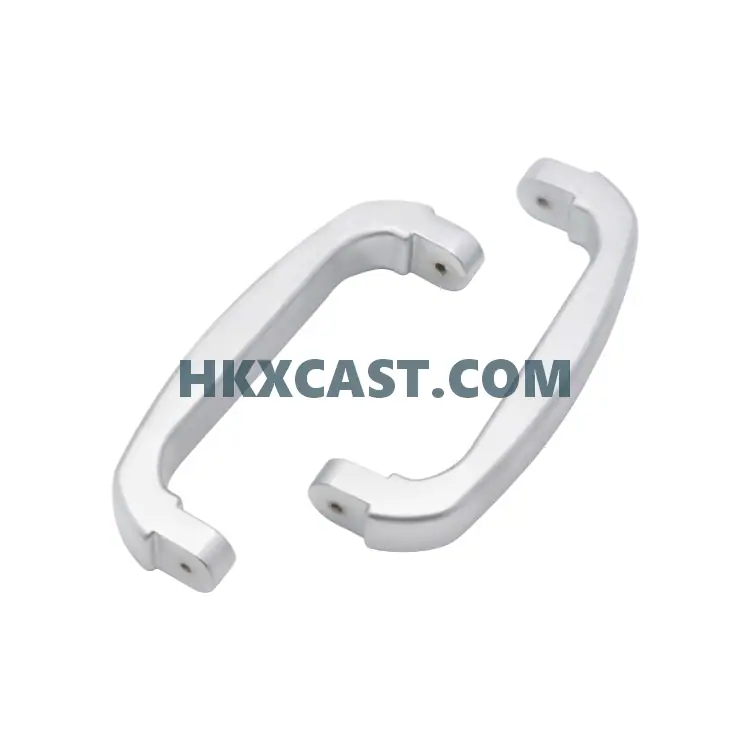
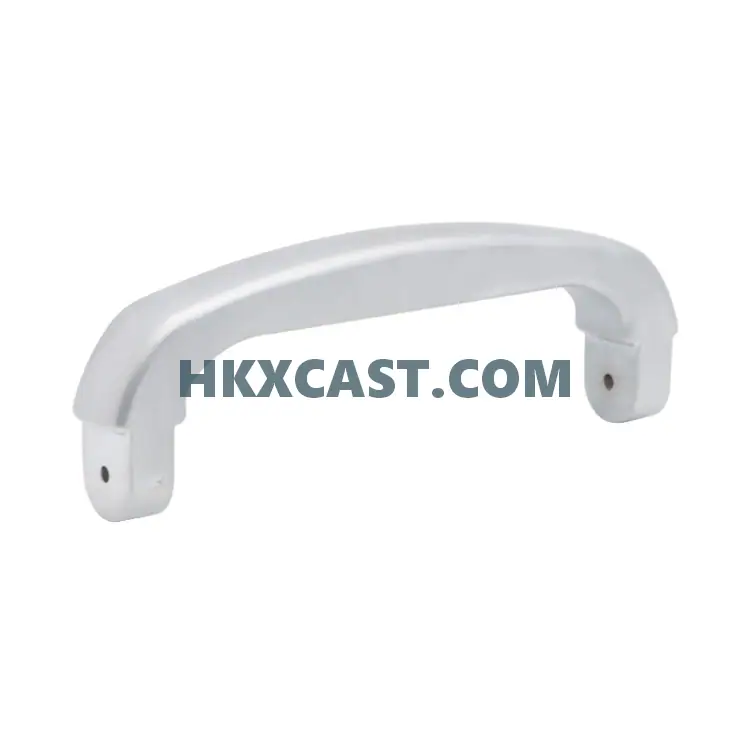
HKX die casts door handles in zinc and aluminum alloys, then machines, polishes and coats them in the same plant in Ningbo. Handles leave the factory as finished parts: spindle bore reamed, screw bosses tapped, surface plated or powder coated, ready to bolt onto a door.
This page covers mechanical (passive) handles — lever, pull and rose handles that release a latch by hand. If the handle has to house a card reader, a fingerprint sensor, a motor or a battery, start from our electronic door handle page instead: the casting rules and the machining list are different.
Mechanical vs electronic handles: where the line is
The two product families share a shape but not a manufacturing route. A mechanical handle is a load-bearing lever with a spindle hole. An electronic handle is a sealed enclosure that happens to look like a lever. Confusing the two is the most common cause of a failed first sample.
| Requirement | Mechanical handle (this page) | Electronic handle |
|---|---|---|
| Function | Releases the latch by hand | Releases the latch, plus reads a credential or drives a motor |
| Alloy | ZAMAK 3 / ZAMAK 5 zinc, ADC12 aluminum | ADC12 / A380 aluminum, A360 for outdoor |
| Wall thickness | 1.5–3.0 mm, solid sections are normal | 1.8–2.5 mm, ribbed shell with internal cavities |
| Critical machining | Spindle bore, screw bosses, rose face | Reader window, gasket groove, battery bay, cable channel |
| Sealing | None required | Gasket groove, IP54 to IP65 |
| Cost driver | Alloy weight plus plated area | Machining time plus sealing and coating masking |
Alloy choice: zinc or aluminum?
Zinc is the default for interior architectural handles. It casts thinner and crisper than aluminum, takes a mirror chrome finish without polishing through, and hot-chamber tooling lasts two to three times longer. Aluminum wins when weight, outdoor corrosion or part size matters more than surface detail.
| Alloy | Density | Tensile strength | Casting route | Where it wins |
|---|---|---|---|---|
| ZAMAK 3 | 6.6 g/cm³ | ~268 MPa | Hot chamber | Crisp detail, best plating quality, longest die life |
| ZAMAK 5 | 6.6–6.7 g/cm³ | ~331 MPa | Hot chamber | Higher load at the lever root, heavy-use doorsets |
| ADC12 | 2.7 g/cm³ | ~230 MPa | Cold chamber | Light weight, good castability, large handles |
| A380 | 2.71 g/cm³ | ~324 MPa | Cold chamber | Best strength-to-cost for structural handles |
| A360 | 2.63 g/cm³ | ~300 MPa | Cold chamber | Best corrosion resistance, outdoor and coastal use |
Alloy data and cross-references for the Chinese grade system are on our Chinese casting aluminum alloy chart. A side-by-side comparison of the two metals is in zinc die casting vs aluminum die casting.
Standard specifications
These are the ranges we tool for most often. Anything outside them is possible — it just changes the die layout or adds a machining step, so tell us the drawing before we quote.
| Parameter | Typical range | Notes |
|---|---|---|
| Handle length | 100–300 mm | Lever, pull, L-shape, D-shape |
| Rose / backplate diameter | 50–65 mm | Round, square or rectangular escutcheon |
| Spindle | 7×7 or 8×8 mm square, 60–110 mm long | Bore reamed after casting, not cast to size |
| Door thickness | 35–55 mm | Thicker doors need a longer spindle, not a longer handle |
| Screw hole pitch | 38 / 50 / 58 mm | Match the existing lockset, or we drill to your pattern |
| Wall thickness | 1.5–3.0 mm | Below 1.5 mm the lever root risks cold shuts |
| As-cast tolerance | ±0.10–0.20 mm | Per NADCA / ISO 8062 tables, dimension dependent |
| Machined tolerance | ±0.05 mm | Spindle bore, screw bosses, mounting face |
| Surface roughness | Ra 1.6 µm machined, Ra 0.8 µm polished | Polishing step is required before bright plating |
| Static pull load | 500–1,000 N | Tested on the assembled lever, not the bare casting |
| Cycle life | 100,000 cycles | Lever return spring and spindle wear |
If your drawing has a tight dimension, check it against our die casting tolerance tables before committing — it is cheaper to relax a tolerance than to add a fixture.
Finishes that survive daily handling
Handles are touched more than any other casting on a door, so finish choice decides how the product looks after two years, not two weeks. Salt spray hours below are ASTM B117 neutral salt spray, measured on the finished part.
| Finish | Base alloy | Salt spray | Best for |
|---|---|---|---|
| Cu-Ni-Cr chrome | Zinc, aluminum | 240–480 h | Retail and interior hardware, high gloss |
| Satin nickel | Zinc | 120–240 h | Hotels, residential, fingerprint-resistant |
| Powder coating | Both | 240–500 h | Colour matching, outdoor ranges |
| Anodizing Type II / III | Aluminum only | 200–1,000 h | Outdoor, brushed or black architectural looks |
| PVD over plating | Both | 400 h+ | Scratch resistance, black and gold hardware |
| Shot blast + passivation | Aluminum | 96–168 h | Industrial enclosures, paint-ready surface |
Finish thickness matters for fit: a 25 µm chrome layer changes a spindle bore. We machine to the plated dimension, not the bare dimension. More options are listed on our surface finishes page.
Where these handles are used
- Residential doorsets — entrance, interior and bathroom handles in zinc with chrome or satin nickel.
- Hotel and office doors — lever handles on rose, matched to euro-profile cylinders.
- Industrial enclosures and cabinets — powder-coated aluminum pulls with a lock cut-out.
- Appliance panels — refrigerator, oven and dishwasher handles, where the casting also acts as a heat break.
- Transport and marine — A360 aluminum with Type III anodizing for salt exposure.
For panel and cabinet pulls — lighter single-boss parts with a different tooling approach — see our cabinet handle line.
Tooling, DFM and lead time
- DFM review on your 3D file before quoting: draft angles 1–2°, minimum wall 1.5 mm, boss wall at least 0.8× the hole diameter, gate position clear of the polished face.
- Tool build 30–45 days in H13 die steel, 2- or 4-cavity depending on annual volume, rated 100,000–300,000 shots.
- T1 samples 5–7 days after the die is cut, with a dimensional report and first-article inspection.
- Production runs from a few thousand pieces a year upward; we hold the die and the process sheet, so a repeat order does not re-qualify from scratch.
Quality control on every batch
- X-ray or sectioning at the lever root, where shrinkage porosity hides.
- CMM first-article report against your drawing, then sampling per AQL on running batches.
- Salt spray cabinet per ASTM B117 on plated and coated parts.
- Coating thickness gauge on every finish lot; plating adhesion by cross-hatch or bend test.
- Cycle tester on the assembled lever for spring return and spindle wear.
FAQ
Can you match a handle we already sell?
Yes. Send a physical sample or a 3D scan. We reverse-engineer the die, then flag anything that will not cast cleanly — usually a wall under 1.5 mm or a sharp inside corner at the lever root — before cutting steel.
Do you assemble the handle or just cast it?
Either. We can ship bare castings, machined and finished parts, or fully assembled handles with spindle, spring, screws and packaging. Assembly in-house removes the mismatch risk between a plated bore and a plated spindle.
What is the minimum order?
It depends on the die, not on a fixed number. A 2-cavity zinc die is usually justified from a few thousand pieces a year; a 4-cavity aluminum die needs more. We quote the tooling and the unit price together so you can see the break-even point.
Keep reading
- Electronic door handle — the same shape, built as a sealed enclosure for smart locks.
- Aluminum die casting — process, alloys and typical applications.
- ADC12 aluminum alloy — properties and why it is the workhorse grade.
- Die casting tolerances — what high pressure casting can actually hold.