Most red flags Chinese supplier quotations carry are visible before a deposit is paid. A quote with one blended price and no tooling, machining or inspection line. A tooling fee with no ownership clause. A reply that arrives in four hours with no questions about wall thickness. None of these is proof of a bad factory. Together they are proof or absence of a system, and that is what a buyer is actually evaluating in the first two weeks. This guide reads the emails sentence by sentence, then turns the reading into a score.
Key Takeaways
- A quote with one piece price and no tooling, machining or packaging line is not a short quote, it is an unaudited one.
- Tooling ownership, die life and maintenance responsibility belong in writing before the deposit, not after the first repair.
- An alloy named only by grade, with no standard reference and no spectro report, cannot be verified once parts ship.
- Generic reassurance in email is a leading indicator: the same habits answer a porosity complaint eight months later.
- A supplier that quotes without asking about wall thickness, tolerance class or annual volume is estimating, not quoting.
- Three itemized quotes you can compare beat one low quote you have to trust, and the comparison takes one afternoon.
Why the Email Is the First Audit
Drawings are the most standardized document in the trade. A wall thickness, a datum scheme and a tolerance block follow published conventions, so a competent toolmaker reads them the same way in Ningbo as in Detroit. Commercial correspondence has no such convention. Two quotations for the same part can describe the same scope in formats that share no line item, and two emails can answer the same question with opposite levels of commitment.
That gap is where risk accumulates. A drawing error surfaces in DFM review, which is cheap. A quotation error surfaces three months later as an invoice dispute, a missing machining step, or a die the supplier considers its own property. The quote is not paperwork attached to the deal. It is the technical agreement, written in commercial language, and the email chain around it is the evidence of how that agreement will be honored.
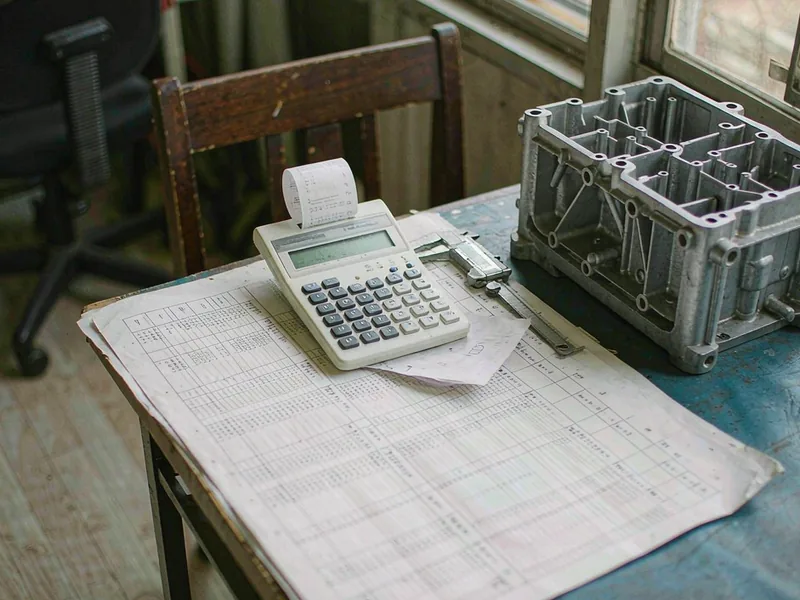
Quoting is also the period of highest attention a supplier will ever give an account, because the order is not yet won. Whatever responsiveness exists at that stage is the ceiling, not the average. If replies are slow, generic or evasive while the deal is still open, the same team will handle a schedule slip or a rejected lot with the same habits. Reading a quotation well therefore means reading two documents at once: the numbers, and the behavior that delivered them.
The practical consequence is that buyers should keep a simple log from the first exchange. Time to first reply, number of technical questions asked, whether a drawing came back marked up, whether the file name carries a revision. None of that requires a factory visit, and all of it narrows what to inspect when a visit happens.
What the Sentence Actually Means
The red flags Chinese supplier emails contain are rarely dramatic. They are small, polite, and easy to read past, because the wording is designed to keep a deal moving. The table below pairs the phrasing with the operational reality behind it and the reply that resolves the ambiguity without starting a fight.
| Red flag | What the email actually says | What is really going on | How to reply |
|---|---|---|---|
| Reassurance instead of evidence | “We are a professional factory with rich experience.” | No quality system document to quote from, so the answer is a slogan | “Please send your ISO 9001 certificate, last internal audit date and one dimensional report from a similar part.” |
| Price promised before scope | “Best price for you, please confirm quantity.” | Quoting from a weight estimate, not from a process review | “Before price, confirm wall thickness, tolerance class, alloy standard and annual volume.” |
| Universal capability claim | “No problem, we can make any drawing.” | No DFM gate exists, so nothing has been checked | “Send your DFM comments on this drawing, including draft and any feature you would change.” |
| Deflected tooling question | “Mold is free, we keep it in our workshop.” | Tooling cost is amortized into piece price and ownership stays with the supplier | “State tooling ownership, transfer terms, expected shot life and who pays for maintenance.” |
| Timing without milestones | “Delivery 30 days after deposit.” | Tryout, sample approval and inspection time are outside the number | “Break the schedule into tooling, T1, sample approval, production and transit dates.” |
| Alloy by name only | “We use ADC12, good quality.” | No chemistry window and no per-heat verification is planned | “Confirm the standard you hold to and attach a spectro report for the last three heats.” |
| Silence on porosity | No mention of internal soundness at any point. | Acceptance will be visual, decided at the inspection bench | “Propose a radiographic acceptance level referenced to ASTM E505 for our approval.” |
| Urgency as a closing tool | “Price valid only this week, please confirm today.” | Pressure replaces engineering; the review never happens | “We are comparing three suppliers on the same specification and will decide after technical review.” |
Three patterns sit behind most of these rows. The first is substitution of adjectives for data, which appears whenever a supplier has no report to attach. The second is answering a different question than the one asked, which is usually a language gap compounded by a salesperson working without engineering support. The third is time pressure, which converts a technical discussion into a commercial one before the technical questions are settled.
How to test the reply without antagonizing anyone
Ask one narrow, verifiable question and watch what comes back. “What draft angle do you use on a 60 mm deep bore, and why?” has a checkable answer. A reply that names 1-1.5° and mentions tool steel and ejection comes from someone who casts parts. A reply that says “as per drawing” comes from someone forwarding email. Neither answer is an insult, but only one of them predicts how a porosity dispute will be handled later.
Quote Structure: Missing Lines Cost More Than High Prices
The red flags Chinese supplier quotations hide are usually absent line items rather than inflated ones. Absence is harder to notice, because a quote that omits five scope items looks cleaner and cheaper than a quote that prices them. The test is to compare every quotation against a fixed checklist, not against the other quotations.
| Line item | Typical omission | What it costs after the order | What to require in writing |
|---|---|---|---|
| Machining | Quoted as “as required” or folded into casting price | Per-feature machining becomes a change order at first article | Stock allowance per face, number of setups, cycle time basis |
| Tooling | A single fee with no life, ownership or maintenance terms | Die transfer becomes a negotiation and a second payment | Ownership clause, shot life estimate, repair responsibility, transfer rights |
| Inspection | Nothing listed until the buyer asks | Buyer pays a third party to recreate reports that should ship free | FAI report, dimensional report, material certificate, heat lot traceability |
| Surface finish | “Painting” with no class, color system or thickness | Coating rework, color mismatch, adhesion failure in the field | Finish class, coating thickness range, adhesion test method and salt spray hours |
| Packaging | “Export packing” with no specification | Transit damage that no unit price ever shows | Carton rating, dunnage, pallet pattern, moisture barrier |
| Freight and terms | Price with no named Incoterm or port pair | Freight, duty and insurance land as a surprise on the invoice | Named Incoterm, port pair, who arranges insurance |

An itemized quote is also a capability statement. A foundry that can price machining stock per face has already thought about datum strategy. One that prices “machining” as a lump has not, and the first article will show it. The same logic applies to inspection: naming the reports forces the supplier to confirm which ones the plant can actually issue, which is a different question from whether quality is controlled. According to NADCA, porosity acceptance criteria should be agreed and recorded before production starts, because a visual judgement at the inspection bench cannot be appealed after the lot ships.
Documentation belongs in this conversation early. A supplier certified to ISO 9001 has a management system, not necessarily the reports a buyer needs in hand. Chemical composition should be checked against the range published in ASTM B85/B85M for the specified grade, and the supplier should be able to show that comparison per heat rather than per year. Buyers who want a deeper contract view of the tooling question can start with tooling ownership in China, because that clause survives longer than any price on the page.
Numbers That Do Not Add Up
Some flags live in the arithmetic rather than the wording. The red flags Chinese supplier quotes reveal at this level are internally consistent-looking numbers that cannot all be true at once. Four are worth checking on every quote.
Piece price against casting weight
Ask for the casting weight and the buy weight, which includes runners and overflows. A quote priced on finished weight ignores the yield loss that a real die produces, and a foundry that cannot state its yield has not modeled the die. Typical yield for a mid-size housing sits between 55% and 70%; a claim near 90% on a complex part is a quote for a different process.
Tooling price against cavity count and die size
A tooling number far below the others is usually a different die: fewer slides, a softer steel, a single cavity instead of two, or no vacuum valve. Those choices are legitimate, but they change the shot life and the cycle time. Ask for the cavity count, the steel grade and the expected shot life, then compare the four numbers together. A guide to the real cost of die casting tooling in China lists which items sit outside the headline figure.
Lead time against the process route
A die for a housing with two slides typically needs several weeks of design, machining, heat treatment and fitment before the first shot. A quote that promises a sample in two weeks either has spare capacity on a similar die or has not planned the tryout. Compress the schedule on paper and the compression reappears as a rushed T1 with no dimensional report.
Payment milestones against inspection gates
A schedule that asks for the balance before first article approval removes the buyer’s only leverage. Tie the final payment to sample approval and a pre-shipment inspection, and the quality conversation stays technical. The same discipline applies to GD&T: critical characteristics should be read against ASME Y14.5 practice, and capability confirmed on them rather than inherited from a general tolerance block.
How HKX Answers a Technical Email
At HKX, a new inquiry is routed to an engineer before a price exists, because the Ningbo plant treats the first reply as a technical document rather than a sales courtesy. The reply normally carries a marked-up drawing with draft, fillet and parting line comments, a named alloy window, and the machine tonnage class the projected area implies. When a customer asks for ADC12, the answer states the Si and Cu range the plant will hold, usually 10.5-11.5% Si and 2.0-3.0% Cu, verified per heat on a direct-reading spectrometer before the melt is released. Quotations then leave the plant itemized: casting, machining, surface finish, inspection, packaging and tooling on separate lines, each with the assumption behind it. Die temperature zones, vacuum valve timing and spray cycle appear as process assumptions, because each one changes the porosity level the plant can promise. Inspection is priced as a deliverable, with first article report, dimensional report against drawing datums, X-ray sampling to ASTM E505 and heat lot traceability included rather than quoted as extras. The manufacturing process sequence ships with the quote, so a buyer reads the price against the route it pays for, the same way the plant quotes aluminum motor end covers for automotive programs. Every red flags Chinese supplier list reduces to one question: can this factory show its work? The reply format answers that before the customer has to ask.
Scoring a Supplier in 48 Hours
A checklist tells a buyer what to look for. A weighted score tells a buyer what to do. The red flags Chinese supplier correspondence shows should be graded on the same sheet as the commercial terms, because a supplier that scores well on price and badly on documentation is not a bargain. The weights below reflect what actually causes program failure: scope disputes and tooling fights, not unit price spread.
| Category | Weight | Score 5 looks like | Score 2 looks like |
|---|---|---|---|
| Commercial transparency | 20 | Every cost element itemized and traceable to a process step | Single blended price, breakdown refused |
| Tooling terms | 20 | Ownership, shot life and maintenance written into the offer | Tooling described as included or proprietary |
| Alloy and traceability | 15 | Standard reference plus a per-heat spectro report supplied unasked | Grade name only, reports available on request |
| Engineering response | 15 | Marked-up drawing with specific questions in the first reply | Generic reply, no technical question asked |
| Inspection and documentation | 15 | Named reports, standards and sampling rates | Documentation quoted as an extra line |
| Schedule realism | 15 | Milestone plan with tryout and approval dates | One lead time figure, no milestones |
Multiply each score by its weight, sum, and divide by five to get a figure out of 100. Below 60, the supplier is a sample-only option at best. Between 60 and 75, the gaps are closable with a written clarification before the order. Above 75, the quote is comparable with others on the same basis, and the decision can move to price and schedule. Any score of 2 or lower in the tooling or traceability rows should cap the total, regardless of how well the rest scores.
The score is a conversation tool, not a verdict. Send the completed sheet with the clarification requests attached, and a serious supplier returns a revised quote with the gaps closed. One that answers with a discount instead of an answer has told you which number it is optimizing.
Frequently Asked Questions
Are low prices from Chinese foundries a red flag on their own?
Not on their own. A low price becomes a warning only when it cannot be explained by the itemization. Ask which cost elements are included, then compare alloy, machining stock, finish and inspection line by line. An explained low price is a competitive quote; an unexplained one is usually a quote for a smaller scope.
What are the most common red flags Chinese supplier emails reveal?
Reassurance instead of evidence, price before scope, universal capability claims, no named engineer, attachments with no revision number, and reluctance to put tooling terms in writing. Each is cheap to observe during quoting and expensive to discover during production.
Should a buyer require a sample before a production order?
Yes, and the sample should arrive with a first article report rather than a photograph. A T1 sample with dimensional data, a material certificate and a stated porosity acceptance level proves the process. A sample alone proves only that one part can be made.
How do I verify the alloy that was actually supplied?
Request a spectro report per heat lot and cross-check the chemistry against the standard range for the grade specified. Independent verification on arrival costs little and settles disputes quickly, because the composition limits are published and not open to interpretation.
Is a factory audit necessary if the emails look professional?
Professional correspondence raises the prior probability of a working system but does not replace evidence. A short audit confirms machine tonnage, die maintenance records, calibration status and inspection capability. The email pattern tells you what to look for during that visit.
What single clause protects a buyer most?
A written tooling clause covering ownership, transfer rights, expected shot life and who pays for maintenance. It is the only term that still matters after the relationship ends, and it is the term most often left to verbal assurance.
Author: HKX Engineering Team
HKX — Ningbo Hexin Mould Co., Ltd., an aluminum die casting manufacturer in Ningbo, China, with 30+ years of tooling experience, in-house machining and finishing, ISO 9001 and IATF 16949 certification, and customers in more than 20 countries.
Talk to the HKX Engineering Team
Send a drawing and the annual volume, and HKX returns a quotation built the way this guide describes: casting, machining, finish, tooling, inspection and packaging on separate lines, with the process assumptions written beside the price. Buyers also receive the alloy window the plant will hold and the documentation that ships with each lot, including a first article report and heat lot traceability. The red flags Chinese supplier quotes share are omissions rather than errors, so the reply names every deliverable before it names a number. To start, contact our engineering team with the tolerance class and any leak test requirement.