The short answer to IATF 16949 vs ISO 9001 is that IATF is not a replacement standard. It is ISO 9001 with roughly 60 additional requirements bolted on, plus a layer of customer-specific rules that varies by automaker. ISO 9001 asks whether a foundry runs a controlled quality system. IATF 16949 asks the same question and then demands a control plan, a PPAP file, capability studies, tooling records and a contingency plan. That difference is what buyers pay for.
Key Takeaways
- IATF 16949 cannot be certified on its own; a foundry must hold ISO 9001 first and layer the automotive requirements on top.
- The automotive standard applies only to sites producing production or service parts, so a lighting line in the same plant may sit outside its scope.
- IATF adds named documents: APQP, PPAP, control plan, MSA, SPC and a die register, each with a defined retention period.
- ISO 9001 asks for risk-based thinking; IATF asks for written contingency plans reviewed at least once a year.
- Switching from an ISO 9001-only foundry to an IATF one adds PPAP approval, run-at-rate and capability studies, typically four to eight weeks.
- Certification proves the system exists, not that it is healthy. Audit findings and PPM history tell you whether it works.
The Short Answer: Same Skeleton, Deeper Obligations
ISO 9001:2015 defines a generic quality management system: context, leadership, planning, support, operation, performance evaluation and improvement. It is deliberately sector-neutral, which is why a machine shop, a printer and a foundry can all certify to it with the same clause numbers.
IATF 16949:2016 keeps those ten clauses and inserts automotive-specific sub-clauses beneath them. The structure is identical, so an auditor reads the same outline. The obligations are not identical, and that is where quotes diverge.
Why it cannot stand alone
IATF 16949 is a supplemental standard. A site certifies to ISO 9001 and IATF 16949 together, on one certificate with both references. That matters commercially: any IATF 16949 vs ISO 9001 claim should be read off the same scope statement, and a supplier advertising the automotive standard without an ISO 9001 certificate on that scope has a documentation problem rather than an advantage.
Scope is narrower than most buyers assume
The automotive standard covers sites that manufacture production parts, service parts or accessories for automotive customers. A plant running LED street lamp housings and industrial enclosures on separate cells may hold IATF certification for the automotive portion of the site while the rest is governed by ISO 9001 alone. Ask which product lines sit inside the certification scope, because a certificate number does not answer that question.
According to the published history of IATF 16949, the standard replaced a set of national automotive schemes, including QS-9000, VDA 6.1 and AVSQ, in order to give global OEMs one common baseline. The consolidation is the reason a Chinese foundry can now serve a German, American and Japanese customer with a single audit program instead of three.
Clause by Clause: What Actually Gets Added
Most IATF 16949 vs ISO 9001 comparisons stop at “IATF is stricter.” The table below maps the clauses where the addition changes what a foundry must produce, and what a buyer can therefore request as evidence.
| Clause | ISO 9001:2015 baseline | IATF 16949 addition |
|---|---|---|
| 4.4 / 4.4.1.2 | Processes and their interactions defined | Product safety responsibilities, escalation process and documented training |
| 6.1.2.3 | Risk-based thinking, no named output | Contingency plans for utility loss, labour shortage and key equipment failure, reviewed annually |
| 7.1.5.2.1 | Monitoring resources controlled | Internal laboratory scope defined; external labs must hold ISO/IEC 17025 unless the customer waives it |
| 8.3.4.4 | Verification and validation planned | Product approval process (PPAP) recognized and submitted at the customer’s level |
| 8.5.1.1 | Production carried out under controlled conditions | Control plan linked to the PFMEA and revised after every customer complaint |
| 8.5.1.3 | No first-off requirement | Job set-up verification at every shift and die change, with last-off parts retained |
| 8.5.1.6 | Tools handled as infrastructure | Tooling management: die register, identification, ownership, repair history, storage records |
| 8.5.6.1.1 | Changes controlled | Temporary change of process controls, with approval, expiry date and a return-to-standard plan |
| 9.2.2.3 | Internal audits at planned intervals | Separate manufacturing process audits and product audits on defined frequencies |
| 10.2.3 / 10.2.4 | Nonconformity corrected, cause removed | Defined problem-solving method, error-proofing verification and warranty analysis |
Read the middle rows together and the practical difference appears. A control plan tied to a PFMEA, a first-off check at every die change and a die register with repair history are the three records that make a defect traceable to a specific cavity and a specific shift. Under ISO 9001 alone, a foundry can be perfectly certified while producing none of them.
Two rows are frequently misread. Clause 7.1.5.2.1 does not require every foundry to own an accredited laboratory, but it does require an external lab to be accredited unless the customer agrees otherwise, which affects how a dimensional report is received at an OEM. Clause 9.2.2.3 is not about the annual system audit; it requires audits of the manufacturing process itself, walking the line, checking the control plan against what operators actually do.
The Five Documents That Only Exist Under IATF
Buyers do not need to read the standard to evaluate a supplier. Five artifacts cover most of the IATF 16949 vs ISO 9001 gap, and each one has a defined content and a defined owner.
APQP, PPAP and the control plan
Advanced product quality planning sequences the launch; the production part approval process proves the result. The control plan is the operating document that sits between them, listing each characteristic, the measurement method, the sample size, the frequency and the reaction plan. In a die casting program, the control plan is where porosity acceptance, X-ray frequency and leak test limits become auditable rather than verbal.
MSA and SPC
Measurement system analysis proves the gauge can see the variation it is asked to judge, usually through a gauge repeatability and reproducibility study. Statistical process control then tracks the characteristic over time. Neither is a document for its own sake: a leak tester with poor repeatability will pass and fail the same part, and no amount of SPC on its output will fix that.
| Element | What the foundry submits | Acceptance threshold |
|---|---|---|
| PFMEA | Process failure modes, severity, occurrence, detection and actions | Reviewed at every engineering change |
| Control plan | Characteristic, method, sample size, frequency, reaction plan | Matches the PFMEA line by line |
| Dimensional results | Full layout on 3-5 parts from the production die | 100% of drawing characteristics reported |
| Material and performance tests | Chemistry, mechanical properties, leak and salt spray where specified | Against the referenced ASTM or ISO method |
| Initial process studies | Capability on special characteristics | Ppk 1.67 or better at launch |
| MSA | Gauge R&R on each gauging system in the control plan | 10% or better, 30% maximum |
| PSW | Part submission warrant signed against the customer’s level | Level 3 is the common default |
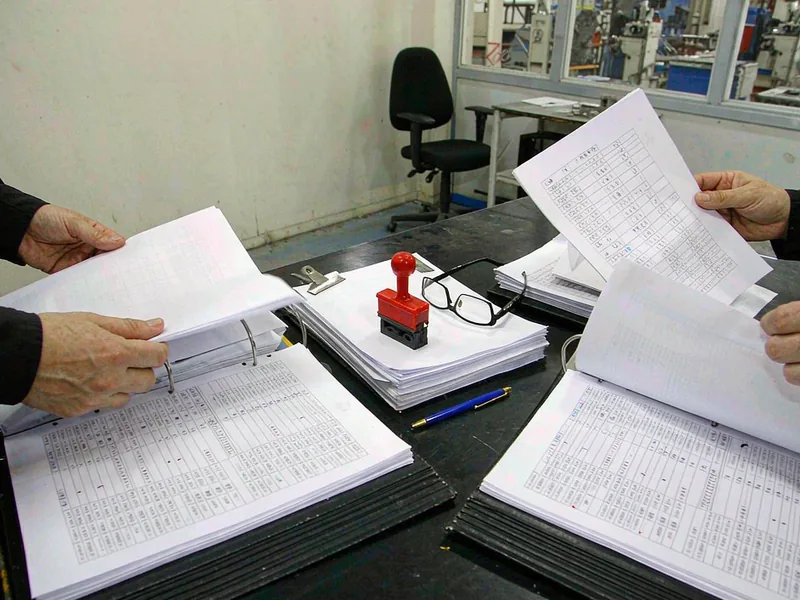
Audits, Competence and the Paper Trail
An IATF 16949 vs ISO 9001 comparison usually ignores the audit calendar, yet that calendar is where the two systems feel different inside a plant. ISO 9001 requires internal audits at planned intervals. IATF requires three distinct types, each with its own purpose and frequency.
Three audits instead of one
The system audit checks the quality management system against the standard. The manufacturing process audit checks a specific production line against its control plan, usually annually per process. The product audit takes finished parts and verifies them against the drawing and customer requirements. A foundry that only runs the first has a certificate and no early warning system.
Competence, not just training records
IATF requires on-the-job training for new or reassigned personnel, and it requires internal auditors and second-party auditors to be competent in the specific process they audit. In practice this means a die casting process audit should be done by someone who understands die thermal balance and gate velocity, not by a generalist with a checklist. Buyers can test this with one question: who audited the last process audit, and what did they find?
Retention and traceability
Retention periods are longer and more specific. Production part approvals, tooling records, purchase orders and corrective action records are kept for the length the customer specifies, and often for the life of the program plus a calendar year. That archive is what makes a field failure investigation possible three years after shipment, and it is also what makes a supplier switch expensive for the foundry leaving.
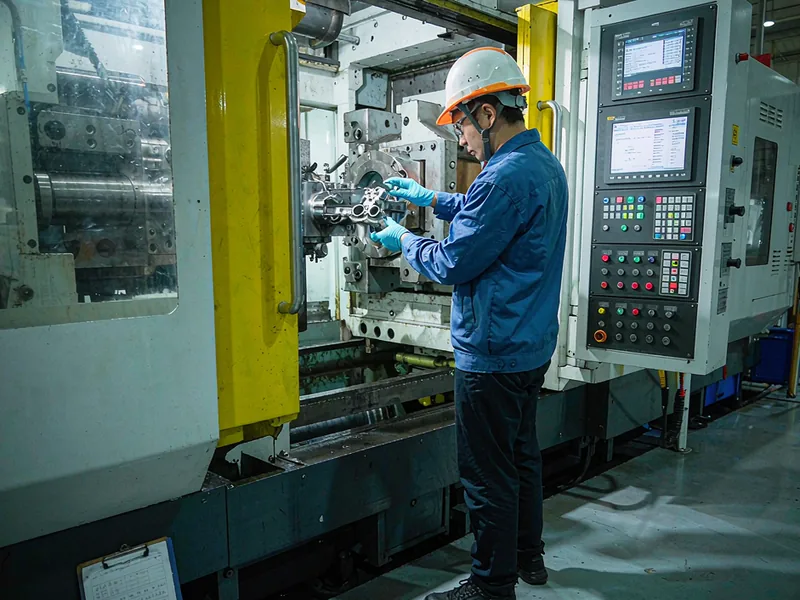
What Switching Suppliers Actually Costs
This is the decision most purchasing teams get wrong. A foundry holding only ISO 9001 can often quote lower on the same drawing, and the gap is real rather than a bargaining position. In an IATF 16949 vs ISO 9001 price comparison, part of that gap is the documentation and validation work an automotive supplier carries as routine overhead, and part of it is the inspection depth behind the control plan.
The cost appears on the buyer’s side at the moment of the switch, not in the piece price. The table below lists what has to be repeated when a part moves to a new source.
| Switching step | From an ISO 9001-only foundry | Practical burden |
|---|---|---|
| PPAP submission | Usually a dimensional and material report | Full file at the customer’s level, four to eight weeks |
| Run-at-rate | Rarely requested | 300-500 consecutive parts at production rate, witnessed |
| Tooling transfer validation | First-off dimensional check | Die re-qualification, capability study and full layout |
| Gauge and test stand approval | Correlation check | Gauge R&R on every control plan characteristic |
| Customer notification | Often internal only | Formal change request and re-approval before shipment |
| Launch containment | Ad hoc | Intensified inspection for the first 90 days, documented |
| Sub-supplier requalification | Not applicable | Ingot, coating and heat treat sources re-approved |
Add the engineering hours and the answer becomes obvious: the switch consumes 40-80 internal hours before the first approved shipment, and the risk sits with the buyer if the new source is weaker than the old one. That is the real argument for paying a modest premium to a foundry that already runs the system, and the real argument against switching purely on piece price.
How HKX Runs Both Systems in One Plant
HKX operates a single quality system at the Ningbo plant, written to IATF 16949 and used for every customer, whether an automotive end cover or a lighting housing. Automotive programs carry the full document set: PFMEA, control plan, MSA and PPAP at the level the customer requests, with the PSW signed before the first production shipment.
Chemistry is confirmed by spectrometry on every melt, and the ADC12 window is held at 10.5-12.0% silicon with copper between 2.0 and 3.0%, so fluidity and die life stay inside the validated range. Die temperatures are controlled per zone with oil heaters, and vacuum valve timing is checked at the start of each run rather than assumed. X-ray review follows ASTM E505 severity grading on a 2% per shift sample, with 100% on the first five shots after any die change.
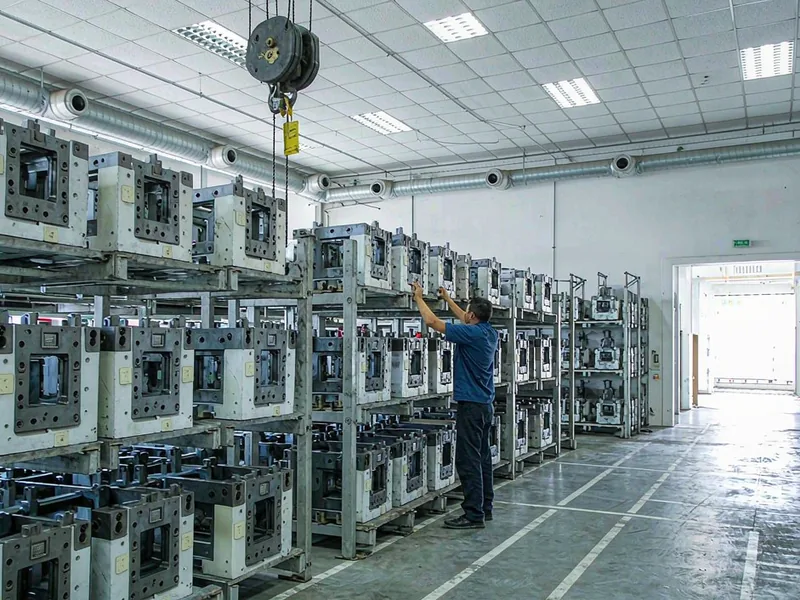
Each die carries an identification plate tied to a register that records cavity count, repair history and storage location, which allows a returned part to be traced to a specific tool and shift. CMM programs are built from the drawing datum scheme, and leak test stands are subject to gauge studies before they are used for release. When a customer asks for the evidence behind a shipment, HKX produces the control plan, the capability charts and the inspection records as one package rather than separate requests. Buyers comparing sources can see the same discipline applied to automotive die casting quality programs and to industrial equipment enclosures that do not require automotive approval at all.
Which One Do You Actually Need?
The decision is not “IATF is better,” it is whether the part enters an automotive supply chain. If the casting ships to a tier-one automotive customer, IATF 16949 is not optional: the customer’s supplier manual will require it, and the PPAP will not be accepted from a source that cannot demonstrate the underlying system. On that side of the line, the IATF 16949 vs ISO 9001 question answers itself.
For lighting, industrial equipment, electronic enclosures and general OEM work, ISO 9001 is the appropriate baseline. Demanding IATF on a street lamp housing buys paperwork that nobody will read, and it usually adds cost without adding protection. The useful question is which characteristics actually need capability data, and that is answered by the application rather than by the certificate.
Where the answer is genuinely unclear, ask for the last three audit findings and the PPM history for a comparable part. A foundry with IATF certification, a short findings list and a stable rate is a different supplier from one with the same certificate and eleven open major findings. Certification is a gate. The evidence behind it is the decision.
According to the North American Die Casting Association, process control documentation in die casting is only as good as the process data feeding it, which is why capability studies on wall thickness, die temperature and intensification pressure sit at the center of any automotive approval.
Frequently Asked Questions
Is IATF 16949 harder than ISO 9001?
It is more specific rather than more philosophical. The audit is longer, the documentation is named, and the evidence requirements are concrete: PPAP records, control plans, capability studies and contingency plans. A well-run ISO 9001 foundry usually needs six to twelve months of system work before an IATF audit, mostly to build records it never had to keep.
Can a Chinese foundry hold both certificates?
Yes, and most automotive-focused Chinese die casters do. The two standards share one audit cycle and are issued on a combined certificate. What matters is the certification scope: confirm that the product line you are buying sits inside the listed scope, since a plant can hold IATF for one workshop and ISO 9001 alone for another.
Does IATF 16949 guarantee better castings?
No. It guarantees that a defined system exists with records behind it, which raises the floor and makes problems traceable. A certified plant can still ship porosity if its control plan accepts it. In any IATF 16949 vs ISO 9001 decision, pair the certificate with PPM history and audit findings before drawing a conclusion.
What is the main document difference in daily work?
The control plan. Under ISO 9001 a process can be controlled by work instructions alone; under IATF every special characteristic needs a control plan line with method, sample size, frequency and reaction plan. That single document is what an auditor walks the line with, and what a customer reads after a defect escape.
How long does a supplier switch take with PPAP?
Four to eight weeks is typical for a die casting part at PPAP level 3, assuming the tooling already exists and only the source changes. A new die adds tool build and tryout time on top. Buyers who plan the switch around a model-year change usually absorb it; buyers who switch mid-program discover the cost in expedited freight.
Is IATF 16949 required for non-automotive parts?
Not usually. ISO 9001 with a documented control plan for the critical characteristics covers most lighting, industrial and electronic work. Requiring the automotive standard on a non-automotive part adds audits and record keeping that do not change the part, and it can push a capable supplier out of the comparison for no benefit.
Author: HKX Engineering Team
HKX — Ningbo Hexin Mould Co., Ltd., an aluminum die casting manufacturer in Ningbo, China, with 30+ years of tooling experience, in-house machining and finishing, ISO 9001 and IATF 16949 certification, and customers in more than 20 countries.
Talk to the HKX Engineering Team
Send a drawing with the destination market and the approval level your customer requires, and HKX will confirm which document set applies before quoting: the PPAP level, the control plan characteristics, the capability targets and the inspection records that will ship with the parts. Programs moving from an ISO 9001-only source get a written transition list covering tooling transfer, re-qualification and run-at-rate. To start that review, contact our engineering team and include the customer-specific requirements you are working to; the aluminum die casting overview shows the process range those systems cover.