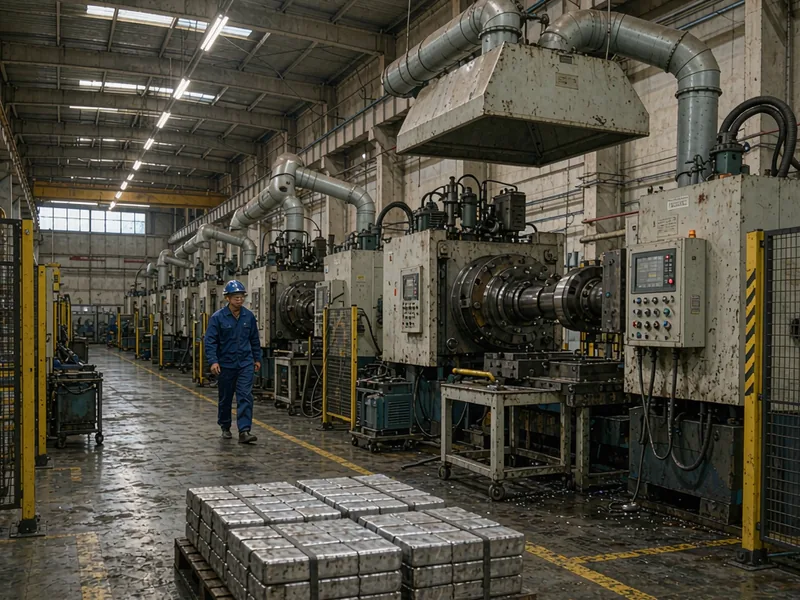
A real factory owns the furnace, the 压铸 machines and the dies. A trading company owns none of those and buys capacity from whoever has a free machine this month. The fastest way to settle the factory vs trading company China question is to request three documents and one walk-through: the business license scope, the certification certificate carrying the plant address, and the die register. Then verify each item on the floor. A genuine plant passes all three in under an hour.
关键要点
- A factory can name the machine, the die number and the heat lot behind your part; a trader can only forward the question.
- Nine checks settle it: license scope, certificate scope, machine nameplates, die register, process chain, engineering depth, inspection data, quote structure and site address.
- The trading margin is rarely the largest cost. A slower change loop and specifications that degrade across three parties cost more.
- Ask for the die number of a part the supplier already makes, then walk to the rack and find it yourself.
- Send a drawing with one deliberately thin rib and compare how fast geometry-specific DFM comments come back.
- An agent can be the right answer for low-volume, multi-category programs, provided tooling and quality records stay under your control.
Why the Answer Changes Your Landed Cost
Two suppliers quote the same drawing, both answer email within a day, and both send a polished capability deck. One melts metal at 680 °C eight kilometers from the address on the letterhead. The other forwards your file to a plant it does not own and adds a margin to the reply. Nothing in the quotation reveals which is which.
The difference surfaces later, where it is most expensive. A leak test fails on your line and the answer takes nine days, because the question travels from sales to agent to plant and back. Nobody can name the die number, the shot count or the heat lot.
Every hand between your drawing and the die adds three things: time in the change loop, ambiguity in the specification, and a margin that has to be recovered somewhere. It is usually recovered in the tolerance you did not question, the machining stock you did not budget, or the second sample round you did not plan. A buyer comparing ten quotations is often comparing ten sets of assumptions, and the factory vs trading company China check makes them visible.
A trader is not automatically a bad supplier. For a low-volume program spanning castings, stampings and packaging, a well-run agent saves real coordination work. The mistake is paying factory-level control for agent-level control. Once the supplier type is known, the risk can be priced: tighter incoming inspection, written tooling ownership, a named process engineer, and a visit before the die is cut.
The Nine Checks in One Table
Most advice stops at “ask for the business license”. That document filters out the crudest intermediaries, because a license is easy to copy. The checks below run from easy to fake to nearly impossible. Work down the list and stop trusting the supplier at the first item that produces a story instead of a document.
| Check | Factory behavior | Trading company behavior | 如何验证 |
|---|---|---|---|
| 1. License scope | Names casting, mould making, machining; address matches | Names trading or import-export; address is an office suite | Compare the registry record with the gate you drive through |
| 2. Certificate scope | ISO 9001 or IATF 16949 lists this plant | Certificate belongs to a “partner factory” | Ask the issuing body to confirm number and site |
| 3. Machine ownership | Asset list matches nameplates: tonnage, year | Machines sit “at our cooperation factory” | Read three nameplates at random against the list |
| 4. Die register | Numbered die, rack position, repair log | No die number; moulds “managed by the partner” | Request a die number, then find that die on the rack |
| 5. Process chain | Melting, X-ray, CMM, CNC and finishing in one system | Subcontracts heat treatment or machining silently | Ask who signs the radiograph and prints the CMM report |
| 6. Engineering depth | DFM cites draft, wall, gate position and porosity risk | Price and lead time only; DFM is a template | Send a drawing with one 0.8 mm rib and read the reply |
| 7. Inspection data | First article, PPAP, CMM program, heat lot traceability | “Quality certificate” with no values and no part number | Request three months of records for one part number |
| 8. Quote structure | Tooling and piece price separate, alloy indexed, PPAP milestones | One blended price; tooling “included”, never itemized | Ask for the tooling line and who owns the die later |
| 9. Site and team | Office, lab and shop share one address | Sales office in a business park; engineers “by video” | Meet the engineer who will sign your PPAP, in person |
Read the table bottom-up when time is short: checks three and four are the hardest to fake, because faking them needs a building full of equipment.
Checks 1 to 3: Legal Scope, Certification, Machine Ownership
The first three items in any factory vs trading company China screen are documents, and the business license is the starting point rather than the answer. A die casting plant lists metal casting, mould design and manufacture, often machining and surface treatment. A trading company lists wholesale, retail, and import or export of hardware. Both documents are genuine. Only one describes a plant.
Compare the registered address against the site you are invited to visit. Manufacturers in Ningbo or Dongguan sit in industrial zones with a gate, a loading yard and a dormitory block. Traders cluster in office towers. When the license shows a floor number in a commercial building and the tour happens elsewhere, an intermediary has arranged a visit at a friendly plant.
Certification is the second filter, and the scope line matters more than the logo. A certificate issued to a trading company covers trading, not casting. According to the International Organization for Standardization, the standard applies to the processes an organization actually performs, which is why the scope statement and certified address are the two fields to read. For automotive work, an IATF 16949 certificate should name the manufacturing site, and the number can be confirmed with the issuing body.
The third check separates a plant from a broker faster than any other question. Ask for the asset list with tonnage, year and controller type, then walk the floor and read nameplates. A 1,600 t cold chamber machine is not something a trader keeps in a drawer. The same applies to melting: a plant knows its charge mix, degassing routine and spectrographic check frequency. A trader knows the name of the plant that has them.
Tooling ownership deserves its own clause, agreed before the first payment. The background sits in this guide to tooling ownership in China, which is worth reading before a purchase order rather than after a supplier change.
Checks 4 to 6: Die Register, Process Chain, Engineering Depth
Checks four to six are where a factory vs trading company China audit stops being paperwork. Ask for the die register, then ask to see one die from it. A factory keeps a register because it needs one: die numbers, cavity count, shot counters, last maintenance date, repair history, rack position. The rack is the proof: dies are heavy, they leak cooling water, and they wear in ways that cannot be staged.
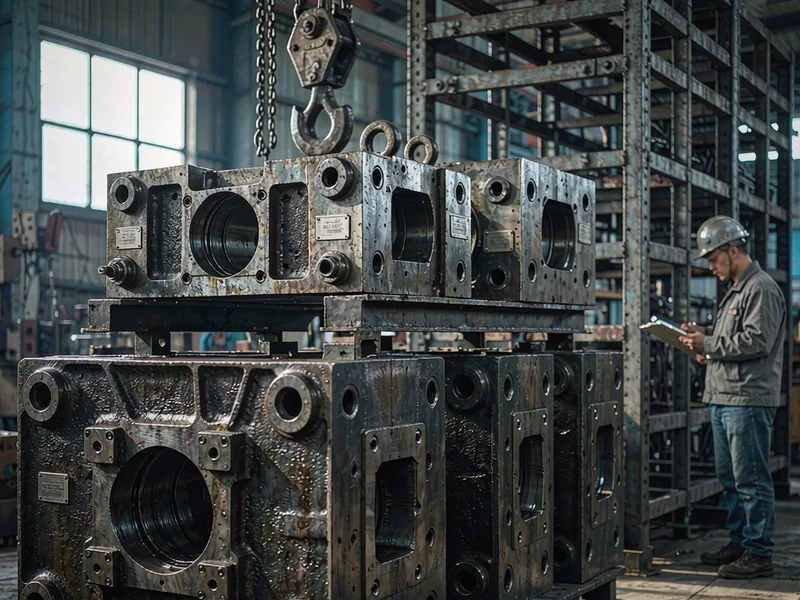
The process chain check looks for gaps that hide cost. A supplier that casts but subcontracts heat treatment controls less over quench delay, furnace uniformity and distortion than one that runs the furnace. Machining follows the same logic. According to the North American Die Casting Association, product standards and process control attach to the facility producing the part, not to a supply chain in general. Ask directly: which operations happen inside this gate?
Engineering depth is the check most buyers skip, and it predicts the first three months better than price does. Send a drawing with one feature that should raise a flag, such as a 0.8 mm rib at the end of a long flow path or a 6 mm boss beside a 1.8 mm wall. A die casting engineer will comment on fill, draft, ejection, shrinkage and where porosity will land. A sales office replies with price and lead time. Both replies are fast. Only one contains a decision.
Vertical integration answers several of these at once. HKX casts aluminum motor end covers and similar thin-wall housings, then machines the bearing bore and mounting face on the same site, so a dimensional question has one owner instead of three. The sequence is visible in the manufacturing process overview.
Die condition belongs in the audit. A die at 60,000 shots behaves differently from the same die at 8,000, and a supplier tracking shots can place the tool in its life. The economics are covered in this article on 压铸 mold life; the practical question is how many shots the die has run.
Checks 7 to 9: Inspection Data, Quote Structure, Site Behavior
Inspection data moves the conversation from claims to measurements. Ask for three months of CMM reports for one part number, the first article report from the last tooling transfer, and leak test records for a sealed part. Real records carry part numbers, lot identifiers, measured values against tolerance, the inspector and the date. A page stating that quality is guaranteed carries none of that.
Radiography is a useful test case because it is easy to describe and hard to fake. Ask who reviews the X-ray images, at what sampling rate, and against which acceptance level. A plant will name a standard such as ASTM E505 for internal soundness and the sampling that follows a die repair. Chemistry should trace to a spectrographic analysis of the actual melt, not the ingot supplier’s certificate, with the alloy referenced to ASTM B85/B85M.
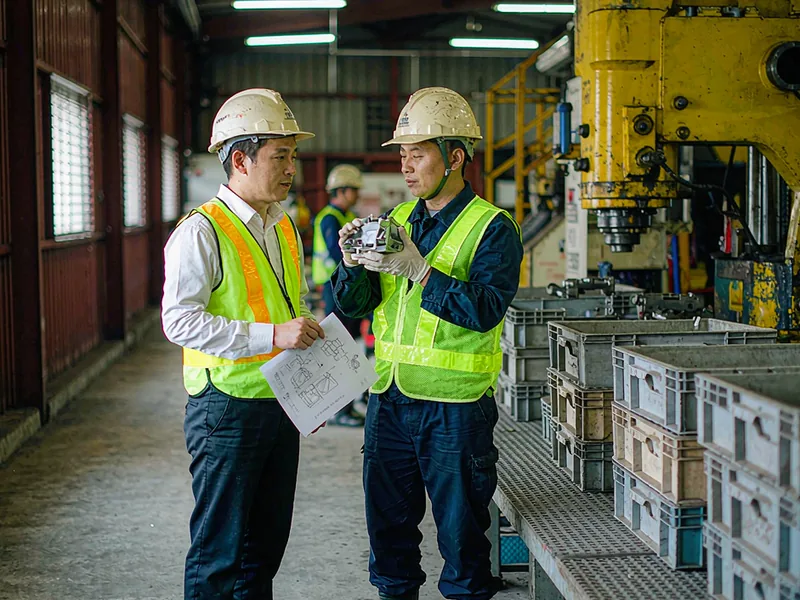
The quote structure shows what the supplier expects to be asked. A factory separates tooling from piece price, states the alloy basis and index mechanism, and ties payment to sample approval and PPAP. A trading company quotes one blended number, because the cost structure belongs to someone else. Neither format is dishonest, but only the itemized one lets you calculate break-even.
Site behavior is the last check and the least formal, and it finishes most factory vs trading company China audits on its own. Who signs the NDA, and does that person work near the machines? Does the technical contact know what a shot sleeve is? When you ask to see the scrap area, does the route change? Do the bins carry other customers’ part numbers? These details resist staging.
A documented first sample review reaches the same conclusion faster. Ask what the tryout report contains before any steel is cut. This guide to T1 samples and tryout reports lists the measurements a buyer should expect and doubles as a checklist for the visit.
Scoring a Supplier: A 100-Point Screen
The nine checks work better with weights, so the screen below assigns points by how much each item affects part quality and program risk, not by how easy it is to collect. Any factory vs trading company China assessment should end with a dated sheet in the supplier file.
| 类别 | 重量 | Full marks | Deduct or fail |
|---|---|---|---|
| Legal entity and scope | 10 | Scope names casting; visited address matches | Trade-only scope, office site (0) |
| 认证 | 15 | ISO 9001 and IATF 16949, this plant in scope | Certificate held by another company (0) |
| Machine assets | 15 | Nameplates match list, tonnage covers the part | List borrowed from a partner (0-5) |
| Tooling control | 10 | Numbered dies, rack positions, repair log | No die register (0) |
| Process chain | 15 | Melting to finishing in one quality system | Silent subcontracting (5-8) |
| Metrology | 15 | Spectrometer, X-ray, CMM, leak test in-house | Everything sent to a third-party lab (5) |
| Engineering | 10 | Written DFM naming geometry-specific risks | Template DFM or none (0-3) |
| 可追溯性 | 5 | Heat lot to part lot, records retained | Batch certificate only (0-2) |
| Commercial transparency | 5 | Separate tooling line, alloy index, PPAP milestones | Blended price, no tooling item (0-2) |
The thresholds matter less than the pattern. A score of 80 or above indicates a plant that can carry an automotive program with normal surveillance. Between 60 and 79, expect a capable factory with weak documentation, workable if your quality team can absorb the gap and the contract defines the records. Below 60, assume an intermediary until proven otherwise.
Re-score after the first production lot. By then the promises have met a delivery schedule, a dimensional report and at least one engineering change.
Inside the HKX Plant: What the Checks Look Like in Practice
At HKX, in Ningbo, these nine checks are the ones the plant applies to itself before accepting a new program. Every melt is confirmed by direct-reading spectrometry before the first shot of a run, with the silicon and copper window for ADC12 recorded against the heat number. Die temperature is held by zone controllers on the fixed and moving halves, and vacuum valve opening timing is set per die and verified at shift start. Release agent is sprayed on a fixed cycle rather than by operator feel, because spray variation moves porosity more than most buyers expect.
Tooling is numbered, racked and logged, and the shot counter on each die drives a maintenance trigger rather than a repair-after-failure habit. Quality holds the evidence in the same building: CMM programs with a defined datum scheme, X-ray sampling that increases after any die repair, pressure decay testing with a written limit on pressure drop per minute, and salt spray hours recorded per batch. When a customer’s SQE asks why a bore moved, the answer comes from a die history, a machine log and a CMM trend on one page, because all three records live in the same plant. Nothing is retyped between the floor and the submission.
That is what an audit really tests. A factory answers a question about a specific part on a specific date, with a document that carries a number. A trading company can only ask someone else, and the delay shows in the reply.
经常问的问题
How do you tell if a Chinese supplier is a factory or a trading company?
Start with the license scope and certified address, then ask for a die number and find that die on the rack. That step settles most factory vs trading company China cases on its own. A supplier that cannot produce a die number for a part it claims to make is buying capacity elsewhere, whatever the website says.
Is buying directly from a Chinese factory always cheaper?
No. Below a few thousand parts a year, an agent that consolidates several processes can beat a single factory on landed cost: one freight bill, one inspection. Above that volume, the margin on factory pricing usually exceeds the saving.
Can a trading company deliver acceptable quality?
Yes, if the quality system belongs to the plant and the records reach you unedited. The risk is not the model but the loss of direct technical contact. Insist on written tooling ownership, named process engineers, and inspection reports carrying the producing plant’s name.
What documents should a buyer request before a tooling order?
Business license, certification with scope and site address, a die register extract, the last first article report, three months of dimensional and leak test data, and a tooling ownership clause. Each is quick to send and hard to fake, which is why asking is informative.
Do buyers need to visit the plant before placing an order?
For a new die, yes. One day covers the floor, the die rack, the metrology room and the person who signs your PPAP. If travel is impossible, an unscripted video walk, machine running, die number visible, covers most of the same ground.
What if the supplier is a factory but subcontracts machining?
Common and acceptable, provided the subcontractor is named in the PPAP, the drawing revision is controlled, and dimensional responsibility stays with one party. Ask who signs the CMM report and who owns the scrap when a machined feature runs out of tolerance.
作者:HKX 工程团队
HKX — 宁波合信模具有限公司,一家铝压铸件 中国宁波的制造商,拥有 30 多年的工具 经验,内部加工和精加工,ISO 9001和IATF 16949认证,以及20多个国家的客户。
与 HKX 工程团队交谈
The factory vs trading company China checks above are the ones HKX expects a buyer to run, and the plant is set up to answer them without rehearsal. Send a drawing with annual volume and inspection standard, and the engineering team returns a written process review: alloy recommendation, wall and draft comments, die concept, machining stock and metrology plan. Sample parts and a dimensional report follow the tool, and every shipment leaves with matching records. To start that review or book a plant visit, contact our engineering team.