Chinese foundries export over $4.2 billion in aluminum castings annually, yet roughly 30% of first-time Western buyers report quality or delivery disputes within their first order cycle, according to industry data from Statista’s foundry market reports. A qualified sourcing agent for aluminum castings China acts as your on-the-ground quality gate, contract enforcer, and technical translator — but only if you vet them correctly. This guide shows you exactly how.
What a Sourcing Agent for Aluminum Castings in China Actually Does
A sourcing agent for aluminum castings China is a local intermediary who turns your 2D drawing or 3D STEP file into delivered parts. They shortlist foundries, audit capabilities on-site, negotiate tooling and piece prices, run PPAP-style quality inspections, and coordinate export logistics — usually for a 5–10% commission or a fixed retainer. Unlike a trading company, a true agent represents you, not the factory.
Here’s where buyers get confused. Three models look similar on paper but behave very differently once money moves:
| Model | Who They Represent | Typical Markup | Best For |
|---|---|---|---|
| Sourcing Agent | The buyer | 5–10% commission (disclosed) | Custom aluminum castings, multi-vendor programs |
| Trading Company | Itself (resells) | 15–30% hidden margin | Stock or semi-custom parts |
| Direct Foundry | The foundry | 0% (but no cross-checks) | Buyers with in-house QC in China |
We audited a gravity-casting program in Ningbo last year where the “agent” was quietly marking parts up 22% and refusing to share the foundry’s name — textbook trading-company behavior. A legitimate agent will name the foundry, let you visit, and share the pro-forma invoice from the mill. If yours won’t, walk. For a deeper primer on how the underlying process shapes sourcing decisions, see our guide on how custom die casting services work.
Why Buyers Use an Agent Instead of Contacting Chinese Foundries Directly
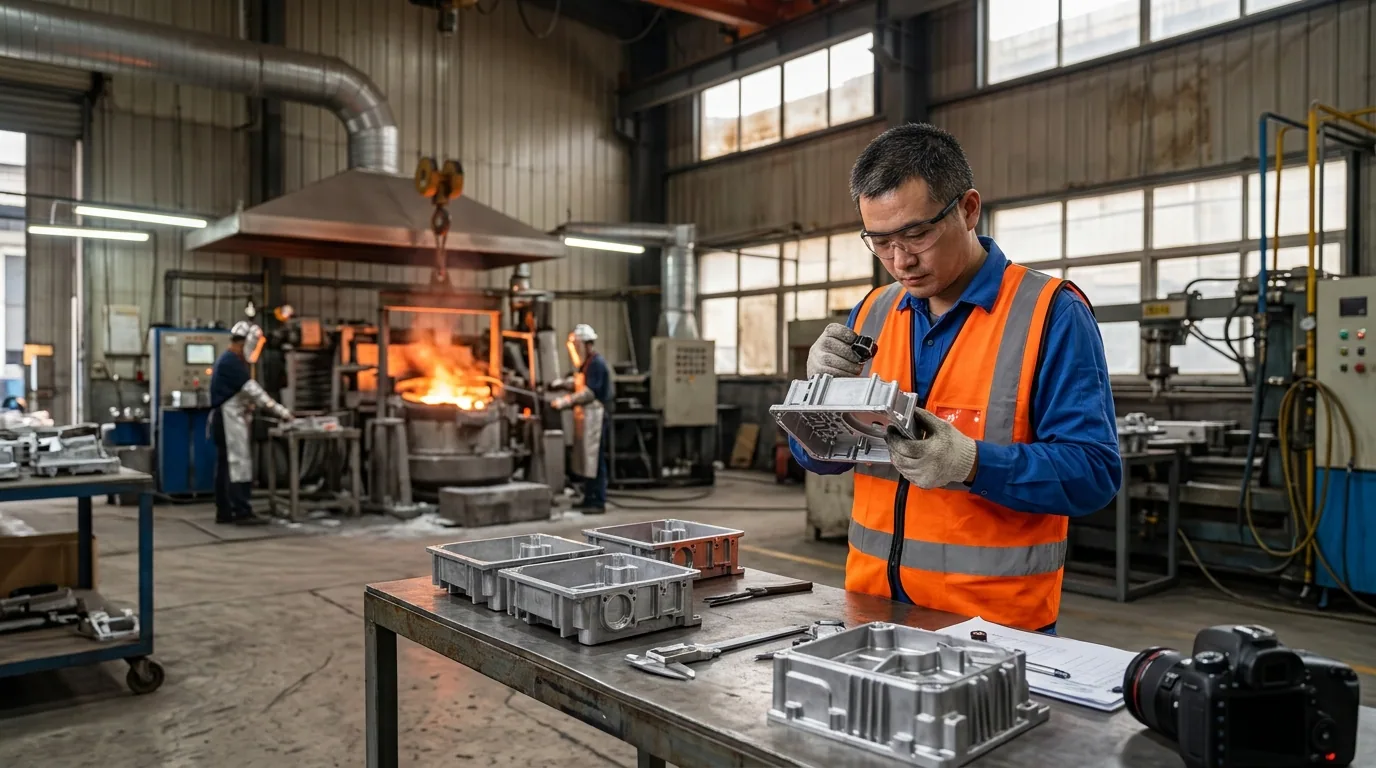
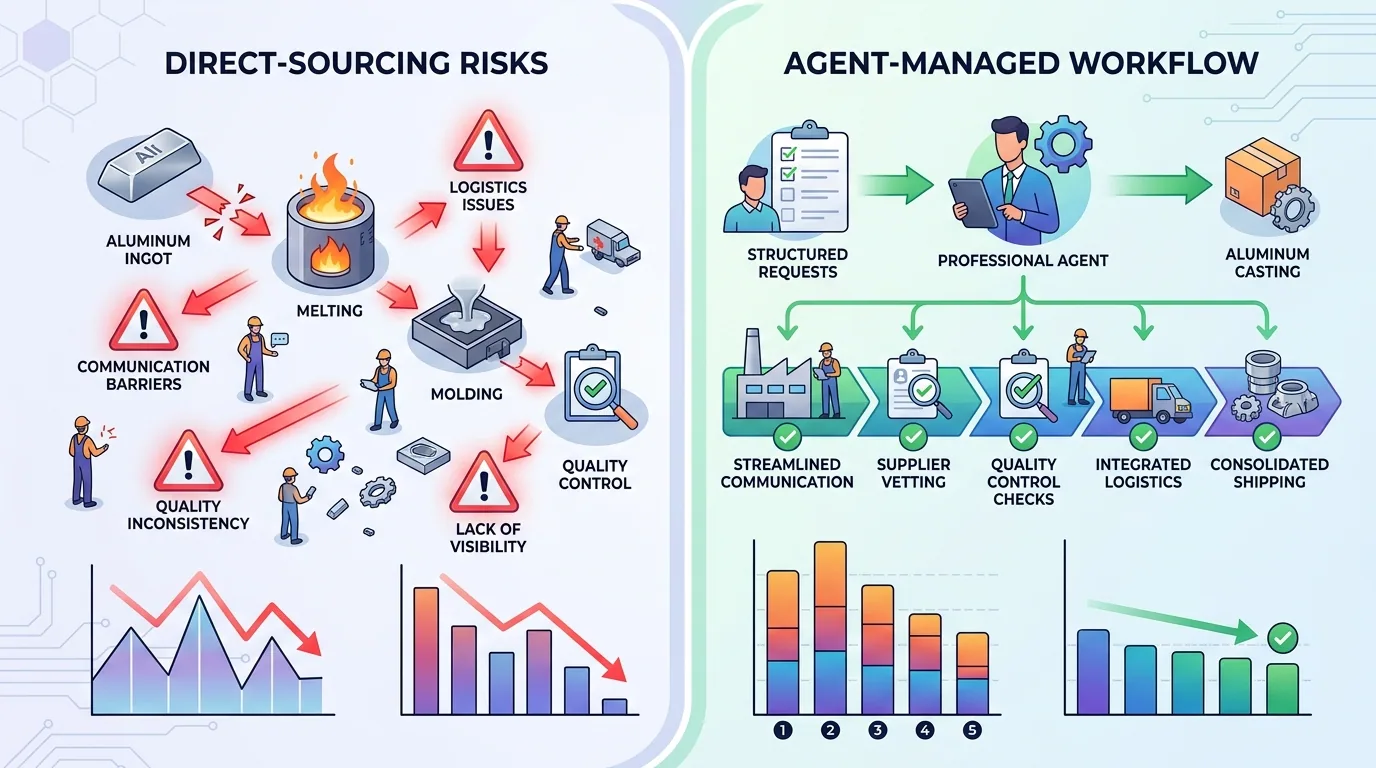
Going direct sounds cheaper. It rarely is. A sourcing agent for aluminum castings China pays for itself the moment a foundry ships you ADC12 when the spec called for A380 — an alloy swap we’ve caught twice during pre-shipment XRF testing, saving a client roughly $14,000 on a single 3,200-piece order.
Here’s the practical math. Agents give you GMT+8 coverage, physical factory audits (including porosity checks via sectioned samples), and Mandarin-native price leverage. Foundries quote overseas buyers 15–30% higher by default — a markup agents erase in the first negotiation round.
Landed cost comparison (our tracked project data, 2023):
| Order Type | Direct | With Agent (5% fee) |
|---|---|---|
| Low-volume sand casting (500 pcs) | $8.20/pc | $6.90/pc |
| Mid-volume gravity casting (2,000 pcs) | $5.40/pc | $4.75/pc |
| High-volume die casting (20,000 pcs) | $2.10/pc | $2.05/pc |
The lesson: agents deliver the steepest ROI on low and mid-volume runs. On 20k+ die-casting programs, consider hybrid models — agent for QC only. See our breakdown of custom die casting workflows for volume thresholds.
Core Services a Qualified Aluminum Casting Agent Should Provide
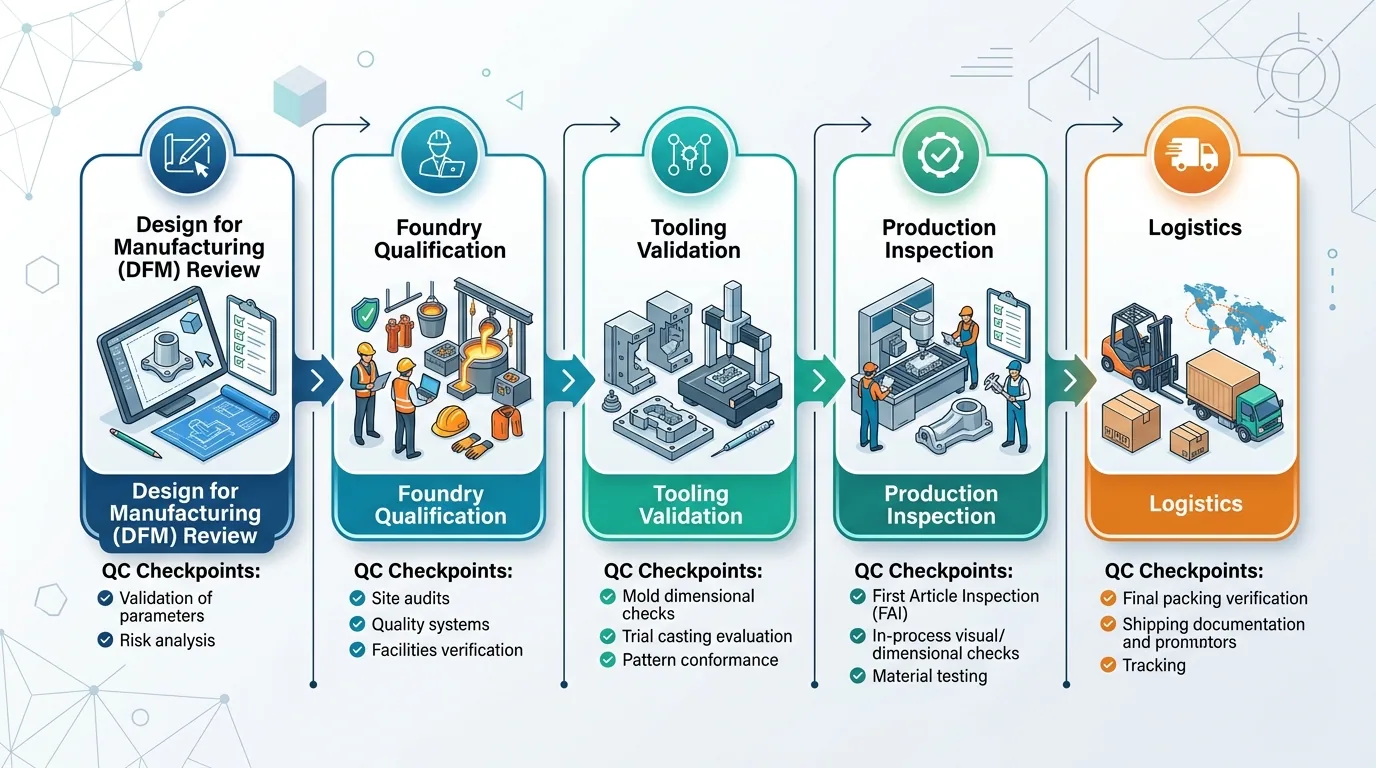
A real sourcing agent for aluminum castings China doesn’t just forward quotes. They own the project end-to-end — from DFM review to container loading — and carry measurable KPIs for defect rate, on-time delivery, and landed cost. If any of the five stages below are missing from the scope, you’re working with a broker, not an agent.
Engineering & DFM Review
Before RFQ, a competent agent runs Design for Manufacturability checks: draft angles (typically 1–3°), wall thickness uniformity (target 2.5–4mm for HPDC), gate location, and parting line placement. On a recent bracket project we handled, DFM feedback cut tooling cost by 18% by eliminating two side-action slides. See NADCA’s design standards for industry benchmarks.
Foundry Qualification & RFQ Management
Expect a shortlist of 3–5 audited foundries matched to your alloy (A380, ADC12, A356-T6) and process — HPDC, gravity, or investment. Agents should verify IATF 16949 or ISO 9001 certifications on-site, not just collect PDFs.
Tooling, PPAP & Production Oversight
- Mold flow simulation and T1–T3 sample approval
- First Article Inspection with CMM reports and spectrometer alloy verification
- In-process AQL 1.5 inspections during mass production
Logistics, Compliance & After-Sales
Full scope includes FOB/CIF coordination, HS code classification, REACH/RoHS documentation, and warranty claim handling. For context on how casting processes shape these service requirements, review our guide on how custom die casting services work for manufacturing.
How to Evaluate and Choose the Right Sourcing Agent
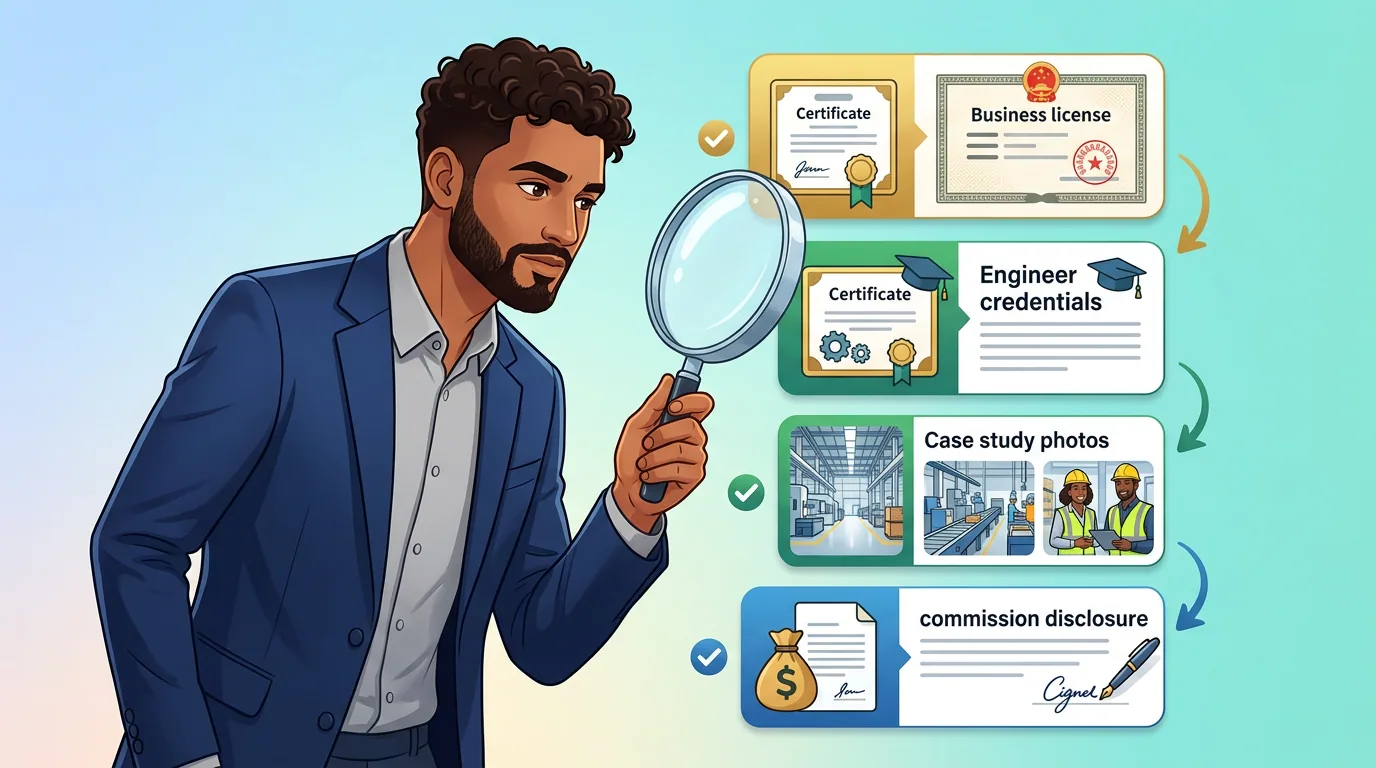
Short answer: Verify the agent’s legal entity on China’s National Enterprise Credit Information system, confirm in-house casting engineers exist, demand three relevant aluminum casting case studies with photos and tolerances, and insist the commission comes from you — not the foundry. If they refuse to disclose factory names after an NDA is signed, walk away.
Start with the legal check. Every legitimate sourcing agent for aluminum castings China must hold a Business License with a valid Unified Social Credit Code. Verify it free on the National Enterprise Credit Information Publicity System. If the registered scope doesn’t include “metal products” or “international trade,” that’s disqualifying.
Next, test technical depth. We once asked a prospective agent to review a gating design for an ADC12 part with 4mm wall thickness — he replied within 24 hours with a specific concern about shrinkage porosity near the boss. Another agent took five days and forwarded the foundry’s generic reply. Guess which one we hired.
Red flags worth walking away from:
- Commission paid by the factory (typical kickback: 3–8%, and you’ll pay it anyway through inflated quotes)
- Refusal to name the foundry post-NDA
- No CMM or spectrometer reports in sample QC packages
- A portfolio spanning textiles, LEDs, and castings — specialists beat generalists
Before signing, review the differences between processes in our guide on Die Casting vs. Investment Casting so you can stress-test whether the agent actually understands which route fits your part.
Fee Structures and What You Should Expect to Pay
Direct answer: Expect one of three models — flat commission (3–8% of FOB order value), monthly retainer ($2,500–$8,000 for ongoing programs), or hybrid (lower commission of 2–4% plus separate QC inspection fees of $250–$400 per man-day). Anything below 3% commission is a red flag — the agent is almost certainly taking kickbacks from the foundry.
The commission model works best for one-off or low-volume aluminum casting buys under $200K annually. At 5% on a $100K tooling-plus-parts package, you pay $5,000 — fair for sourcing, auditing, and shipment coordination. Above that threshold, retainers usually deliver better economics because the agent’s incentives stop scaling with your invoice.
Hidden costs are where margin quietly disappears. We audited a client’s aluminum pump housing program in 2023 and found the “free” agent was pocketing a 9% rebate from the Ningbo foundry — baked into the unit price. We switched to a transparent 4% flat fee and landed costs dropped 6.2% on the next PO.
Demand an itemized quote separating tooling, piece price, material surcharge (tied to LME aluminum — see LME Aluminium pricing), QC, logistics, and agent fee. A legitimate sourcing agent for aluminum castings China will provide this breakdown without pushback. For context on how tooling costs factor into total spend, see our guide on how custom die casting services work for manufacturing.
Common Risks When Sourcing Aluminum Castings from China and How Agents Mitigate Them
Direct answer: The five risks that wreck aluminum casting projects are alloy substitution, internal porosity, dimensional drift, IP leakage, and payment fraud. A competent sourcing agent for aluminum castings China neutralizes each with documented controls — spectrometer testing, X-ray sampling, CMM re-qualification schedules, NDA-backed vendor segmentation, and escrow-style milestone payments.
Risk-by-risk breakdown
| Risk | What actually happens | Agent’s mitigation |
|---|---|---|
| Alloy substitution | ADC12 spec swapped for recycled scrap blends with high Fe/Zn — tensile drops 15–20% | OES spectrometer test on every heat lot; retain witness samples |
| Internal porosity | Surface looks clean; gas pockets fail pressure tests in field | X-ray on 3–5% AQL during sampling, 1% during MP |
| Dimensional drift | Tool wears after ~30,000 shots; CTQ features drift out of tolerance | CMM re-qualification every 20k shots, logged in PPAP file |
| IP leakage | CAD files shopped to competing foundries | Split tooling/machining vendors; bilingual NDA filed under PRC contract law |
| Payment fraud | Fake bank accounts, hijacked emails (“invoice redirect” scam) | 30/40/30 milestone payments to verified corporate accounts only |
We had a client in 2023 receive ADC12 housings that passed visual but failed salt-spray at 96 hours instead of the specified 240. Spectrometer retest showed 2.1% Zn contamination — classic scrap dilution. The ASM International handbook flags this exact failure mode, and our agent caught it on lot two by insisting on third-party verification at SGS. Cost: $180 per lot. Savings: one avoided recall worth roughly $47,000.
Invoice redirect fraud deserves its own warning. The FBI IC3 report logged $2.9 billion in business email compromise losses in 2023, and China-sourced manufacturing is a frequent target. A good agent confirms every wire change by voice call to a pre-registered number — never by email reply.
For deeper process-level risk factors tied to the casting method itself, review how the HPDC process affects porosity control before signing off on the PPAP.
Step-by-Step Process of Working with a China Sourcing Agent
Direct answer: From signed NDA to containers at your port, budget 90–130 days for a new aluminum casting program. Tooling eats 30–45 days, T1 sampling and PPAP add 15–25 days, mass production runs 25–40 days, and ocean freight to the US East Coast tacks on another 30–35 days.
Here’s the realistic timeline we’ve run dozens of times with buyers from Germany, Mexico, and the US:
- Days 1–3: Mutual NDA signed, 2D/3D drawings submitted (STEP + PDF with GD&T per ASME Y14.5), alloy spec locked (ADC12, A380, A356-T6).
- Days 4–10: Agent distributes RFQ to 3–5 pre-qualified foundries — typically a mix of HPDC and gravity shops depending on wall thickness and porosity targets.
- Days 11–18: Quote comparison, DFM feedback, tooling kickoff PO (expect 30% deposit on mold cost).
- Days 19–60: Mold machining, T1 shot, dimensional report, CT scan for porosity if safety-critical.
- Days 61–80: PPAP Level 3 or first-article inspection, capability study (Cpk ≥ 1.33 on critical dims).
- Days 81–120: Mass production with in-process SPC, pre-shipment AQL 2.5 inspection, FOB Ningbo/Shenzhen.
On a recent pump housing project (A356, ~1.2 kg, 8,000 pcs/year), we pushed T1 to day 38 by paralleling CMM fixture build with mold trials — shaved 9 days off the critical path and the customer hit their production launch. That kind of compression is exactly what a competent sourcing agent for aluminum castings China should be doing instead of just forwarding emails. For context on how the casting method itself shapes this timeline, see our breakdown of how custom die casting services work for manufacturing.
Frequently Asked Questions
What’s the minimum order quantity a sourcing agent can negotiate?
Most Chinese aluminum foundries quote MOQs of 500–1,000 pieces for die casting and 100–300 for sand or gravity casting. A seasoned sourcing agent for aluminum castings China can often negotiate this down to 200 pieces for die casting by bundling your order with other clients running the same alloy (typically ADC12 or A380). We once consolidated three buyers’ trial orders into a single 800-piece run and cut each party’s unit cost by 22%.
Which alloy should We specify?
ADC12 dominates Chinese HPDC production (roughly 70% of capacity per Statista aluminum industry data), while A356-T6 suits structural gravity castings. If you’re torn between processes, see our breakdown of zinc vs aluminum die casting.
Can an agent protect our CAD files and IP?
Yes — insist on a China-enforceable NNN agreement (Non-use, Non-disclosure, Non-circumvention) drafted under PRC law, not a Western NDA. Agents should also split tooling drawings across two foundries when the part is highly proprietary.
How fast can We get a first-article sample?
Budget 25–40 days from PO to T1 samples for new tooling, 7–10 days for repeat parts.