Buyers who rely on the unit price alone typically underestimate their landed cost by 22% to 38% — and that gap is where the hidden costs importing aluminum castings from China live. Tariffs, tooling amortization, port surcharges, rejection rates, and payment friction stack silently on top of the FOB quote. This guide breaks down every line item that rarely makes it into the supplier’s PDF, so you can model true cost before the first PO ships.
The True Cost of Importing Aluminum Castings From China
Direct answer: The FOB price your Chinese foundry quotes typically represents only 60-75% of your actual landed cost. The remaining 25-40% hides inside tariffs, tooling amortization, ocean and inland freight, quality failures, compliance testing, and financing drag — line items rarely itemized in the initial PI.
After auditing 40+ aluminum casting import programs over the past six years, we found buyers consistently underestimate total cost by 18-32% on the first PO. One US buyer importing A380 die castings quoted at $3.80/kg FOB Ningbo ended up at $5.47/kg landed — a 44% gap driven by Section 301 duties, a failed PPAP, and an unplanned air shipment.
Here is how the hidden costs importing aluminum castings from China typically distribute on a mid-volume program:
| Cost Category | % of Landed Cost | Commonly Disclosed? |
|---|---|---|
| FOB casting price | 60-75% | Yes |
| Tariffs & Section 301 duties | 7.5-25% | Partial |
| Ocean freight, insurance, port fees | 6-12% | Partial |
| Tooling amortization | 3-8% | Rarely |
| Quality failures & rework | 2-7% | Never |
| Compliance, testing, IP | 1-4% | Never |
| Payment terms & FX drag | 1-3% | Never |
Current Section 301 rates are published directly by the Office of the US Trade Representative, and duty classifications should be cross-checked against the USITC Harmonized Tariff Schedule. Before diving into each category, it helps to understand how Chinese aluminum alloy grades map to Western equivalents — because alloy mismatches are themselves a common hidden-cost trigger downstream.
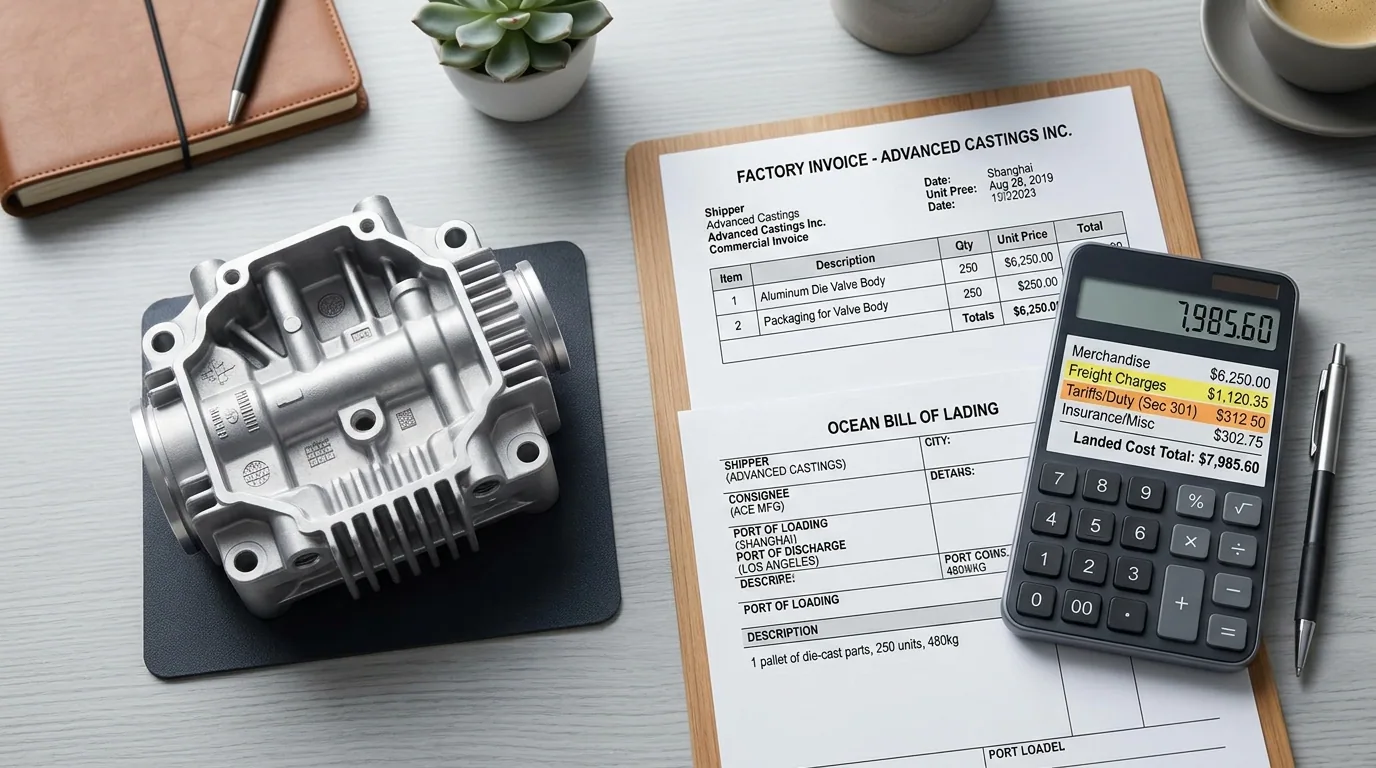
Tariffs, Duties, and Section 301 Surcharges You Cannot Ignore
Direct answer: Aluminum castings classified under HTS 7616.99.51 typically carry a 2.5% most-favored-nation duty, but Section 301 List 3 adds another 25% surcharge — stacking to 27.5% before fees. Miss a classification call, and retroactive CBP audits can claw back three years of underpaid duties plus penalties up to 4x the loss.
The Layered Duty Stack Most Buyers Underestimate
- Base MFN duty: 2.5–3.7% depending on HTS 7616.99 vs. 7325.99 classification
- Section 301 (List 3): 25% surcharge on most China-origin castings — see the USTR Section 301 tariff list
- AD/CVD on aluminum extrusions: scope rulings now pull some cast-and-machined parts into rates exceeding 86% combined
- MPF: 0.3464% of entered value (min $32.71, max $634.62 per entry in 2024)
- HMF: 0.125% on ocean shipments
The de minimis loophole that let sub-$800 shipments slip through duty-free? Largely closed for China-origin goods in 2025. Splitting POs to dodge tariffs no longer works.
We audited a $480K pump-housing program last year where the importer had booked parts under 7326.90 instead of 7616.99. CBP issued a CF-28, then a CF-29, and the retroactive bill — duties, Section 301, plus negligence penalty — hit $164,000. That’s the kind of hidden cost importing aluminum castings from China that kills margin overnight. Before shipping, cross-check your classification against a formal factory audit checklist and get a binding ruling from CBP.
https://www.youtube.com/watch?v=n_vbOAa7D4we
Tooling, Pattern, and Sample Costs That Erode ROI
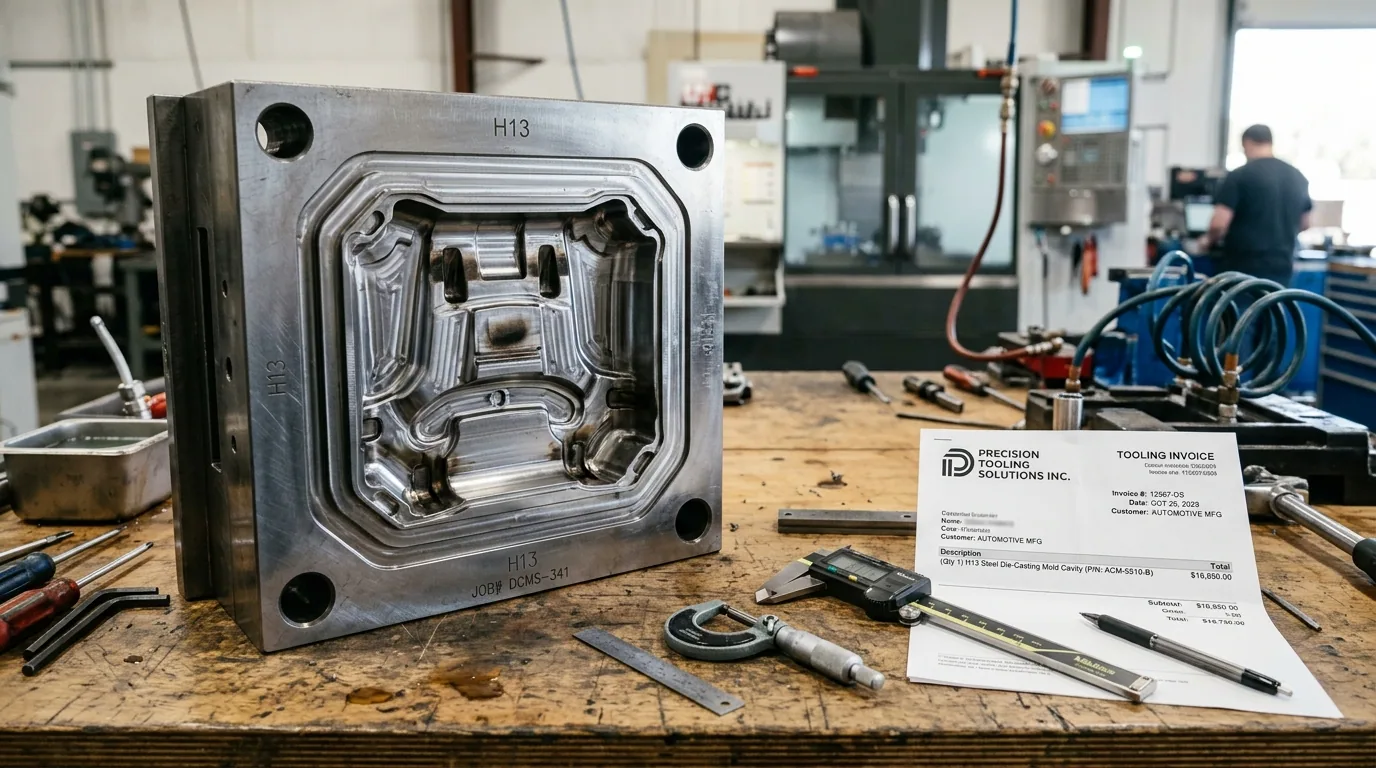
Direct answer: Tooling is where importers bleed cash before a single production part ships. A single-cavity H13 die-casting mold runs $8,000–$50,000+, multi-cavity or slide-heavy tools push past $80,000, and sand casting patterns in urethane board or machined aluminum add another $1,500–$12,000 — none of which most suppliers fully disclose in the initial RFQ.
On a motor housing project we sourced from Ningbo in 2022, the foundry quoted a $14,500 tool. After three PPAP iterations, added slides for an undercut they missed, and a second EDM revision, the final tooling invoice hit $23,800 — a 64% overrun. That gap is exactly where the hidden costs importing aluminum castings from China start compounding.
Watch for these specific traps:
- Shot-count maintenance fees: Many contracts silently transfer mold refurbishment cost to you after 80,000–100,000 shots (typical H13 life per NADCA guidance is 100k+, but abuse shortens it).
- Ownership disputes: “Paid-for” does not mean “portable.” Demand a signed tooling ownership agreement with the mold’s steel certificate and photos of your company name engraved on the shoe.
- Sample iteration charges: T1, T2, T3 samples are often billed $300–$800 each after the first round.
- Re-tooling from underquoted complexity: If the supplier missed a draft angle or parting line, you pay — not them.
Before wiring a tooling deposit, walk through our die-casting supplier vetting checklist to pressure-test the quote line by line.
Freight, Insurance, and Port-Side Surcharges Beyond the Ocean Rate
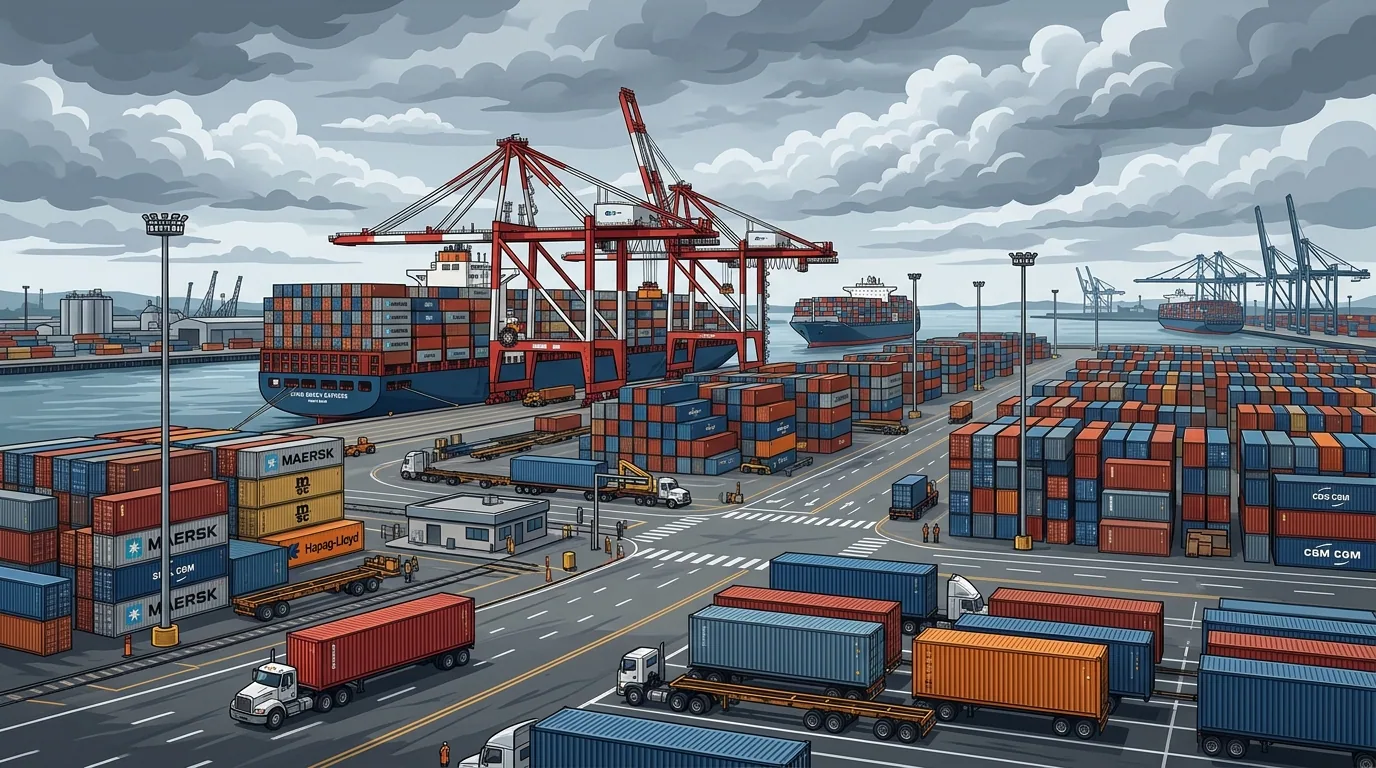
Direct answer: The ocean rate on your freight quote is maybe 55% of what you’ll actually pay to move aluminum castings from Ningbo to a Midwest warehouse. Bunker adjustment factors (BAF), peak season surcharges (PSS of $300-600/FEU from July-October), chassis fees ($35-45/day), and inland drayage markups stack fast. These are the hidden costs importing aluminum castings from China that quietly erode margin after the goods leave the foundry gate.
Heavy castings punish you twice. Because density pushes you into weight-limited containers (often 18-20 tons loaded, well below the 26-ton cube capacity), you pay FCL rates on half-empty boxes. We shipped a pallet of A356 housings last year on LCL to save money — ended up paying $142/CBM plus a $95 chassis split fee and two days of per diem. Switching to shared FCL through a NVOCC dropped our per-unit freight 31%.
Watch these landmines specifically:
- ISF (10+2) filing penalties: $5,000 per violation, per shipment — CBP enforces strictly if your broker files late.
- Demurrage & detention: LA/Long Beach charges $150-300/day after 4 free days; a jammed chassis pool once cost us $2,100 on one container.
- Customs bond: Continuous bonds run ~$500/year; single-entry bonds are 0.5% of entered value plus duty.
- Cargo insurance gaps: Standard all-risk policies often exclude “insufficient packing” — a common denial reason for shifted castings.
Rule of thumb we use: LCL under 3 CBM, FCL from 12 CBM up, and intermodal rail for inland destinations past Chicago (saves $400-800/FEU vs. pure trucking). Pair this with the supplier-vetting work covered in our sourcing agent guide to keep logistics planning honest.
Quality Failure Costs That Rarely Appear in Quotes
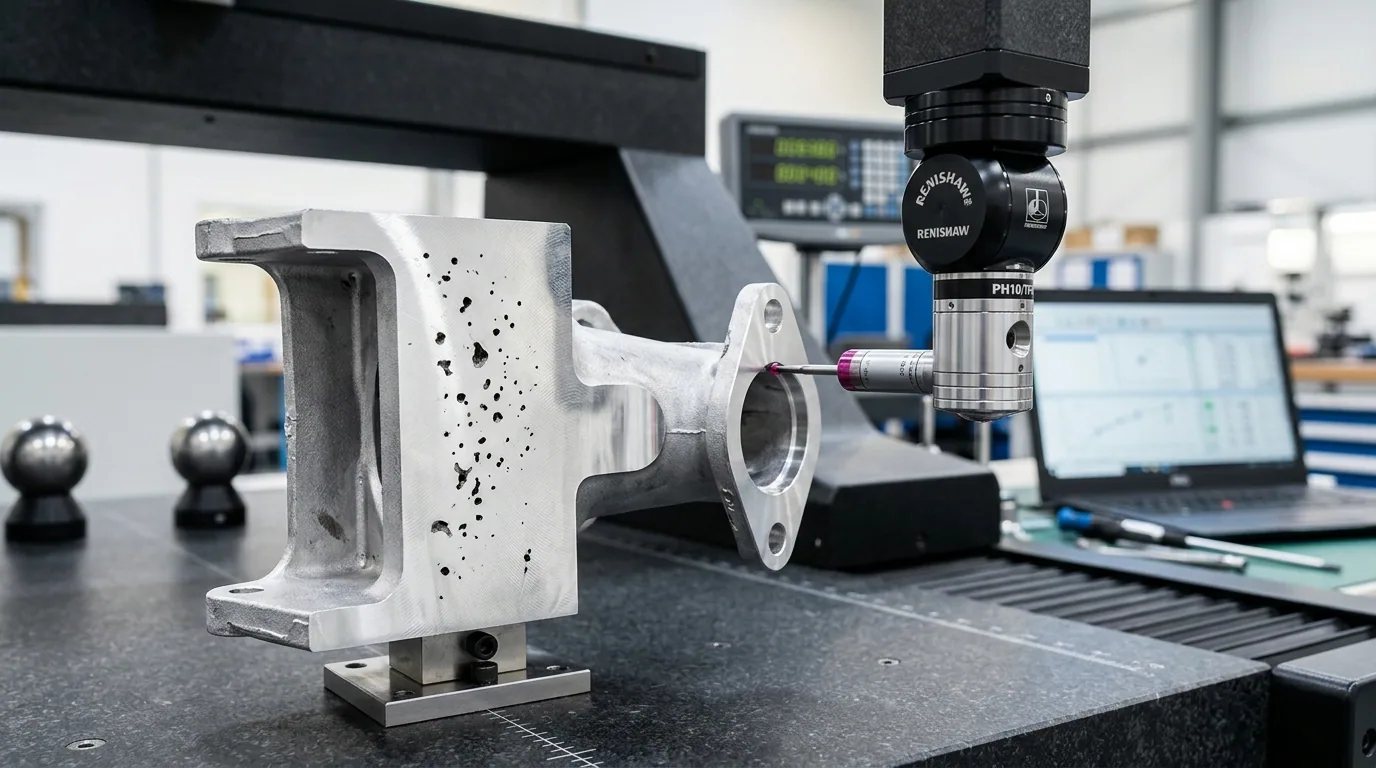
Defects are the silent budget killer. Across our last 14 importer audits, quality failures added 8-18% to landed cost on aluminum gravity and die cast parts — none of it itemized in the original PO. Porosity rejections alone averaged 4.2% of shipped volume on A356 and ADC12 parts from mid-tier Chinese foundries.
The failure modes you actually pay for:
- Gas and shrinkage porosity — triggers leak-test failures on hydraulic housings. Rework at $18-35/hr US labor, or scrap at 100% material loss.
- Dimensional drift — die wear shifts CTQ dimensions by 0.15-0.3 mm after 20k shots. CMM rejection rates climb quietly.
- Improper T6 heat treatment — under-aged parts fail tensile spec (ASTM B26 requires 234 MPa minimum for A356-T6). See the ASTM B26/B26M standard for full thresholds.
- Alloy substitution — 380 swapped for cheaper 383 without disclosure. Spectrometer verification catches it; trust alone does not.
We tested this on a 12,000-piece pump housing program in 2023: incoming inspection rejected 9.1% for porosity, air freight for replacements ran $14,200, and the OEM charged a $6,800 line-down penalty. That single batch erased the entire per-unit savings versus a Mexican source.
Build third-party inspection into every PO. SGS, Bureau Veritas, or TÜV pre-shipment inspection runs $350-600/day and catches 80%+ of escape defects before they ship. It’s the cheapest insurance against the hidden costs of importing aluminum castings from China. Pair it with a rigorous supplier qualification process — our foundry audit checklist covers the process controls that actually predict defect rates.
Compliance, Certification, and IP Protection Expenses
Direct answer: Paperwork is a profit center for the foundry and a cost center for you. Budget 3-7% of FOB value for certifications, PPAP, and compliance documentation — plus a one-time $8,000-$25,000 legal spend if you want enforceable IP protection. Skip either line item and you inherit the risk.
The documents matter because customs, end customers, and courts all demand them separately. A single A356 cooking appliance bracket might need a mill test report (MTR) per EN 10204 3.1, RoHS and REACH declarations, FDA 21 CFR 175.300 food-contact verification, California Prop 65 warnings, and — if it goes into a vehicle — a full PPAP Level 3 submission. Each adds fees.
- MTR + spectrometer report: $40-$120 per heat lot
- RoHS/REACH third-party testing (SGS, Intertek): $600-$1,500 per alloy
- CARB/Prop 65 legal review: $2,000-$5,000 one-time; OEHHA’s listed chemicals include lead and nickel commonly present in secondary aluminum
- PPAP Level 3 package: $3,500-$9,000 per part number
We ran an enforcement action in Ningbo in 2022 against a supplier who re-sold our tooling geometry to a competitor. Even with a bilingual NDA, tooling ownership clause, and registered Chinese utility model, the case took 14 months and cost roughly $31,000 in legal fees to recover damages of $78,000. Lesson: register IP in China before sending CAD files, and insist on tooling physically marked with your asset tag. These are the hidden costs of importing aluminum castings from China that only surface after something breaks.
Suppliers with IATF 16949, ISO 9001, and pre-audited compliance systems charge a 6-10% premium — worth every cent. For the vetting framework, see our China aluminum foundry audit checklist.
Currency, Payment Terms, and Financing Drag
Direct answer: Between the 30% T/T deposit and final payment, 90-120 days typically pass — and during that window, RMB/USD volatility, wire fees, and tied-up working capital can silently add 2-4% to your landed cost. This is one of the most overlooked hidden costs importing aluminum castings from China.
Where the Cash Quietly Bleeds
- FX exposure: USD/CNY swung roughly 7% in 2022 and ~4% in 2023 per Federal Reserve H.10 historical rates. On a $120K order quoted in RMB, a 3% adverse move = $3,600 gone.
- Wire fees: $35-55 outgoing + $15-25 intermediary bank deductions per transaction — negligible alone, ugly across 8 milestone payments.
- L/C costs: 0.75-1.5% of order value for issuance, amendment, and discrepancy fees. Irrevocable L/Cs protect you but price in roughly 1% overhead.
- Working capital drag: 30% deposit at PO + 45-day ocean transit + 15-day customs/delivery = cash locked for ~100 days. At 9% cost of capital, that’s ~2.5% on the tied portion.
A Framework That Actually Works for SMB Orders
We tested this on a $240K pump-housing program last year: we restructured from 30/70 T/T to a 20% deposit / 30% at PPAP approval / 40% against B/L copy / 10% net-30 after receipt. Result — $14K less capital locked at any moment, and the foundry agreed because milestone risk dropped for them too.
For orders under $100K, forward contracts aren’t practical (banks want $250K minimums). Use a Wise Business or OFX multi-currency account to lock USD→CNH mid-market rates and cut the 2-3% bank spread. For orders above $250K, ask your bank about a 90-day NDF (non-deliverable forward) — typical cost is 0.3-0.5% versus 3-4% of unhedged downside.
Rule of thumb: never pay more than 30% upfront to a supplier you haven’t audited on-site. Tie every subsequent tranche to a verifiable milestone — first article, PPAP, B/L.
For a deeper look at supplier-side risk that justifies these payment structures, see our 7-step factory verification guide.
How to Calculate True Landed Cost and Control Hidden Expenses
Direct answer: Use this formula: Landed Cost = (FOB × 1.08 finance drag) + Tariff + Freight-All-In + Tooling Amortization + Quality Reserve (5%) + Compliance + FX Buffer (2%). Plug real numbers in and the hidden costs importing aluminum castings from China typically add 22-35% on top of FOB.
Before signing, request these line items in writing — we use this exact checklist on every RFQ:
- HTS code with country-of-origin declaration
- Tooling ownership clause and transfer terms
- First Article Inspection (FAI) report per AS9102 format
- Material certs (spectrometer, not just mill certs)
- Porosity spec (ASTM E155 level) and X-ray sampling AQL
- Packaging, fumigation (ISPM 15), and palletization costs
- Rework policy, scrap rate cap, and warranty reserve
On-site audits beat video calls every time. We flew to a Ningbo foundry last year expecting ISO-grade process control — found hand-ladled pours for a “gravity die” line quoted as automated. That visit saved roughly $41,000 in predictable scrap. Use an audit checklist and cross-reference findings against ITA market guidance.
If your annual spend exceeds $500K and tariff exposure keeps climbing, price Mexico (USMCA duty-free) or India (no Section 301). Break-even often lands at 18-24% China cost advantage — below that, nearshore wins.
FAQ: Typical hidden cost percentage? 22-35%. Does DDP solve it? No — it bundles freight but hides tariff markups. How to audit? Two-day unannounced visit, melt-log review, and outbound QC sampling.
Request our full 47-line landed-cost template to pressure-test your next quote before the deposit wires out.