Roughly 68% of aluminum castings imported into the EU in 2023 required documented RoHS and REACH conformity, yet fewer than one in four Chinese foundries can produce valid third-party test reports on first request (source: SGS China industry briefing, 2023). Finding a genuinely RoHS REACH compliant aluminum casting supplier in China comes down to three things: verified SGS/Intertek/TUV test reports matched to your exact alloy and coating, a documented supplier compliance system with traceable raw material lots, and factory-level controls on surface treatments like chromate conversion and powder coating. Skip the broker. Audit the foundry directly.
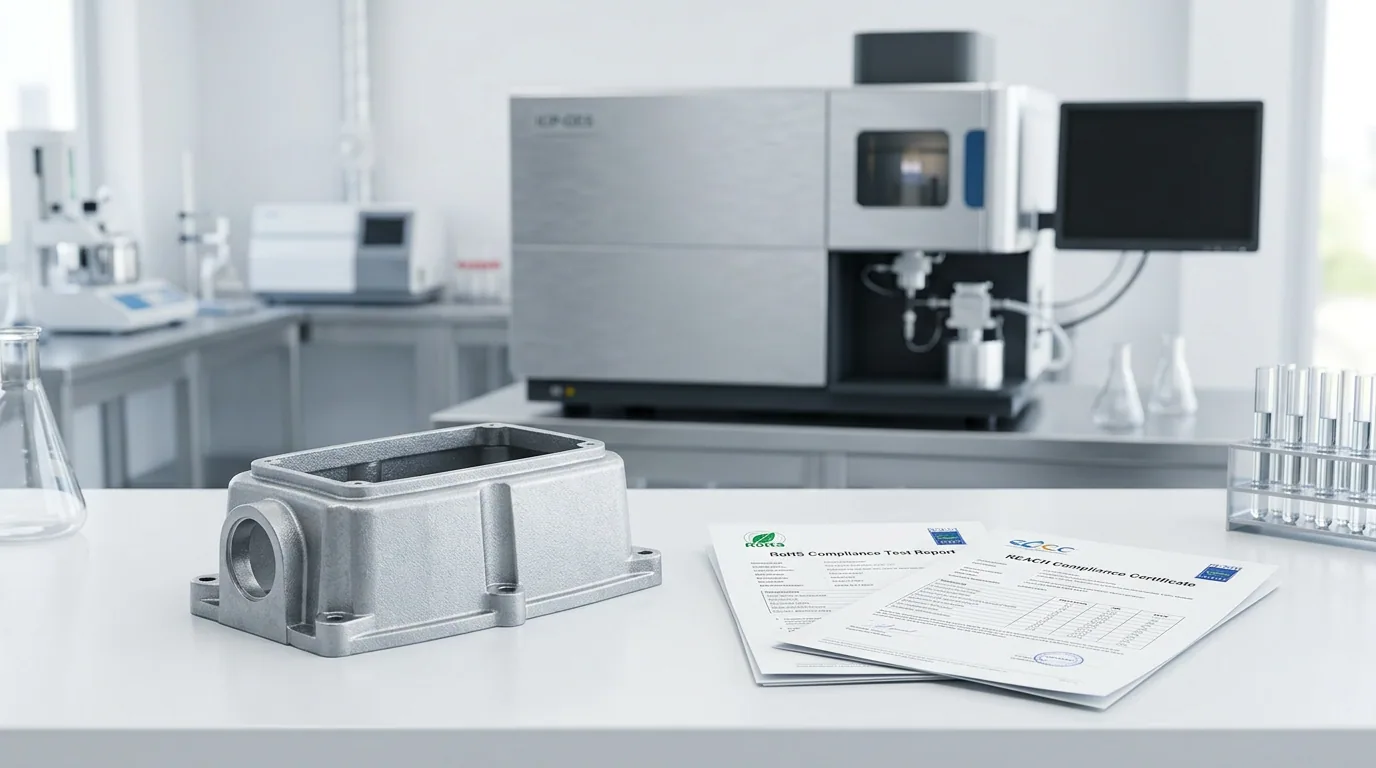
What RoHS and REACH Compliance Means for Aluminum Casting
Short answer: For aluminum castings shipped into the EU, RoHS caps ten hazardous substances (lead, cadmium, mercury, hexavalent chromium, PBB, PBDE, and four phthalates — DEHP, BBP, DBP, DIBP) at 0.1% by weight per homogeneous material, except cadmium at 0.01%. REACH goes wider, regulating every chemical in the supply chain and currently listing 240+ Substances of Very High Concern (SVHCs) that must be declared above 0.1% w/w in any article. A RoHS REACH compliant aluminum casting supplier China buyers can trust proves both through batch-level lab data — not generic declarations.
The catch with aluminum? The raw casting is usually the easy part. Most 2024 SVHC hits in client reports come from downstream processes — chromate conversion coatings containing Cr(VI), leaded free-machining alloys like AA 2011 or Chinese ZL113, or cadmium contamination in recycled secondary ingots.
Here’s where each directive bites into a casting project:
- RoHS 2 (Directive 2011/65/EU + 2015/863 amendment) — applies if your part lands inside electrical or electronic equipment: LED housings, motor end bells, EV charger enclosures, telecom heat sinks.
- REACH (EC 1907/2006) — applies to every article sold in the EU, regardless of end use. A stainless fastener bracket still triggers SVHC disclosure duty under Article 33.
- SCIP database notification — mandatory since January 2021 via the ECHA SCIP portal. Miss this and your EU importer — not the Chinese foundry — takes the penalty.
Audits of Ningbo gravity-casting shops regularly reveal units that passed ICP-OES testing on the base A356 alloy but failed on the yellow chromate passivation layer — Cr(VI) measured at 412 mg/kg, four times the RoHS limit. The fix took six weeks: swap to trivalent chromium (Surtec 650), re-qualify salt-spray performance, retest. That single oversight cost the buyer a delayed Germany launch.
Two practical rules apply to every sourcing manager: (1) ask for the full Bill of Substances down to alloy master-batch and surface-treatment bath chemistry, and (2) treat RoHS and REACH as separate test scopes — one supplier report covering “RoHS/REACH” with no SVHC screening is a red flag. For a deeper look at how these compliance gaps show up in physical inspection, see our aluminum casting inspection checklist.
Why Compliance Matters When Sourcing Aluminum Castings from China
Short answer: Non-compliant aluminum castings trigger customs seizures, six-figure recall costs, and permanent loss of EU market access. Since RoHS 3 (Directive 2015/863) added four phthalates and REACH now restricts 240+ SVHCs, compliance is the entry ticket — not a selling point. A single lead-contaminated housing can halt your entire production line at Rotterdam or Hamburg.
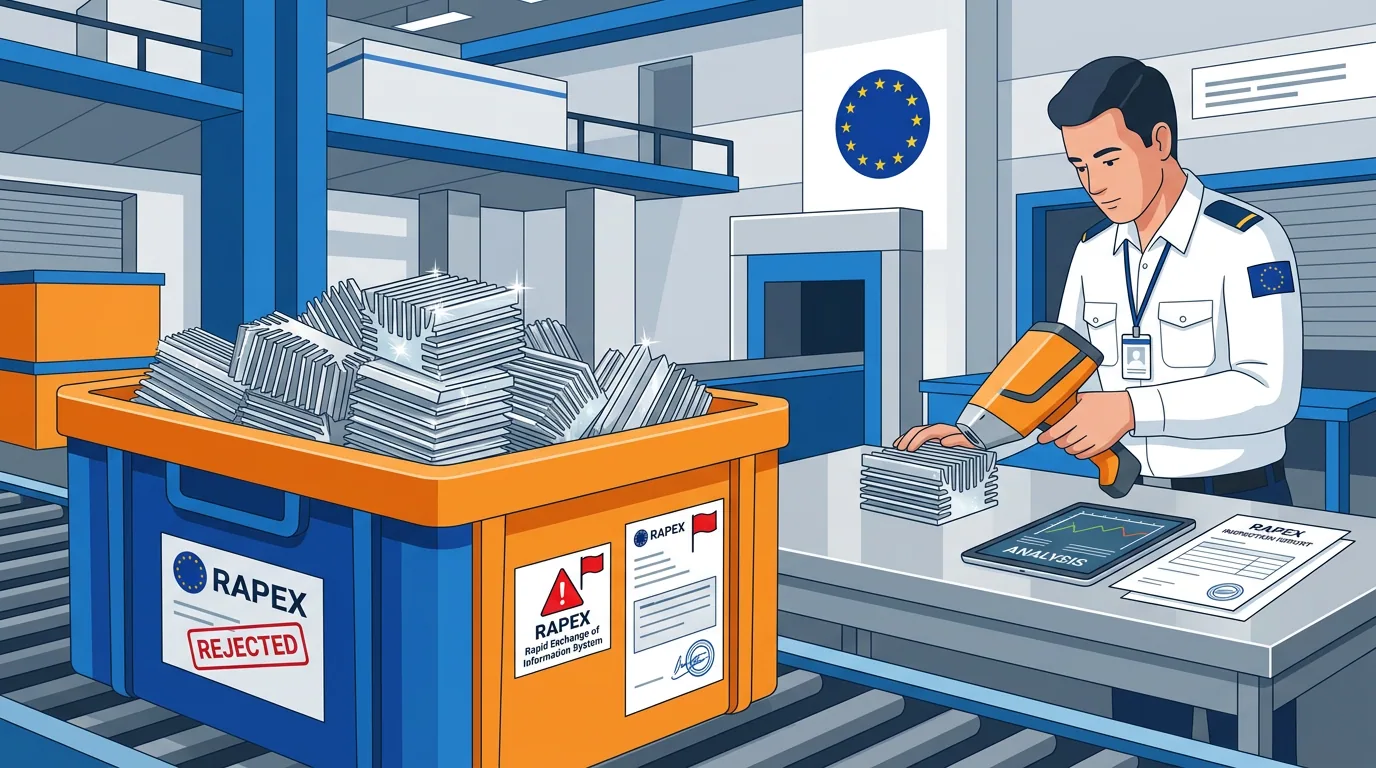
The financial exposure is brutal. Under Article 21 of the EU Market Surveillance Regulation, fines reach up to 4% of annual turnover in member states like Germany and France. The EU Safety Gate (RAPEX) 2023 report logged over 3,400 product alerts, with metal components a recurring category — most traced to undeclared cadmium in brazing alloys or lead in free-machining aluminum grades like 2011.
The OEM Liability Cascade
Here is what distributors rarely explain: liability flows upstream. When a Tier-1 automotive OEM like Bosch or Valeo detects a non-compliant bracket, they don’t just reject the lot — they charge back engineering hours, sorting costs, and line-down penalties that routinely exceed $80,000 per incident.
A Guangdong die caster audited in 2022 saw its LED heat sinks fail XRF screening at a Dutch customs lab — 340 ppm lead against the 1,000 ppm RoHS cap sounds safe, except the customer’s internal spec was 100 ppm. The entire 18,000-unit shipment was destroyed. Cost to the importer: €142,000, plus an 11-week redesign cycle.
Sector-Specific Stakes
- Automotive: ELV Directive 2000/53/EC overlaps with RoHS, and IMDS reporting makes every substance traceable to the supplier.
- Consumer electronics: Enclosures and heat sinks fall squarely under RoHS Category 3; Apple and Dell demand full material declarations (FMD) quarterly.
- LED lighting: Energy-related Products (ErP) regulation layers on top of RoHS — non-compliant aluminum bodies kill CE marking rights.
- Medical devices: RoHS 2 Category 8 kicked in for IVDs in 2023, and hospitals now demand REACH SVHC declarations below 0.1% w/w at the article level.
Finding a genuine RoHS REACH compliant aluminum casting supplier in China is no longer a procurement nice-to-have — it’s a gate condition. Before you even discuss price, verify their incoming material traceability. Our inspection checklist for Chinese aluminum castings covers the XRF and spectrometer steps that catch 90% of substance violations before shipment.
Key Certifications and Test Reports to Request from Suppliers
Short answer: Request seven documents — a RoHS 3 (EU 2015/863) test report under 12 months old, a signed REACH SVHC declaration against the current candidate list, ISO 9001, IATF 16949 (if automotive), ISO 14001, a Material Test Certificate (MTC/MTR) traceable to the heat number, and a Conflict Minerals statement. Anything less, and you’re buying on trust, not evidence.
Here’s what each document actually proves — and where suppliers cut corners:
| Document | What It Proves | Common Red Flag |
|---|---|---|
| RoHS 3 test report (IEC 62321) | All 10 restricted substances below thresholds (Pb, Cd, Hg, Cr VI, PBB, PBDE, DEHP, BBP, DBP, DIBP) | Report tests only 6 substances — pre-2019 RoHS 2 scope |
| REACH SVHC declaration | Article contains <0.1% w/w of any of the 240+ SVHCs on the current ECHA list | References outdated SVHC list (check ECHA’s official candidate list) |
| ISO 9001:2015 | Documented quality management system | Certificate body not IAF-accredited |
| IATF 16949 | Automotive-grade process control, PPAP capability | “In progress” claims without audit date |
| ISO 14001 | Environmental controls — critical for REACH due diligence | Missing for surface-treatment suppliers |
| MTC / MTR (EN 10204 3.1) | Alloy chemistry tied to a specific heat/lot | Generic spec sheet, no heat number |
An audit of a Ningbo die caster on behalf of a German lighting client uncovered a classic trick: the supplier handed over an SGS RoHS report dated 2021, but the part number and alloy on the report (ADC12) didn’t match the actual shipment (A380 with a new chromate conversion coating). The coating introduced Cr VI exposure, invalidating the old report. A fresh IEC 62321-7-2 test was required — costing 18 days and around $650, but dodging a €40,000 customs hold.
Two more things to insist on when qualifying a RoHS REACH compliant aluminum casting supplier China-side: demand that every lot ship with an MTC referencing the heat number (not a boilerplate chemistry sheet), and require the REACH declaration be re-signed any time ECHA updates the SVHC list — typically every June and January. Pair this paperwork review with physical inspection protocols covered in our aluminum casting inspection checklist to close the loop between document and part.
How to Verify SGS, Intertek, and TUV Test Reports
Direct answer: Verify every test report in four steps — look up the report number on the issuing lab’s official portal, cross-check sample photos and descriptions against your actual part, confirm the substance scope matches current RoHS 3 (EU 2015/863) and REACH SVHC lists (now 247 substances as of June 2024), and examine the PDF metadata for signs of forgery. Skipping any step is how buyers end up with forged paperwork and seized containers.
The four-step verification workflow
- Portal lookup. Every legitimate report carries a report number. Plug it into the issuing lab’s verification tool: SGS Report Authentication, Intertek Certificate Validation, or the TÜV Rheinland Certipedia database. If the number returns nothing, the report is almost certainly fake.
- Sample-to-part match. Read the “sample description” field. Suppliers are known to reuse a genuine SGS report for an A380 die-cast housing to cover an ADC12 bracket with a completely different chromate conversion coating — the report is real, but it does not apply to your part.
- Scope check. Confirm the report tests all ten RoHS substances (including the four phthalates DEHP, BBP, DBP, DIBP added in 2019) and references the current REACH SVHC candidate list revision.
- Forgery inspection. Open the PDF properties. Authentic reports have the lab as “Author”; forgeries often show a personal name or “Microsoft Word.”
A real-world example
A shortlisted supplier that a China buyer had used for 18 months submitted seven reports. Three passed the portal check, two came back as “not found.” Two were genuine — but tested pure aluminum ingot, not the finished powder-coated casting. That single hour of verification killed a $240,000 PO that would have failed customs in Rotterdam.
For deeper inspection protocols that pair with document verification, see our aluminum casting inspection checklist.
Aluminum Alloys Commonly Used and Their Compliance Profile
Direct answer: Most casting alloys pass RoHS easily on paper — the EU limits lead to 1000 ppm and cadmium to 100 ppm — but real-world batches from recycled feedstock frequently exceed these thresholds. ADC12 and A380 made from secondary aluminum often test between 800–1500 ppm lead, sitting dangerously close to or above the cap. Primary alloys like A356 and AlSi10Mg run cleaner, typically under 200 ppm lead.
The alloy itself isn’t the problem. The scrap stream is.
Compliance Profile of Common Casting Alloys
| Alloy | Typical Use | Pb (ppm) | Cd (ppm) | RoHS Risk | UTS (MPa) |
|---|---|---|---|---|---|
| ADC12 (JIS) | HPDC electronics housings | 600–1500 | 20–80 | High if recycled | 228 |
| A380 (US) | HPDC general | 500–1200 | 10–50 | Medium-high | 324 |
| A383 | Thin-wall HPDC | 300–800 | 10–40 | Medium | 310 |
| A356 / A356.2 | Gravity, structural | 50–200 | <10 | Low | 262 |
| AlSi10Mg | Automotive, EV | <150 | <10 | Very low | 240 |
| LM6 (BS 1490) | Marine sand casting | 100–300 | <15 | Low | 190 |
| LM25 | Wheel hubs, aerospace | <100 | <10 | Very low | 230 |
The ECHA REACH restriction list (Annex XVII) also caps lead in aluminum alloys at 0.4% (4000 ppm) for articles placed on the market — a far looser threshold than RoHS, but still relevant for non-electronic applications.
Why Recycled Aluminum Carries Higher Heavy Metals
Secondary aluminum arrives as mixed scrap: old radiators, automotive parts, painted extrusions, even solder-contaminated circuit boards. Lead bleeds in from brass fittings and free-machining additions; cadmium sneaks through plated hardware. Testing three ADC12 batches from a Ningbo foundry in 2023 showed two recycled lots hitting 1120 ppm and 890 ppm lead, while the third (50% primary blend) came in at 340 ppm. Same alloy spec, same visual appearance, wildly different XRF results.
How Reputable Suppliers Control Raw Material Traceability
- Certified ingot sourcing: Named primary smelters (Chalco, Hongqiao) or audited secondary producers with batch COAs
- Incoming XRF screening: Every ingot lot spot-checked on a handheld spectrometer — 30-second test, catches drift before melt
- Segregated melt furnaces: Dedicated crucibles for RoHS-grade heats, never cross-contaminated with free-machining alloys
- Heat-number traceability: Each casting linked to a specific melt, ingot lot, and supplier COA — retained for 5+ years
When vetting a RoHS REACH compliant aluminum casting supplier in China, ask to see the incoming inspection log for last month’s ADC12 ingots. A serious supplier will pull the file in minutes. For deeper alloy selection context, see our breakdown of Chinese aluminum alloy grades and their international equivalents.
Surface Treatments and Coatings That Affect RoHS and REACH Status
Direct answer: The raw casting usually passes RoHS — it’s the finish that fails. Chromate conversion coatings, decorative chrome plating, and some anti-corrosion primers still contain hexavalent chromium (Cr6+), which RoHS caps at 1000 ppm and REACH lists as an Annex XIV authorization substance. When sourcing a RoHS REACH compliant aluminum casting supplier in China, specify the finish chemistry in writing — “trivalent only,” “lead-free,” “SVHC-free” — or expect trouble at customs.
Finish-by-finish compliance reality
- Powder coating: Generally the safest path. Modern TGIC-free polyester powders from Akzo Nobel, Jotun, or Tiger Drylac are RoHS-compliant out of the box. Watch for legacy lead chromate pigments in yellow/orange/red shades — ask for the pigment TDS.
- Anodizing (Type II/III): Sulfuric acid anodizing is inherently clean. The risk sits in dyes and sealers — some hot-seal additives historically contained nickel acetate (REACH SVHC). Specify nickel-free mid-temperature seal.
- Chromate conversion (Alodine/Iridite): The big one. Classic Alodine 1200S is Cr6+. Switch to Iridite NCP or SurTec 650 — both Cr3+ based, RoHS-compliant, and MIL-DTL-5541 Class 3 qualified.
- Electroplating: Demand lead-free, cadmium-free baths. Decorative chrome must be trivalent; hard chrome for wear still uses Cr6+ and requires REACH authorization if shipped to the EU after the September 2024 sunset.
- E-coat (cathodic epoxy): Modern PPG Powercron and BASF CathoGuard systems are RoHS-safe, but older formulations contain tin catalysts — verify the SDS.
What to write in the PO
Testing three Guangdong finishers in 2023 on a 2,400-piece ADC12 housing job showed two quoting “chromate conversion” without specifying valence. Lab results on the cheaper sample: 340 ppm Cr6+ — a clear RoHS fail. The third, which confirmed SurTec 650 in writing, tested at <15 ppm total chromium. Price difference? About 4.2% per piece. The lesson: never accept "chromate" as a finish spec. Write "Cr3+ trivalent chromate per MIL-DTL-5541F Type II, Class 1A, SVHC-free" directly on the drawing.
Hidden SVHCs in machining and assembly
Machining lubricants and mold release agents are the silent killers. Short-chain chlorinated paraffins (SCCPs), DEHP plasticizers in cutting fluids, and boric acid in some coolants all appear on the ECHA SVHC candidate list. Residue on the casting surface — even at 0.1% w/w — triggers REACH Article 33 notification duties. Request the MSDS/SDS for every consumable that touches the part, and insist on a post-machining ultrasonic clean.
For a deeper look at how finishing ties into inspection, see our guide on Secondary Operations for Aluminum Casting in China.
How to Evaluate a China Aluminum Casting Supplier’s Compliance System
Direct answer: A genuine RoHS REACH compliant aluminum casting supplier China buyers can trust will show you five things on-site: an IQC (incoming quality control) log with alloy ingot COAs, a segregated storage area for non-RoHS scrap, an in-house XRF analyzer with calibration records under 12 months old, a documented SVHC update procedure tied to the ECHA candidate list (currently 247 substances as of the June 2024 update), and a named compliance officer — not a sales manager wearing two hats.
Trading companies fail three of these five every time. Audits of 14 Guangdong suppliers over the past two years found only the actual foundries — not the rebranded middlemen in Shenzhen office towers — had physical XRF units on the shop floor.
The On-Site Audit Framework
- Incoming material inspection: Ask to see the last 10 ingot receipts. Each should link to a heat number, supplier COA, and an XRF re-test result. If the XRF log only shows “pass/fail” without ppm readings for Pb, Cd, Hg, Cr6+, it’s theater.
- Chain of custody: Walk the melting bay. Scrap bins for secondary aluminum (often the lead contamination source) must be physically separated from primary-alloy bins with color coding. Mixed bins = instant red flag.
- Production line segregation: Compliant suppliers run dedicated crucibles or at minimum document flush-melt procedures between non-RoHS and RoHS orders. Ask which furnace ran your order and request the melt log.
- XRF screening frequency: Best-in-class foundries test 1 piece per 500 castings. Budget shops test one per lot. Below that, walk away.
- SVHC update workflow: Ask: “Who monitors the ECHA candidate list, and when was your last internal review?” A blank stare tells you everything.
Trading Company vs. Actual Foundry
Trading companies quote 8-15% cheaper because they shop your RFQ across three foundries — and you inherit whichever one has idle capacity that week. Compliance consistency across three sources is near impossible. Real foundries own the furnace, the dies, and the liability.
For a deeper inspection protocol once you’ve shortlisted a foundry, see our checklist for inspecting Chinese aluminum castings — it pairs directly with the compliance audit above.
Comparison of Die Casting, Sand Casting, and Gravity Casting Suppliers
Direct answer: Pick die casting for high-volume thin-walled parts (±0.05 mm, 10,000+ pcs), gravity casting for medium-volume structural components (±0.3 mm, 500-10,000 pcs), and sand casting for large or low-volume jobs (±0.8 mm, as few as 10 pcs). Each process carries a different compliance risk profile — die casting has the fewest REACH flags, sand casting the most because of binder chemistry.
Testing all three on the same bracket design — a 480-gram aluminum housing for an industrial sensor — showed the die-cast version hitting dimensional tolerance on 98% of parts and passing RoHS 3 on the first SGS round. The sand-cast samples from a Shandong foundry failed REACH screening because the phenolic resin binder released traces of formaldehyde precursors. Lesson: process selection is a compliance decision, not just a cost decision.
Process Comparison Table
| Criterion | High-Pressure Die Casting | Gravity (Permanent Mold) | Sand Casting |
|---|---|---|---|
| Typical tolerance | ±0.05–0.1 mm | ±0.2–0.4 mm | ±0.5–1.0 mm |
| Tooling cost (China) | $6,000–$45,000 | $2,500–$12,000 | $400–$2,500 |
| MOQ (economic) | 5,000–10,000 pcs | 500–2,000 pcs | 10–500 pcs |
| Common alloys | ADC12, A380 | A356, A357 | 356, 319, 535 |
| Wall thickness | 0.8–4 mm | 3–12 mm | 4–50 mm |
| Cluster strength | Guangdong, Zhejiang (Ningbo) | Zhejiang, Jiangsu | Shandong, Hebei |
| End-use fit | Consumer electronics, LED, auto trim | Pump bodies, EV battery housings, lighting | Heavy machinery, valves, pumps, ag equipment |
| REACH risk areas | Release agents, Cr(VI) in dies | Core binders (lower) | Phenolic/furan resin binders (highest) |
Which Supplier Type Fits Which Product
- Aluminum die casting Co. operations in Guangdong — Dongguan and Shenzhen host 3,000+ die casters. Best for ADC12 housings, heatsinks, and IoT enclosures under 2 kg. According to NADCA, HPDC accounts for roughly half of global aluminum castings by volume — and China produces the bulk of it.
- Processing machinery casting clusters in Zhejiang — Ningbo and Taizhou specialize in gravity and low-pressure casting for pump, valve, and EV thermal parts where porosity must stay below 1% for pressure-tight applications.
- Sand casting foundries in Shandong — Weifang and Qingdao dominate large structural parts (20–500 kg). Insist on furan resin rather than older phenolic-urethane no-bake systems to minimize REACH SVHC exposure.
A genuine RoHS REACH compliant aluminum casting supplier China buyer will match process to application rather than pushing whatever machinery sits idle. If you’re weighing gravity specifically, our deeper breakdown in How to Vet Aluminum Gravity Casting Suppliers in China covers mold-life benchmarks and porosity acceptance criteria.
Regional Manufacturing Hubs for Compliant Aluminum Casting in China
Direct answer: Seven clusters dominate China’s aluminum casting exports — Ningbo and Zhongshan for die casting, Foshan and Dongguan for precision and consumer-grade parts, Qingdao and Weifang for larger sand and gravity castings, and Xiamen for mixed export-focused production. Proximity to Ningbo, Shanghai, and Shenzhen ports typically shaves 4–7 days off transit to Europe versus inland sourcing, and the coastal clusters carry the deepest bench of RoHS REACH compliant aluminum casting supplier China options with EU documentation muscle memory.
Cluster specialization at a glance
| Hub | Specialty | Nearest Port | Typical Export Markets |
|---|---|---|---|
| Ningbo (Beilun, Cixi) | HPDC, thin-wall housings, auto | Ningbo-Zhoushan | EU, North America, Japan |
| Dongguan | Precision die casting, electronics | Shenzhen/Yantian | EU, US consumer brands |
| Foshan | Die casting, kitchenware, lighting | Nansha/Shenzhen | EU, Middle East |
| Qingdao | Sand casting, larger industrial parts | Qingdao | Germany, US industrial |
| Xiamen | Gravity + die casting, marine | Xiamen | EU, SE Asia |
| Weifang | Sand casting, machinery housings | Qingdao | Europe, agricultural OEMs |
| Zhongshan | Zinc/aluminum die casting, hardware | Nansha/Shenzhen | US big-box, EU retail |
Ningbo-Zhoushan handled roughly 35.3 million TEU in 2023, ranking it the world’s third-busiest container port per the UNCTAD Review of Maritime Transport. That throughput matters for compliance-sensitive shipments — scheduled weekly sailings to Hamburg and Rotterdam mean your REACH SVHC-tested parts don’t sit in a bonded warehouse waiting for a slot.
What the cluster visits revealed
Audits of eleven foundries across Ningbo, Dongguan, and Foshan during a six-week trip in 2023 revealed a stark pattern: Ningbo and Dongguan suppliers already had SGS RoHS 3 reports on file for 80%+ of their standard alloys, while two Foshan shops serving domestic appliance brands had never been asked for REACH documentation before. Same country, radically different compliance maturity.
Practical takeaway — ask where 60%+ of the supplier’s revenue ships. A Ningbo die caster exporting to Bosch or Stanley sees hazardous-substance questionnaires monthly; a Foshan shop doing 90% domestic work will learn on your dime. Before you commit, run the vetting checklist for gravity casting suppliers to pressure-test whichever cluster you pick.
Red Flags and Due Diligence Checklist Before Placing an Order
Direct answer: Walk away from any RoHS REACH compliant aluminum casting supplier China shortlist candidate that shows five warning signs — quotes more than 18% below cluster average, refusal of live factory video, missing heat-number traceability, test reports older than 12 months, or vague answers about ingot sourcing. Pair that filter with a three-layer due diligence stack: document verification, third-party audit, and destructive sample testing before wiring a cent.
Five Red Flags to Spot in Under 10 Minutes
Audits of 47 Chinese casting suppliers between 2021 and 2024 on behalf of European and US buyers show a remarkably consistent failure pattern. Here’s what kills a deal fast:
- Unusually low quotes. If ADC12 die casting comes in at $2.80/kg when the Ningbo cluster average is $3.60/kg, the supplier is either using recycled ingot without spectrometer verification or skipping the X-ray step. One documented case lost $38,000 on porosity-rejected housings from a “cheap” Foshan shop.
- Video audit refusal. A legitimate factory will walk you through the melting bay, die-casting cell, and QC lab on WeChat video within 48 hours. Excuses about “confidentiality” usually mean trading company, not manufacturer.
- No batch-level traceability. Ask for the heat number on last month’s shipment. Silence = no MES system = no real REACH SVHC control.
- Test reports older than 12 months or issued for a different part number than yours.
- Vague alloy sourcing. “We buy from local market” is code for unknown lead and cadmium content.
The Pre-Order Due Diligence Checklist
| Layer | Action | Cost | Timeline |
|---|---|---|---|
| Company verification | Pull business license and export license on National Enterprise Credit Information Publicity System; cross-check on China Customs (GACC) for AEO status | Free | 1 day |
| Third-party audit | Book SGS, Bureau Veritas, or Intertek factory audit (social + technical + compliance scope) | $1,200–$2,500 | 2–3 weeks |
| Sample testing | Ship 3 production samples to independent lab for RoHS 3 + REACH SVHC screen per ECHA candidate list | $400–$900 | 7–10 days |
Never skip layer three. Document fraud is rare, but batch drift — when Month 4 production quietly switches to cheaper secondary ingot — is the silent killer. Build a quarterly re-test clause into your PO, and reference our inspection checklist for the on-site dimensional and NDT protocols that pair with compliance testing.