China produces roughly 40% of the world’s aluminum castings, and US importers can typically save 30-50% on unit costs versus domestic suppliers — but only if they navigate HTS classification, Section 301 tariffs, and supplier vetting correctly. This 7-step guide on how to import aluminum castings from China to USA walks through every critical decision, from choosing between die casting and sand casting to clearing CBP without costly delays.
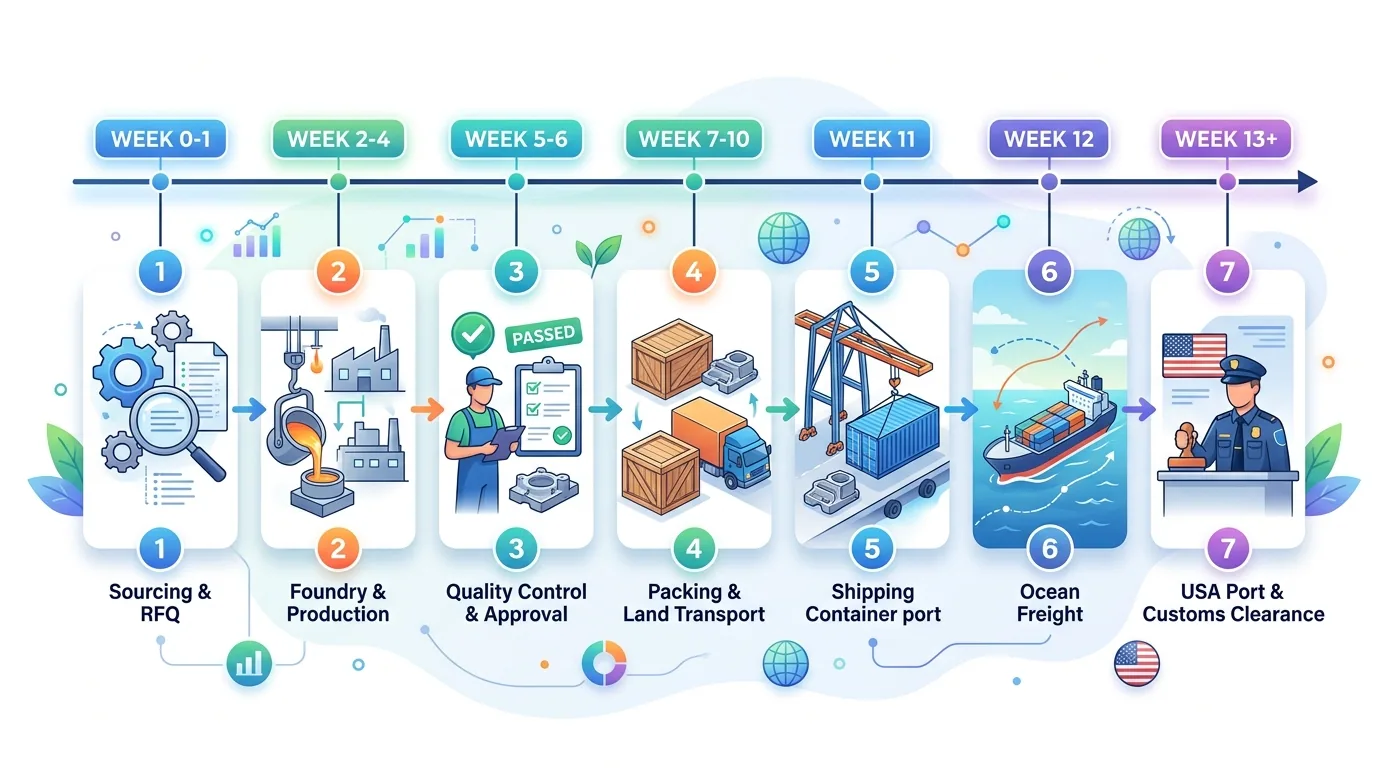
Expect to spend 8-14 weeks from first RFQ to warehouse delivery on a new program. Get any single step wrong — wrong HTS code, weak PPAP documentation, or an FOB term you didn’t understand — and margins evaporate fast.
Quick Answer on Importing Aluminum Castings from China
Importing aluminum castings from China to the USA takes 10-16 weeks end-to-end and typically costs 30-50% less than domestic US foundries, even after Section 301 tariffs. The core process: define casting specs (alloy, tolerance, finish), vet foundries with audits and ISO 9001 verification, order pre-production samples, lock terms via a bilingual contract, inspect before shipment, then handle ocean freight and customs clearance under HTS code 7616.99.51 (most aluminum castings).
Here’s the 7-step workflow we use for first-time buyers:
- Specs lockdown (Week 1-2): Drawings, alloy grade (e.g., A356, ADC12), AQL level
- Supplier vetting (Week 2-4): Shortlist 3-5 foundries, run ITA due diligence checks
- Sampling (Week 4-8): T1 samples + dimensional report
- Contract & deposit (Week 8-9): 30% T/T, FOB or CIF terms
- Production & QC (Week 9-13): Pre-shipment inspection
- Ocean freight (Week 13-16): 28-35 days transit from Ningbo/Shenzhen to LA
- Customs release: Pay duties (2.5% MFN + 25% Section 301), get delivery
On our last A356 gearbox housing project sourced from Ningbo, landed cost came in at $4.80/kg versus $9.20/kg from an Ohio foundry — a 48% savings on a 12,000-unit run. First-time importers should budget $8,000-$25,000 for tooling upfront. For a full landed-cost breakdown, see our guide on the real cost of importing aluminum castings from China.
Understanding Aluminum Casting Types and Specifications Before Sourcing
Pick the wrong casting process and you’ll overpay by 30-60% — or worse, get parts that fail in service. Before you even request quotes, nail down three things: casting method, alloy, and tolerance grade. Sand casting suits low-volume (under 500 pcs) or large parts up to 2,000 kg. High-pressure die casting (HPDC) wins at volumes above 10,000 pcs with thin walls. Gravity die casting sits in the middle. Investment casting gives you the tightest tolerances (±0.1mm) for aerospace-grade geometry.
Matching Process to Application
- HPDC (ADC12, A380): Automotive housings, electronics enclosures. Cycle time ~60 sec; tooling $15K-$80K.
- Gravity die casting (A356-T6): Pump bodies, lighting fixtures. Better mechanical properties than HPDC.
- Sand casting (356, 319): Prototypes, large industrial parts. Lowest tooling cost.
- Low-pressure (A356): Wheels, structural components. 95%+ density.
- Investment casting: Complex geometries, valve components.
Alloy Selection and the Spec Equivalence Trap
We learned this the hard way on a 2022 pump-housing project: the Chinese foundry quoted “A356 equivalent” which was actually YL104 (GB/T standard). The magnesium content was 0.05% lower than ASTM B108 spec — we caught it during spectrometer testing at PPAP, but it cost us six weeks. Always demand the exact Chinese GB designation alongside the US/EN equivalent. Reference ASTM B85 for die casting alloys and cross-check against Chinese aluminum alloy equivalents before signing a PO.
Building a Quote-Ready Technical Package
The root cause of 70% of quoting delays we see in how to import aluminum castings from China to USA projects? Incomplete drawings. Chinese foundries need: STEP file (3D), 2D PDF with full GD&T per ASME Y14.5, material cert requirements (EN 10204 3.1 mill certs), surface finish spec (Ra value, not just “smooth”), and critical-to-quality (CTQ) dimensions flagged. Specify tolerance grade using ISO 8062-3 CT grades — CT7-CT8 for HPDC is realistic; demanding CT5 will double your price or kill the quote entirely.
How to Find and Vet Reliable Aluminum Casting Suppliers in China
Skip Alibaba for serious sourcing. The fastest path to a vetted foundry is combining Canton Fair (Phase 1, Industrial Materials) or Die Casting China Expo in Shanghai with a regional cluster visit — Ningbo for die casting, Qingdao for sand/gravity, Dongguan for thin-wall precision parts. Expect 40-60% of “manufacturers” on B2B platforms to actually be trading companies. Learning how to import aluminum castings from China to USA starts with eliminating middlemen.
Non-Negotiable Vetting Checklist
- Business license verification — cross-check the 18-digit Unified Social Credit Code on the National Enterprise Credit Information Publicity System. Registered capital under ¥5M is a red flag for tooling-heavy orders.
- Certifications — ISO 9001 minimum; IATF 16949 for automotive; AS9100 for aerospace. Ask for the certificate number and verify via IAF CertSearch.
- Third-party audit — a full factory audit from SGS, TÜV, or Bureau Veritas runs $800-$1,500 and takes 3-5 days. Cheapest insurance you’ll ever buy.
- Capacity math — ask for monthly tonnage output, number of die casting machines (and tonnage of each), and current utilization rate. Above 85% utilization means your delivery will slip.
We audited a Ningbo foundry last year that showed gorgeous CNC photos on their website — turned out they outsourced 100% of machining to a shop 40km away. We caught it only because the foreman couldn’t answer questions about their (nonexistent) CMM machine. Always ask to see the specific equipment making your part, on camera, in real time.
For deeper diligence on pour-specific suppliers, see our guide on how to vet aluminum gravity casting suppliers in China.
Navigating US Tariffs, HTS Codes, and Section 301 Duties on Aluminum Castings
Direct answer: Most Chinese aluminum castings land in HTS 7616.99.51 (base duty 2.5%) plus Section 301 List 3 duty of 25%, bringing effective duty to ~27.5%. Automotive parts often shift to Chapter 87 (e.g., 8708.99), and AD/CVD orders on aluminum extrusions can add 50-400% if your casting is reclassified as an “extruded” component.
Classification is where importers hemorrhage money. A housing we helped reclassify from 7616.99.51 to 8409.91.50 (engine parts) dropped the combined duty from 27.5% to 2.5% + 25% Section 301 — saving roughly $18,000 on a $240K shipment. Chapter 84/85/87 classifications often carry lower base rates when the casting is a “part of” a specific machine.
Three tools every serious importer should use:
- CBP Binding Ruling (eRulings): Free, legally binding classification decisions in 30-90 days. File via CBP’s Rulings portal before your first shipment.
- HTS verification: Cross-check codes against the USITC HTS database — Section 301 exclusions expire and rotate; check the current USTR exclusions list.
- First-sale valuation: If your foundry buys raw aluminum from a mill and resells the finished casting, you may declare duties on the lower factory-to-trader price rather than trader-to-you — legal under Nissho Iwai and often cuts dutiable value 8-15%.
Watch the AD/CVD trap. Commerce Department orders A-570-967 on aluminum extrusions were expanded in 2024 to cover certain cast-and-extruded hybrid parts. If your casting includes an extruded sleeve or bracket, you may face cash deposits exceeding 86%. Get a scope ruling before importing. For a deeper breakdown of total landed cost, see our guide on the real cost of importing aluminum castings from China.
Tariff engineering is legal; misclassification is fraud. Document your HTS reasoning in writing, keep supplier mill certs on file, and never let a broker guess. Knowing how to import aluminum castings from China to USA profitably in 2025 means treating duty strategy as a line item — not an afterthought.
Quality Control Inspection and Testing Protocols
Direct answer: A defensible QC framework for importing aluminum castings from China to USA uses four gates — PPAP or FAI before mass production, DUPRO at 20-30% output, PSI at 100% packing, plus lab testing on sampled parts. Budget 0.8-1.5% of PO value for third-party inspection; it catches the 5-8% of shipments that would otherwise arrive defective.
The Four Inspection Gates
- PPAP / FAI: Required for automotive (AIAG PPAP Level 3) and aerospace. First Article Inspection validates the tool before you green-light 10,000 units.
- DUPRO: Inspector visits when 20-30% of parts are cast. Catches porosity drift and dimensional creep early — when the foundry can still fix it.
- PSI with AQL 2.5: Per ISO 2859-1, a 1,000-piece lot requires 80 sample units; 7 major defects = reject.
Lab Tests to Specify in the PO
Never leave testing to the supplier’s discretion. Write these into the contract: OES spectrometer for chemistry (verify A356 Si at 6.5-7.5%), tensile/yield per ASTM B557, X-ray or CT for internal porosity (ASTM E155 Level 2 for pressure parts), dye penetrant for surface cracks, CMM reports on critical dimensions, and 96-hour salt spray (ASTM B117) for anodized or powder-coated parts.
We ran a PSI on a 4,200-piece pump housing order last year where the visual pass rate looked perfect — until X-ray revealed 11% internal shrinkage porosity in the flange area. We rejected the lot, the foundry re-gated the die, and the rework bill was theirs, not ours. That single $900 inspection saved a $47,000 warranty disaster downstream. See our inspection checklist for the exact parameters to enforce.
Shipping, Incoterms, and Customs Clearance Logistics
Direct answer: For US importers learning how to import aluminum castings from China to USA, FOB (Free On Board) is almost always the right Incoterm. You control the freight forwarder, insurance, and customs broker — the three levers that actually affect landed cost. Skip DDP unless you enjoy surprise invoices.
Incoterms Decoded for Heavy Castings
- EXW: You handle everything from the factory door. Only use if you have a China-based agent.
- FOB Ningbo/Shanghai/Shenzhen: Supplier covers export clearance and loading. You own ocean freight and US-side costs. Best control-to-simplicity ratio.
- CIF: Supplier picks the forwarder — and pockets the kickback. Expect 8-15% freight markup.
- DDP: Tempting, but suppliers frequently under-declare value to reduce duty exposure, putting your importer of record on the hook with CBP.
Ocean Freight and Weight Realities
Aluminum castings are dense. A standard 20′ container legally caps at roughly 17,000-19,500 kg cargo weight depending on chassis limits at the destination port — and a 20′ full of machined housings hits that ceiling long before it fills the cube. We shipped a 4,200 kg order of A356 pump bodies last year and LCL was 40% cheaper than a half-empty FCL, despite what the forwarder initially quoted.
Typical transit times from CBP-documented major lanes:
| Origin → Destination | Transit (days) |
|---|---|
| Shanghai/Ningbo → LA/Long Beach | 14-18 |
| Shenzhen → Houston (via Panama) | 28-35 |
| Ningbo → New York/Savannah | 30-38 |
Documents and CBP Entry
File your ISF 10+2 at least 24 hours before vessel loading — late filings trigger a $5,000 penalty per shipment. Required docs: commercial invoice, packing list, ocean bill of lading, certificate of origin (Form A isn’t needed post-GSP, but COO still proves non-preferential origin for Section 301), and mill certs if claiming specific HTS subheadings.
Hire a licensed customs broker — not your forwarder’s in-house clerk. A good broker catches HTS misclassifications that cost five figures. For deeper cost breakdowns, see our full landed-cost guide.
Managing Payment Terms Contracts and Intellectual Property Risks
Direct answer: Structure payments as 30% deposit / 70% against pre-shipment inspection report (never against B/L alone), sign a bilingual contract governed by Chinese law with CIETAC arbitration, and execute an NNN agreement before sharing any CAD files. For orders under $30,000, Alibaba Trade Assurance escrow is acceptable; above that, T/T with inspection-release terms gives you real leverage.
L/C at sight sounds safer but adds 0.75–1.5% in bank fees and 10–15 days of paperwork. Most mid-size Chinese foundries quietly refuse L/Cs below $80k. Skip it unless your CFO insists.
The tooling ownership trap
We learned this the hard way on a $42,000 die-casting tooling project in 2022 — the PO said “tooling paid by buyer” but didn’t specify physical ownership or transfer rights. When we tried to move production, the supplier demanded a $9,800 “release fee.” Your contract must state: tooling is buyer’s property, stored at supplier premises, transferable on 30 days’ notice, with engineering drawings held in escrow.
NNN, not NDA
American NDAs are nearly worthless in Chinese courts. Use an NNN agreement (Non-Disclosure, Non-Use, Non-Circumvention) drafted in Chinese, governed by PRC law, with liquidated damages of $50,000–$200,000 per breach. Register your design patent or utility model with CNIPA before sending drawings — first-to-file wins in China, regardless of your US patent.
Disputes? CIETAC arbitration in Shanghai typically resolves in 6–9 months versus 3+ years for litigation, and awards are enforceable under the New York Convention. For negotiation leverage tactics that reinforce these contract terms, see our 7 negotiation tactics guide. This contractual layer is the hidden half of how to import aluminum castings from China to USA without getting burned.
Frequently Asked Questions About Importing Aluminum Castings from China
These are the questions we get weekly from buyers figuring out how to import aluminum castings from China to USA — answered with the numbers that actually matter.
What’s the typical MOQ for Chinese aluminum castings?
Die casting: 500-1,000 pieces due to tooling amortization. Sand casting: 50-100 pieces. Gravity/permanent mold: 200-500. Foundries will run smaller lots, but expect a 25-40% per-unit premium below MOQ.
What does it really cost?
Landed cost typically runs $4.50-$12/kg for standard ADC12 die castings at volume. Read our full landed-cost breakdown with real invoice data.
Do We need an import license or customs broker?
No federal import license is required for aluminum castings, but you need a CBP-assigned importer number and a customs bond (single-entry or continuous $50K+). Self-filing via ACE is legal but impractical — we tested it once on a $28K shipment and spent 14 hours on HTS validation and PGA flags. A licensed broker charges $125-$250 per entry. Worth it.
Are these castings subject to antidumping duties?
Aluminum extrusions face AD/CVD orders, and the 2024 scope expansion pulled in some cast-and-machined parts. Check the current ITA AD/CVD database by HTS and product description before every shipment.
How do We handle defective shipments?
Document with photos, third-party inspection report, and written rejection within 7 days. Withhold the 70% balance if defects exceed AQL. Never ship parts back — negotiate credit, rework in the US, or replacement in the next PO.