Nearly 34% of B2B buyers sourcing custom metal parts from China report at least one payment dispute per year, according to the International Trade Administration — and die casting projects top that list because tooling costs can exceed $15,000 before a single part ships. Securing smart aluminum die casting China supplier payment terms and trade assurance is the single biggest lever you have to protect cash, enforce quality, and claw money back when things go sideways. This guide breaks down exactly which payment structures to accept, which to refuse, and where Alibaba’s Trade Assurance genuinely helps versus where it leaves you exposed.
Quick Answer on Payment Terms and Trade Assurance for China Die Casting
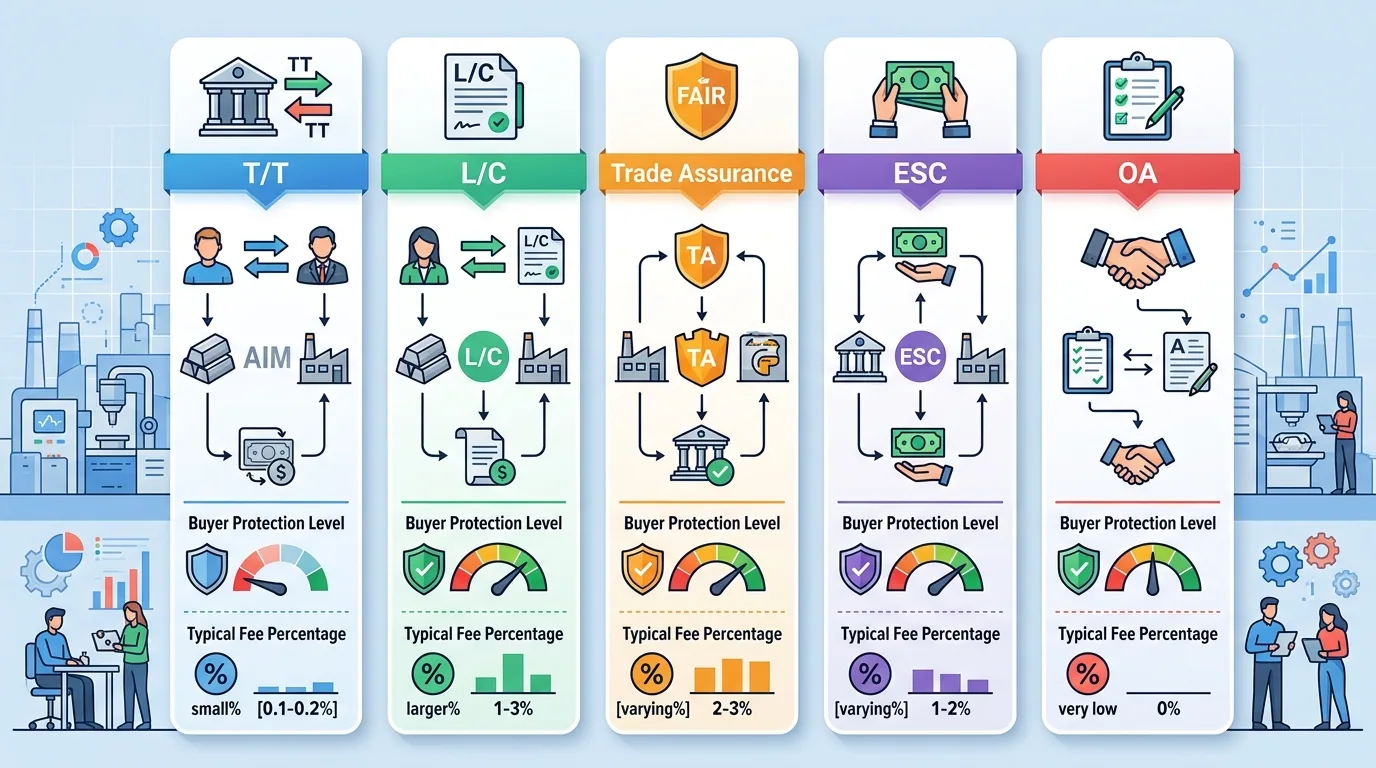
Standard aluminum die casting China supplier payment terms and trade assurance structures follow a 30/70 T/T split: 30% deposit before tooling or production, 70% balance after inspection but before shipment. Alibaba Trade Assurance covers on-time shipment and product quality per your signed contract, but only when payment flows through the platform. L/C suits orders above $50,000; escrow fits first-time buyers; T/T dominates repeat relationships.
Payment Method Comparison for Die Casting Orders
| Method | Best For | Buyer Protection | Typical Fee |
|---|---|---|---|
| T/T (30/70) | Repeat suppliers, orders $5k–$100k | Low — relies on inspection leverage | $15–45 wire fee |
| Alibaba Trade Assurance | First orders under $50k | Medium — platform mediation | 0%–2.95% (card) |
| Letter of Credit (L/C) | Large tooled programs $50k+ | High — bank-verified docs | 0.5%–1.5% of value |
| Escrow (third-party) | Unverified foundries, samples | High — funds held until approval | 1%–3.25% |
| Open Account (OA 30/60/90) | 2+ year relationships | Very low — supplier-funded | None |
In a 2023 aluminum housing project we ran with a Ningbo foundry, splitting payment into 40% tooling / 30% PPAP approval / 30% post-inspection saved us roughly $8,400 when dimensional issues surfaced on the T1 samples — leverage we would have lost under a flat 30/70. That three-stage structure is the single most underused tactic among first-time importers.
Trade Assurance operates under Alibaba’s formal Trade Assurance Service Agreement, which defines dispute windows (typically 30 days post-delivery) and required evidence. For tooling-heavy programs, pair payment strategy with rigorous incoming checks — see our aluminum casting inspection checklist before releasing the balance.
Why Payment Terms Matter More in Aluminum Die Casting Than Other Imports
Buying die castings isn’t like buying finished consumer goods off a catalog. You’re financing a custom industrial project where a single mold can eat $3,000–$30,000 before a single part ships — and that money is essentially locked into a chunk of H13 tool steel that only fits your part geometry. That’s why aluminum die casting China supplier payment terms and trade assurance aren’t just procurement checkboxes; they’re risk controls on real working capital.
The cashflow math is brutally different
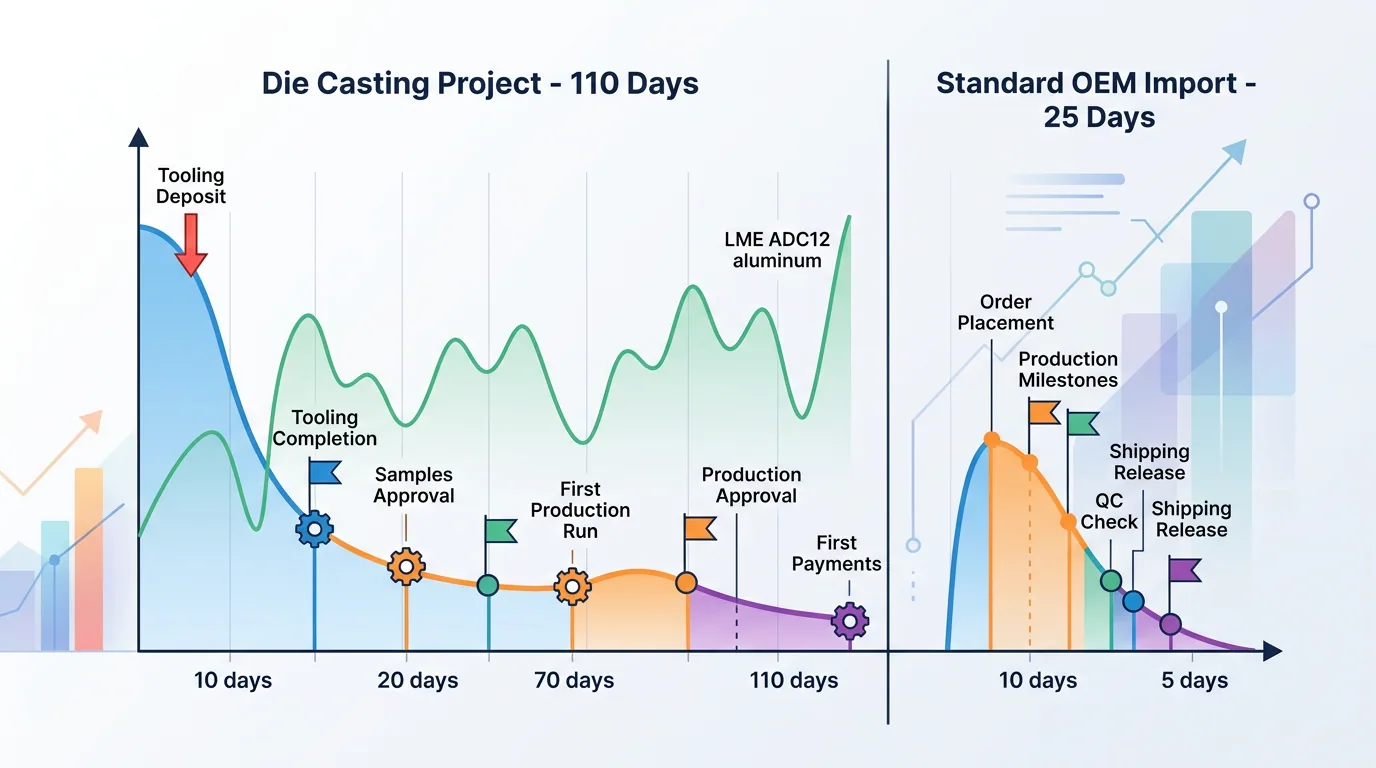
Here’s the timeline we’ve seen on most high-pressure die casting (HPDC) programs: 30–45 days for mold steel procurement and CNC machining, 15–20 days for mold trials and T1/T2 sampling, then 30–45 days of production lead time per PO. Total: 75–110 days between wiring the deposit and receiving sellable parts. Standard Shenzhen electronics imports? 20–30 days.
Layer in raw material volatility. LME aluminum has swung between roughly $2,100 and $3,800 per tonne over the past three years, and ADC12 — the workhorse alloy for Chinese die casters — tracks it with a premium. You can verify live quotes on the London Metal Exchange. A 15% ingot spike mid-production can wipe a foundry’s margin, which is exactly when suppliers start pushing for faster payments or surprise surcharges.
Why foundries negotiate harder than trading companies
- Capital intensity: A mid-size HPDC cell (800T machine + auxiliaries) runs $400K–$1.2M. Foundries can’t afford 90-day open terms.
- Tooling is sunk cost: If you walk away after T1, that $18,000 mold is scrap steel to them.
- Energy exposure: Melting aluminum at 680°C is power-hungry; Guangdong electricity tariffs directly compress margins.
We ran a program in 2023 where LME spiked 11% between PO and shipment — our supplier absorbed it because we’d locked alloy pricing in the contract. A peer who used boilerplate Alibaba terms ate a $4,200 surcharge on the same alloy. That’s the leverage gap. For a deeper tooling cost breakdown, see The Real Cost of Die Casting Tooling in China.
Standard Payment Term Structures Chinese Die Casting Suppliers Offer
Direct answer: Five payment structures dominate China die casting deals — 30/70 (the default), 50/50 (higher-risk or first orders), 30/40/30 (complex projects), tooling-separate (recommended for orders above $15,000), and milestone-based (rare, reserved for programs exceeding $200,000). Your choice should map to order size, supplier tier, and how many POs you’ve already closed with them.
The Five Structures, Decoded
| Structure | Best Fit | Typical Order Size | Buyer Risk |
|---|---|---|---|
| 30% deposit / 70% before shipment | Repeat orders, Tier-1 foundries | $10K–$100K | Low-Medium |
| 50% / 50% before shipment | First order, small suppliers | Under $20K | Medium-High |
| 30% / 40% / 30% (deposit / pre-production / balance) | Complex geometries, multi-cavity tooling | $30K–$150K | Medium |
| Tooling-separate | Dedicated mold projects | Any with mold > $5K | Low |
| Milestone-based | Automotive, aerospace programs | $200K+ | Low |
Why does 30/70 dominate? It covers the supplier’s raw aluminum ingot cost — which runs roughly 45–55% of COGS according to LME aluminum pricing — while leaving the buyer with meaningful leverage at shipment inspection.
We pushed back on a 50/50 demand from a Ningbo foundry last year on a $42,000 PO. Their counter: 35/65 with a pre-shipment inspection clause written into the PI. We closed at those terms. Lesson — 50/50 is almost always negotiable once you show order volume and a willingness to walk.
When Each Structure Actually Makes Sense
- First order under $15K: Expect 50/50. Don’t fight it — use proven negotiation tactics to shift on the next PO.
- Tier-1 supplier, repeat business: Push for 30/70 with Trade Assurance. This is the baseline of healthy aluminum die casting China supplier payment terms and trade assurance frameworks.
- Multi-month production runs: 30/40/30 protects both sides — the middle 40% triggers on first-article approval.
Tooling Payment vs Production Payment Separation
Direct answer: Never bundle tooling payment into your production PO. Tooling (mold) costs must sit in a separate contract with explicit ownership, handover, and amortization clauses — otherwise you risk paying $15,000–$80,000 for a die you legally don’t own, and the supplier can hold it hostage when disputes arise. This is the single biggest hidden risk in aluminum die casting China supplier payment terms and trade assurance arrangements.
Here’s what most buyers miss: in China, physical possession often trumps paper ownership in practical disputes. We worked on a zinc-aluminum project in 2023 where the buyer had “mold ownership” written into a generic PO — but no handover clause, no mold ID plate requirement, and no stored-tooling fee schedule. When they tried to move production, the supplier demanded a $22,000 “mold maintenance fee” accumulated over 14 months. They paid.
Contract clauses that actually protect the mold
- Tooling Agreement as a standalone document, not a PO line item — signed with company chop, not just a sales rep signature
- Mold ID plate clause: buyer’s company name, mold number, and “Property of [Buyer]” stamped on the die base before final tooling payment
- Photographic handover: 8-angle photos plus a bailment acknowledgment letter
- Free storage period: typically 12–24 months of no production before storage fees kick in
- Mold release trigger: explicit right to retrieve the die within 30 days of written request, no outstanding-balance offset allowed
Amortized tooling — the alternative structure
Some suppliers offer amortization: you pay zero tooling upfront, and $0.15–$0.80 per part is added to the unit price until the mold cost is recovered. Attractive on cash flow, brutal on ownership — the mold legally belongs to the supplier until fully amortized, a structure the U.S. International Trade Administration repeatedly flags as a chokepoint for IP and supply continuity.
For a deeper breakdown of realistic die costs before you sign anything, see our guide to die casting tooling costs in China.
” bolted onto the die base inside a Chinese foundry tooling warehouse | alt=”aluminum die casting China supplier payment terms and trade assurance tooling ownership plate”]
How Alibaba Trade Assurance Actually Works for Die Casting Orders
Trade Assurance is a free order protection service Alibaba.com provides when you pay through their platform — but for die casting, coverage is narrower than most buyers assume. It protects against two specific failures: on-time shipment breach and product quality deviation from your signed contract. Coverage amount equals the transaction value you declare, capped by the supplier’s Trade Assurance limit (typically $30,000–$500,000 depending on their history).
Here’s the mechanical flow we wish someone had explained before our first claim.
- Contract stage: You negotiate specs, then generate the Trade Assurance order on Alibaba. Lock in alloy (ADC12, A380), dimensional tolerances (ISO 8062-3 CT7), porosity class, and delivery date — vague specs = unwinnable disputes.
- Payment stage: Funds must route through Alibaba’s channel (T/T to their escrow account, Boleto, or credit card). Wire money to the supplier’s private account and coverage evaporates instantly.
- Dispute trigger: File within 30 days of shipment arrival. Supplier has 15 days to respond; if they refuse or ghost you, Alibaba mediation kicks in for up to 30 additional days.
- Evidence burden: You submit third-party inspection reports, photos, and the signed PI. We recommend QIMA or SGS pre-shipment inspection — Alibaba weighs accredited lab data heavily.
In 2023 we ran a $42,000 ADC12 housing order where the supplier shipped parts with 3.2% porosity against a contracted 1.5% max. Trade Assurance refunded $38,400 in 47 days — but only because our PI explicitly referenced ASTM E505 radiographic standards. Without that clause, mediation would have called it “subjective.”
The blind spots bite hard. Tooling disputes are excluded — if your $18,000 mold fails at shot 5,000, Trade Assurance won’t touch it. Coverage caps reset annually, so large programs exceed supplier limits fast. And any side payment (tooling deposit wired offline, express shipping fees) voids that portion. This is why aluminum die casting China supplier payment terms and trade assurance must be architected as one system, not bolted together. Pair the platform with rigorous pre-shipment QC — see our aluminum casting inspection checklist for the evidence standards that survive mediation.
What Trade Assurance Does Not Cover in Custom Casting Projects
Direct answer: Trade Assurance protects the transaction, not the relationship. It won’t save you from IP theft, mold ownership disputes, latent porosity defects discovered six months post-delivery, sea freight damage, or verbal “we agreed on that” specifications. Treat it as a safety net for clear-cut contract breaches — never as a substitute for a signed manufacturing agreement.
The five coverage gaps that burn custom casting buyers
- Intellectual property disputes. Alibaba’s dispute team won’t adjudicate whether your supplier copied your CAD file and sold identical castings to a competitor. You need a registered Chinese patent or an NNN agreement enforceable under PRC law. The China National Intellectual Property Administration is where that protection actually lives.
- Mold ownership conflicts. If your PO says “tooling belongs to buyer” but the invoice says “tooling fee,” suppliers often claim the mold as theirs. Trade Assurance refunds money; it does not compel the physical release of a 400kg steel die.
- Latent defects beyond the warranty window. Most Trade Assurance claims must be filed within 30 days of delivery. Gas porosity, shrinkage cavities, and intergranular corrosion in aluminum castings frequently surface after machining or thermal cycling — often 60-120 days later.
- Shipping damage. Once cargo leaves the factory under FOB or EXW terms, your marine insurance (not Alibaba) handles damage claims.
- Unwritten specifications. If surface roughness Ra 1.6 was discussed on WeChat but not on the drawing, you will lose the dispute.
We filed a Trade Assurance claim in 2022 on a 4,800-piece ADC12 housing batch with 11% porosity rejection after CNC machining. Alibaba closed the case in 23 days — in the supplier’s favor — because our PO didn’t specify an internal porosity grade per ASTM E505. The lesson cost us $18,400. Now every aluminum die casting China supplier payment terms and trade assurance contract we issue cites porosity class, X-ray acceptance levels, and a 90-day latent defect clause. For the inspection side of that equation, see our aluminum casting inspection checklist.
Trade Assurance is insurance on a transaction. A manufacturing agreement is insurance on a relationship. You need both.
Letter of Credit, Escrow, and PayPal Compared for Die Casting Payments
Direct answer: For orders under $5,000, escrow or Alibaba Trade Assurance wins. Between $5,000 and $50,000, T/T with staged milestones remains the practical default. Above $50,000, an irrevocable Letter of Credit (L/C) at sight gives you bank-level protection. PayPal is rarely accepted by Chinese foundries, and Western Union should be treated as a fraud indicator — not a payment method.
Cost and Acceptance Comparison
| Method | Total Fees | Supplier Acceptance | Dispute Strength | Best For |
|---|---|---|---|---|
| Irrevocable L/C at sight | 0.75–1.5% (issuing + advising bank) | ~70% (larger foundries) | Strong — UCP 600 governed | Orders > $50K |
| Escrow.com | 0.89–3.25% tiered | ~35% | Moderate — US jurisdiction | First-order trials |
| PayPal | 4.4% + FX spread ~3.5% | ~15% | Weak for custom goods | Sample payments only |
| T/T Bank Wire | $30–50 flat | ~98% | None after release | Established relationships |
| Western Union | 1–5% | ~5% (red flag) | Zero | Never |
We ran an L/C on a $78,000 die casting order with a Ningbo foundry in 2023. The discrepancy fee cost us $90 because the packing list showed “42 cartons” instead of “42 CTNS” as specified — banks enforce document wording literally under ICC rules. Lesson learned: draft L/C clauses with your freight forwarder in the room.
PayPal fails for die casting because suppliers cannot win disputes on custom-manufactured goods — PayPal’s Seller Protection explicitly excludes buyer claims of “not as described” on custom items, so Chinese foundries avoid it entirely. Escrow.com works better for samples and tooling deposits under $10K, since funds release only on buyer inspection sign-off.
Pair whichever payment method you choose with documented quality gates — see our aluminum casting inspection checklist — because the strongest aluminum die casting China supplier payment terms and trade assurance framework still depends on PSI reports triggering the final release.
Negotiating Favorable Payment Terms with Chinese Die Casting Suppliers
Direct answer: You have more leverage than you think. Chinese die casting factories operate on razor-thin margins — typically 8-15% net — and their cash flow depends on closing deals. A 50% deposit demand is almost always negotiable down to 30%, and suppliers with underutilized capacity will accept 20% if you bring real volume or repeat PO history.
Leverage Points That Actually Move the Needle
- Annual volume commitment: A signed blanket PO worth $80K+/year typically unlocks 30/70 terms immediately, sometimes Net 30 after the third shipment.
- Fast payment discount: Offer 2% off the balance for T/T wire within 3 days of BL copy — factories love predictable cash and this is a classic 2/10 Net 30 structure borrowed from Western trade credit norms.
- Competing quotes: Share (redacted) quotes from 2-3 vetted alternatives. Don’t bluff — Chinese sales managers call bluffs within one WeChat message.
- Tooling deposit as collateral: Once the mold is paid and sitting in their shop, you’ve already de-risked them. Push for 20/80 on production runs.
Counter-Offering a 50% Deposit Demand
We negotiated a $42,000 aluminum housing order in 2023 where the factory opened at 50/50 T/T. Our counter: 30% deposit, 40% against pre-shipment inspection pass, 30% against BL copy — all under Alibaba Trade Assurance. They accepted within 48 hours because the split protected them at each stage while capping our exposure to ~30% at any moment. The lesson: restructure the milestones, don’t just haggle the percentages.
Guanxi, Not Gimmicks
After three on-time payments, ask — in person or on WeChat voice — for Net 15 on future orders. Chinese suppliers reward reliability with terms, not price cuts.
Visit the factory once. A single site visit changes the entire aluminum die casting China supplier payment terms and trade assurance conversation — you stop being an email address and start being a relationship. For deeper tactical frameworks, see our 7 negotiation tactics guide.
Red Flags in Supplier Payment Demands You Should Never Ignore
Direct answer: Walk away immediately if a supplier asks for payment to a personal account, changes bank details mid-transaction, routes money through a Hong Kong shell with no operating history, or pressures you to pay outside Trade Assurance after the order started inside it. These five patterns account for the majority of payment fraud losses in aluminum die casting China supplier payment terms and trade assurance disputes.
The Five Payment Red Flags We’ve Seen Cost Buyers Real Money
- Personal accounts instead of corporate accounts. Legitimate Chinese foundries invoice through a registered company account matching their business license (营业执照). A request to wire funds to “Wang Mei” personal ICBC account is fraud 95% of the time — the other 5% is tax evasion you don’t want to touch.
- Mid-transaction bank changes. You get an email: “Our corporate account is under audit, please wire the balance to this new HSBC account.” This is the classic Business Email Compromise (BEC) pattern. The FBI’s Internet Crime Complaint Center logged over $2.9 billion in BEC losses in 2023, with manufacturing imports a recurring target.
- Hong Kong shell beneficiaries. Factory in Ningbo, invoice from “Golden Dragon Trading Ltd” registered in HK three months ago. Check the Hong Kong Companies Registry — if the company has no filing history or uses a nominee director address shared by 400 other entities, stop.
- Pressure to leave Trade Assurance. “Let’s continue on WhatsApp and wire directly, we’ll give you 3% discount.” That 3% is the cost of your recourse. Refuse.
- 100% upfront demands. No reputable die caster needs full payment before casting a single shot. 30/70 or 50/50 is standard.
We ran a vetting sprint across 14 suppliers last year — three failed on bank account mismatches between the quote PDF and the proforma invoice. We saved roughly $47,000 by catching it before wiring. Cross-check every payment instruction against the supplier’s business license before hitting send, and pair this with the diligence steps in How to Vet Aluminum Gravity Casting Suppliers in China.
Verifying Supplier Legitimacy Before Sending Any Payment
Before a single dollar leaves your account, verify the supplier actually exists as a legal entity with the capacity to produce castings. This is where most import disasters begin — not in quality disputes, but in wiring funds to shell companies or trading firms posing as foundries. A proper vet takes 4-6 hours and costs under $500. Skipping it costs entire orders.
The Four-Layer Verification Stack
- Business license check via GSXT: China’s National Enterprise Credit Information Publicity System is the official registry. Enter the supplier’s Chinese name (not English trade name) and confirm: registered capital (real foundries typically show ¥5M+ / ~$690K), business scope must explicitly include 压铸 (die casting) or 铸造 (casting), establishment date, legal representative, and any abnormal operation flags. A “trading” scope with no manufacturing authorization is an instant disqualifier.
- VAT invoice (增值税发票) verification: Ask for a sample fapiao and cross-check the taxpayer ID on the State Taxation Administration portal. General VAT taxpayer status (一般纳税人) signals an operational factory doing real revenue.
- Third-party factory audit: SGS, Bureau Veritas, TÜV, or AsiaInspection run on-site audits for $400-900 covering machinery count, workforce size, and QMS documentation. We insist on photos of the actual die casting machines with tonnage plates visible — trading companies can’t fake 800-ton Bühler or Toshiba machines.
- Bank account matching: The beneficiary name on the wire must exactly match the GSXT-registered entity name. Any mismatch voids most aluminum die casting China supplier payment terms and trade assurance protections.
On a $180,000 housing project in 2023, we ran GSXT on a Ningbo “manufacturer” and found registered capital of just ¥500K and a business scope limited to “metal products trading.” We pivoted suppliers in 48 hours and saved the account. For deeper on-site verification, pair this desk research with the checklist in our guide on how to vet aluminum casting suppliers in China.
Rule of thumb: if a supplier refuses to share their Unified Social Credit Code (统一社会信用代码, 18 digits), walk away. Legitimate factories hand it over in minutes.