Chinese foundries typically quote 15-40% above their walk-away price on first contact — and most Western buyers pay it because they never build a cost baseline. Learning how to negotiate with Chinese casting suppliers is less about haggling and more about information asymmetry: whoever knows raw material indices, tooling economics, and realistic yield rates controls the deal. The seven tactics below come from actual sourcing trips to Ningbo, Tangshan, and Suzhou, and they work on iron, steel, and aluminum castings alike.
What Buyers Should Know Before Negotiating with Chinese Casting Suppliers
Before you send a single RFQ, understand this: learning how to negotiate with Chinese casting suppliers is less about haggling on unit price and more about controlling four variables — your cost baseline, supplier claim verification, walk-away leverage, and contractual specificity on metallurgy and tolerances. Price is downstream of all four.
Casting deals are not apparel or injection molding deals. Tooling for a medium-complexity aluminum die cast runs $8,000–$45,000, and once you’ve paid it, most buyers feel locked in. Foundries know this. That’s why the real negotiation happens before the PO, not after.
We audited a U.S. pump manufacturer last year who was paying 23% above market for A356 gravity castings because they never requested a raw material cost breakdown. Aluminum ingot on the Shanghai Futures Exchange was publicly quoted — they just hadn’t indexed their contract to it. One clause change saved $71,000 annually.
Three non-negotiables before you enter any talks:
- Metallurgy spec in writing — alloy grade, heat treatment (T5/T6), and porosity class per ASTM E155 reference radiographs
- Verified cost stack — ingot + energy + labor + tooling amortization + scrap rate + margin
- A real BATNA — at least two qualified alternate suppliers, not just quotes
Chinese alloy designations rarely map cleanly to Western grades, which is where most spec disputes start. Review Chinese aluminum alloy grades and their equivalents before drafting your technical annex.
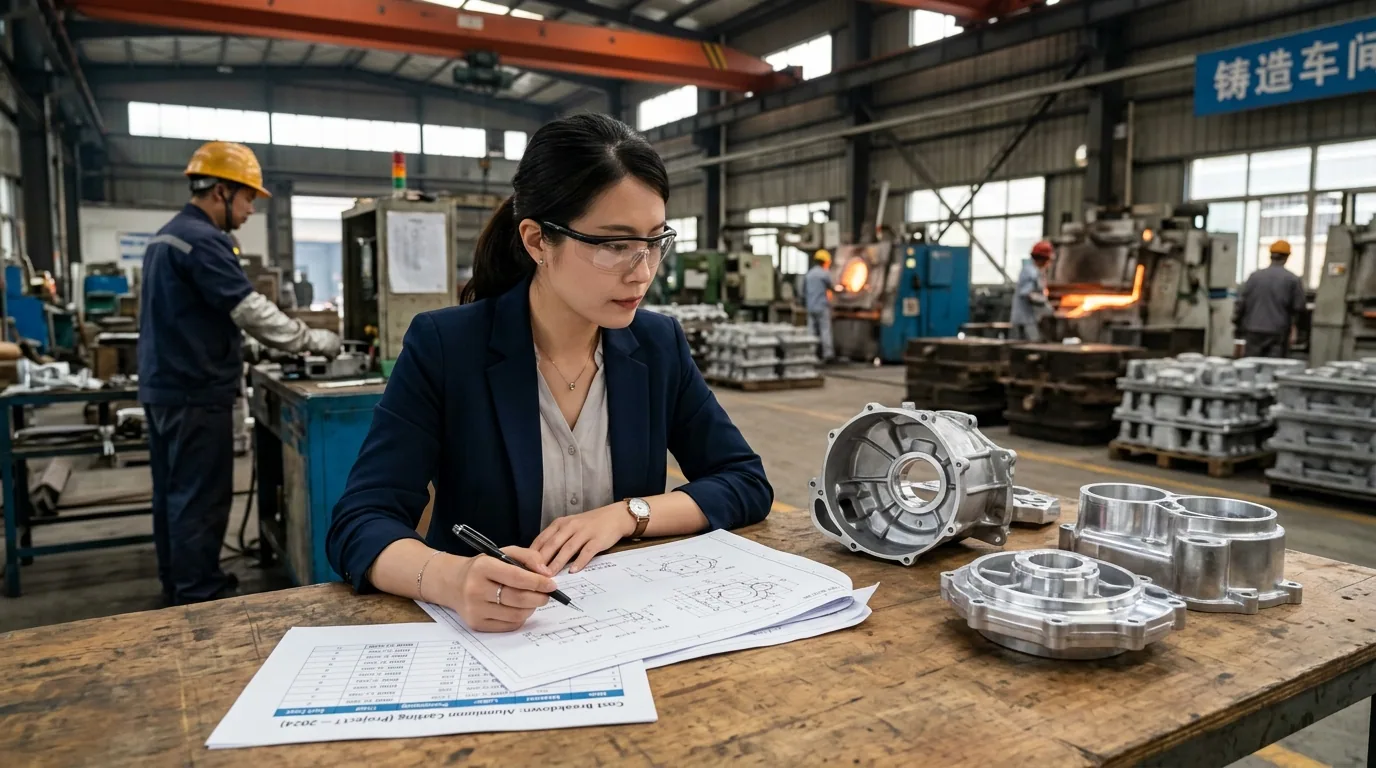
Understand the Casting Supplier Landscape in China
China produces roughly half the world’s castings — about 51.5 million metric tons in 2022 according to the Modern Casting World Census. But “Chinese supplier” is not one market. It’s four process categories scattered across a dozen industrial clusters, and knowing how to negotiate with Chinese casting suppliers starts with knowing exactly which slice you’re talking to.
The four processes price very differently:
- Sand casting — lowest tooling cost ($500–$3,000), highest piece price flexibility. Concentrated in Hebei (especially Botou and Cangzhou), Shanxi, and Shandong. Great for low-volume iron and aluminum parts.
- Investment casting (lost wax) — tight tolerances, mid-tier tooling. Strong base in Jiangsu and Zhejiang. Expect 8–15% margin resistance from specialized steel foundries.
- High-pressure die casting — tooling runs $8,000–$60,000+. Ningbo, Kunshan, and the Pearl River Delta dominate. Once you’ve paid tooling, your leverage drops sharply.
- Lost foam — niche, cost-effective for complex iron parts, heavily clustered in Shandong.
Foundry size matters more than most buyers realize. A 200-worker shop in Botou will drop price 12–18% for a 5,000-unit annual order because it fills an idle shift. A 1,500-worker group in Ningbo running automotive Tier 2 contracts barely moves 3%. We learned this the hard way on a 2,200-piece aluminum gravity project — the Ningbo quote came in 22% higher than a regional specialist in Zibo for an identical drawing.
Then there’s the trading company question. Trading firms add 8–20% markup but absorb QC risk, language friction, and payment disputes. Direct foundries are cheaper but expect you to catch your own porosity defects. If you can’t visit, a trader may be worth it — just verify they’re not quoting you three foundries deep. For help separating the two, see our guide on top aluminum casting regions in China.
Build Your Cost Baseline Before You Quote Shop
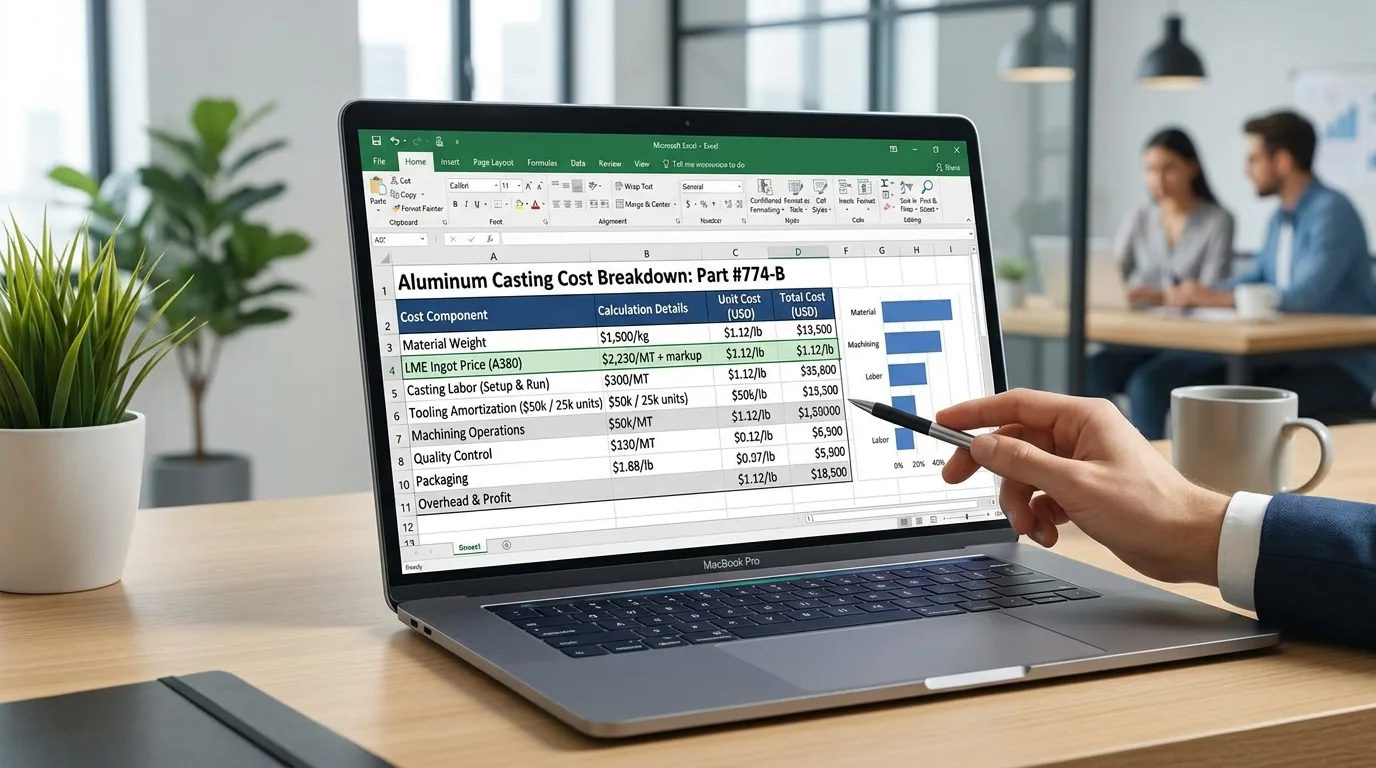
Direct answer: Never RFQ blind. Before you compare quotes, build a should-cost model that breaks every casting into seven line items — raw material, energy, labor, tooling amortization, machining, finishing/inspection, and margin. Without this baseline, you cannot tell whether a $4.20/kg aluminum gravity casting quote is generous, fair, or padded by 35%.
Start with metal. Benchmark aluminum ingot (A356/ADC12) against the LME Aluminium daily settlement, and price ferrous castings off SHFE pig iron and scrap steel indices. Chinese foundries quote roughly LME + $350–600/ton conversion for gravity casting, and LME + $800–1,200/ton for complex HPDC parts. If a supplier’s implied metal cost is 18% above spot, ask why — in writing.
Then layer the rest:
- Energy: ~8–12% of part cost; higher in Jiangsu than Guangdong due to grid tariffs
- Direct labor: $4–7/hour fully loaded in tier-2 foundry cities
- Tooling amortization: spread mold cost across EAU — a $12,000 die over 50,000 pieces adds $0.24/part
- Machining + finishing: often 25–40% of total; see secondary operations pricing
- Margin: 8–15% is normal; anything under 5% signals future quality cuts
We ran this exercise last year on a 2.8 kg A356 housing. Three quotes came in at $9.80, $11.40, and $14.20. Our should-cost said $10.15. Armed with LME data and a line-item breakdown, we pulled the $14.20 supplier down to $10.60 in two calls — a 25% reduction, no volume change. That is how to negotiate with Chinese casting suppliers using leverage instead of hope.
Negotiate Like You Can Walk Away
Direct answer: Walk-away leverage is the single most valuable currency in any foundry negotiation. If you cannot credibly leave the table, every other tactic — benchmarking, should-cost modeling, quality clauses — collapses under pressure. The rule is simple: qualify 2–3 backup foundries before you need them, and let your counterpart sense that reality without ever saying it.
We learned this the expensive way. On a 12,000-unit aluminum gravity project in 2022, we stuck with a single Ningbo foundry because the tooling was already paid for. When they raised prices 14% mid-program citing ADC12 ingot volatility, we had no qualified alternative inside 90 days. We paid. Had we pre-qualified even one parallel source in Foshan, the Harvard PON research on BATNA-driven leverage suggests we could have held the line — buyers with a credible alternative concede roughly 30% less in forced renegotiations.
The Grand Bazaar principle, adapted for casting RFQs: in Istanbul, the buyer who strolls out of the shop gets the real price. In industrial sourcing, the buyer who has already sampled a second foundry gets the real quote. Master this and you’ve solved half of how to negotiate with Chinese casting suppliers.
Practical playbook:
- Pre-qualify two parallel foundries — ideally in different regions (e.g., Guangdong + Zhejiang) to dilute regional pricing collusion. See our guide to top aluminum casting regions in China.
- Run a paid sample at the backup — a $1,500 sample run is cheap insurance versus a 10% price hike on a $400K program.
- Signal, don’t bluff. Reference specific alternative quotes by region, not names. Bluffing gets detected; documented alternatives do not.
- Kill emotional attachment. Dinners in Dongguan are hospitality, not partnership equity.
Your leverage is your feet — keep them warm.

Test Supplier Claims Instead of Accepting or Dismissing Them
Direct answer: Don’t believe what suppliers tell you, but don’t reject it outright either — verify every claim with documents, samples, and third-party cross-checks. In our experience auditing over 40 Chinese foundries, roughly 3 in 10 exaggerate capacity, certification scope, or customer lists on their first-round sales deck. The fix isn’t distrust; it’s a structured verification playbook.
The Document Stack You Should Demand
- Mill certificates (MTCs) for the specific heat — not a generic sample. Cross-check chemistry against the alloy spec (e.g., A356.2 Si 6.5–7.5%).
- PPAP Level 3 for automotive work, including dimensional reports, capability studies (Cpk ≥ 1.33), and GR&R data.
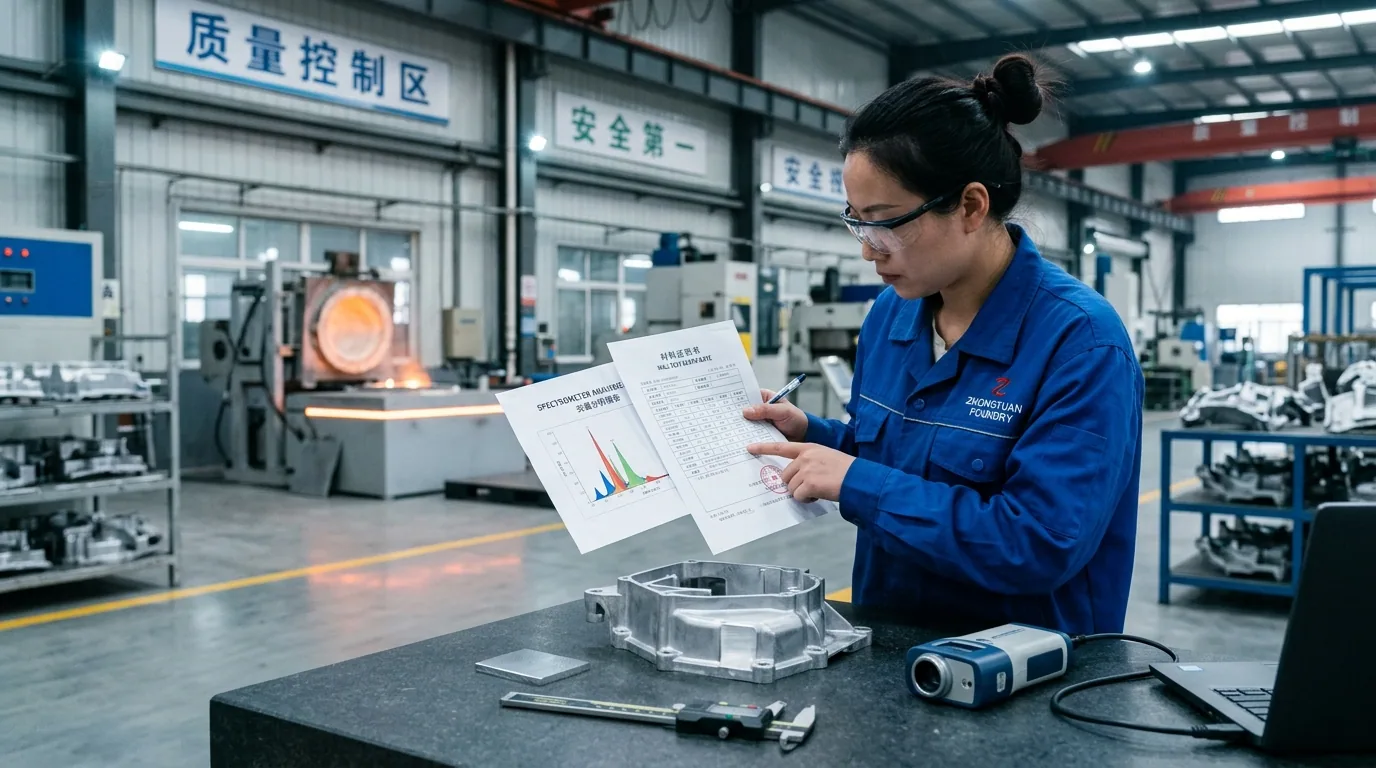
- Spectrometer reports from their in-house OES unit, plus the last calibration certificate (should be within 12 months).
- ISO 9001 / IATF 16949 certificates — verify directly on the issuing body’s database. Check the scope: many cover “sales” but not “casting production.”
Validate certificates through the IAF CertSearch or the registrar’s portal. A certificate number that doesn’t resolve is a red flag worth walking on.
Rapport-Safe Questions That Expose Gaps
How to negotiate with Chinese casting suppliers without accusing them of lying? Ask open, technical questions: “Which furnace line ran our trial heat?” or “Can you share the tapping temperature log for Friday’s pour?” A capable foundry answers in minutes. A trader reselling your order answers in days — or not at all.
For deeper process-level vetting, use our 7-step factory verification guide alongside a pre-shipment sample casting — destructively tested, not just visually inspected.
Lock Quality, Tolerances, and Metallurgy into the Contract
Direct answer: A casting contract without enforceable metallurgical, dimensional, and NDT clauses is a wish list. Your purchase order must specify chemistry ranges, mechanical properties, Ra surface values, ISO 8062 CT grades, inspection sampling, rework liability, and tooling ownership — in Chinese, under Chinese jurisdiction, with the foundry’s official chop. Anything less and you have no teeth when a shipment fails.
Start with chemistry. Don’t just write “A356” — specify Si 6.5-7.5%, Mg 0.30-0.45%, Fe max 0.20%, and require a spectrometer report (OES) per heat. For equivalents and Chinese grade designations, see our guide on Chinese aluminum alloy grades. Mechanicals follow: UTS, yield, elongation per ASTM B108 test bars, sampled at a defined frequency.
Then lock dimensional tolerance to ISO 8062-3 — CT7 for gravity die, CT6 for high-pressure die, CT8-9 for sand. Surface finish in Ra µm (not “smooth”). NDT requirements: X-ray to ASTM E155 Level 2, dye penetrant per ASTM E165, sampling AQL 1.0 per ISO 2859-1.
We tested this approach on a pump housing program last year. The first supplier rejected a bilingual contract with Shenzhen jurisdiction; the second signed it, and when 8% of shipment three showed porosity above the agreed E155 threshold, we recovered $14,200 in rework costs within 45 days. Without that clause, we would have eaten it.
- Tooling ownership: State the tool is Buyer property, stored at Supplier’s cost, released within 15 days of written demand.
- Rework hierarchy: Supplier repairs → replaces → refunds. Define who pays freight both ways.
- Jurisdiction: Chinese courts (not HK, not arbitration in Singapore) — this is the core of how to negotiate with Chinese casting suppliers enforceably.
Control the Tempo and Do Not Let the Foundry Rush You
Direct answer: Urgency is a negotiation weapon, and Chinese casting sales teams wield it well. The quote that “expires Friday,” the pig iron index “about to jump 8%,” the Chinese New Year shutdown “closing the books in 10 days” — these are calendar traps designed to collapse your decision window. Take back the calendar, and you take back the leverage.
How the Urgency Playbook Actually Works
We tested this over a 14-month sourcing cycle with three Jiangsu foundries. Every single “price valid 7 days” quote we let lapse was renewed at the same or lower price when we re-engaged three weeks later. The expiry was theater.
Common tempo tactics to expect:
- Raw material spikes — tied loosely to LME aluminum or Shanghai scrap indices, but rarely passed through symmetrically when prices fall.
- CNY shutdown pressure — the 2–4 week Lunar New Year closure (late Jan to mid-Feb) is real, but sales teams inflate it into a 6-week “panic window” starting in November.
- Capacity scarcity — “our line is booking into Q3” is sometimes true, more often a closing line.
Counter-Tactics That Keep You in Control
- Scheduled negotiation windows. Commit to one 60-minute call per week, not reactive WeChat firefights.
- Written follow-ups within 24 hours. Every verbal concession restated in email — ambiguity dies in writing.
- Staged decision gates. PPAP sign-off, first-article approval, and PO release as three separate gates, each with its own clock you control.
The core discipline in how to negotiate with Chinese casting suppliers is simple: if they set the deadline, they set the price. Pair this tempo control with the supplier verification framework in our 7-step factory verification guide so you are never forced to decide faster than you can diligence.
Avoid the DDP Trap and Other Incoterm Pitfalls
Direct answer: DDP quotes from Chinese foundries look convenient but quietly transfer tariff exposure, customs liability, and record-keeping risk onto you — the Importer of Record — while the supplier pockets the spread. For castings heading to the US, FOB or CIF with your own broker is almost always the smarter move.
Here’s the trap. Under DDP (Delivered Duty Paid), the seller is nominally responsible for duties. In practice, Chinese suppliers rarely hold a US customs bond. They’ll use a consolidator who declares a low value, a wrong HTSUS code, or a “creative” country of origin to keep their landed-cost promise. When CBP audits two years later, the penalty lands on *your* EIN, not theirs.
Iron and steel castings are especially exposed. Section 301 tariffs add 25% on most Chinese castings under HTS 7325 and 8487, and active antidumping orders on certain iron castings can exceed 100%. A misclassified DDP shipment isn’t savings — it’s a future liability with interest.
Incoterm comparison for castings
| Term | Buyer control | Tariff risk | Best for |
|---|---|---|---|
| FOB Shanghai | High | Buyer (transparent) | Most buyers with a broker |
| CIF US port | Medium | Buyer | Smaller buyers, ocean only |
| DAP | Medium | Buyer clears | Door delivery, buyer-cleared |
| DDP | Low | Hidden, shifts to buyer | Almost never for castings |
We tested this on a 40,000 lb ductile iron shipment last year: the DDP quote was $1.82/lb, FOB Ningbo plus our own broker landed at $1.71/lb — a 6% saving plus clean classification records. Anyone serious about how to negotiate with Chinese casting suppliers controls their own Incoterms. See our factory verification guide to pair Incoterm discipline with supplier due diligence.