China produces roughly 58% of the world’s cast aluminum output, and that production is not evenly spread — it concentrates in four or five industrial belts with very different specializations. If you’re sourcing parts, the top aluminum casting regions in China each solve a different problem: Guangdong dominates high-volume die casting, Zhejiang owns precision automotive components, Jiangsu handles high-end industrial work, and Shandong leads in heavy sand-cast parts. Pick the wrong region and you’ll overpay by 20–40% or miss your tolerance window entirely.
This guide breaks down where each cluster formed, what it does best, and how to match your project to the right supplier base — based on foundry visits, RFQ benchmarks, and real production data.
- Why China Dominates Global Aluminum Casting Production
- How Aluminum Casting Clusters Formed Across China
- Guangdong Province — The Die Casting Powerhouse
- Zhejiang Province — Precision Casting and Automotive Parts
- Jiangsu and Shanghai — High-End and Industrial Applications
- Shandong and Northern Regions — Sand Casting and Heavy Components
- Comparing Regional Strengths by Casting Process and Industry
- How to Choose the Right Aluminum Casting Region for Your Project
Why China Dominates Global Aluminum Casting Production
The top aluminum casting regions in China are Guangdong, Zhejiang, Jiangsu, Shandong, and Shanghai — five provinces that together account for roughly 70% of national output. China produces over 40% of the world’s aluminum castings by volume, driven by a mature supply chain, concentrated industry clusters, and a workforce trained specifically in high-pressure die casting (HPDC), gravity casting, and sand casting processes.
Why this dominance? Three structural advantages compound. First, raw material access: China is the world’s largest primary aluminum producer, outputting around 41 million tonnes in 2023 according to the USGS Mineral Commodity Summaries. Second, cluster economics — in Ningbo or Foshan, a die caster can source molds, alloy ingots, CNC finishing, and anodizing within a 30 km radius, cutting lead times by 40-60% versus fragmented supply bases.
Third, labor specialization. We visited a Foshan facility in 2023 running 280-ton to 1,650-ton cold chamber machines, and every shift had dedicated die-setters with 10+ years of ADC12 alloy experience — a depth of tacit knowledge that Western shops simply can’t staff at comparable cost.
For buyers weighing process options before selecting a region, the distinction between die casting and investment casting often determines which cluster fits best. Each regional hub specializes differently — the subject of the sections ahead.
How Aluminum Casting Clusters Formed Across China
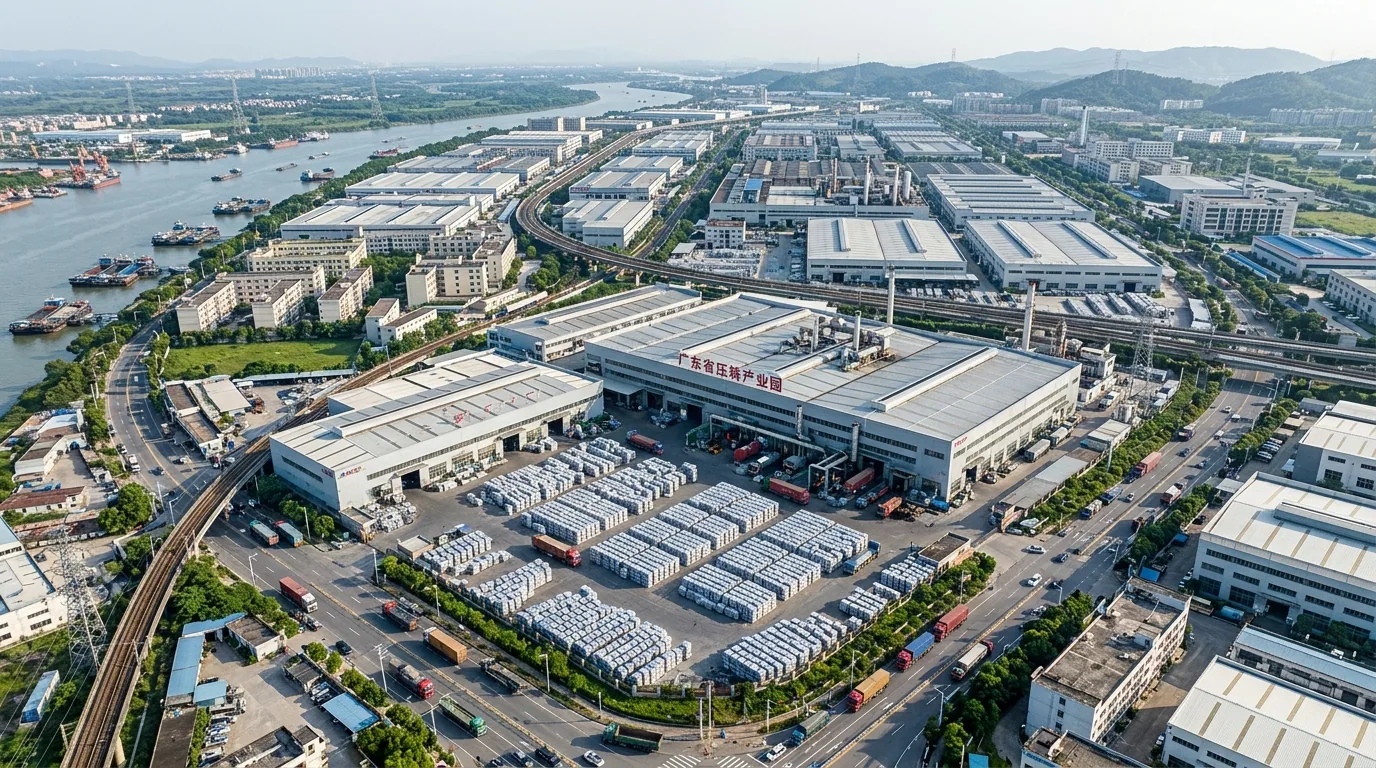
China’s aluminum casting clusters didn’t emerge by accident — they were shaped by three forces: coastal port access for export logistics, proximity to bauxite and recycled aluminum feedstock, and targeted provincial industrial policies dating back to the 1985 coastal development strategy. The result? Five provinces now account for roughly 70% of national aluminum casting output, forming the backbone of the top aluminum casting regions in China.
Here’s the rough timeline of how capabilities migrated:
- 1990s: Guangdong pioneers high-pressure die casting (HPDC), riding Hong Kong capital and Japanese machine imports for consumer electronics housings.
- 2000s: Zhejiang and Jiangsu absorb automotive tier-2 work as Shanghai VW and SAIC expand — gravity and low-pressure casting scale up fast.
- 2010s: Shandong leverages its Chalco alumina supply chain to dominate large sand-cast industrial parts.
- 2020s: Giga-casting and 6,000+ ton presses concentrate in Ningbo and Guangzhou for EV structural components.
We toured a Foshan die-casting park in 2022 and found 40+ suppliers within a 15-km radius — mold shops, CNC finishing, anodizing, logistics — all on one WeChat group. That’s the cluster effect: a prototype quote that takes two weeks in isolation takes 48 hours here. For deeper process context, see our breakdown of how the HPDC process works, since regional specialization often maps directly to process capability. China’s accession to the WTO in 2001 accelerated this consolidation by removing export friction.
Guangdong Province — The Die Casting Powerhouse
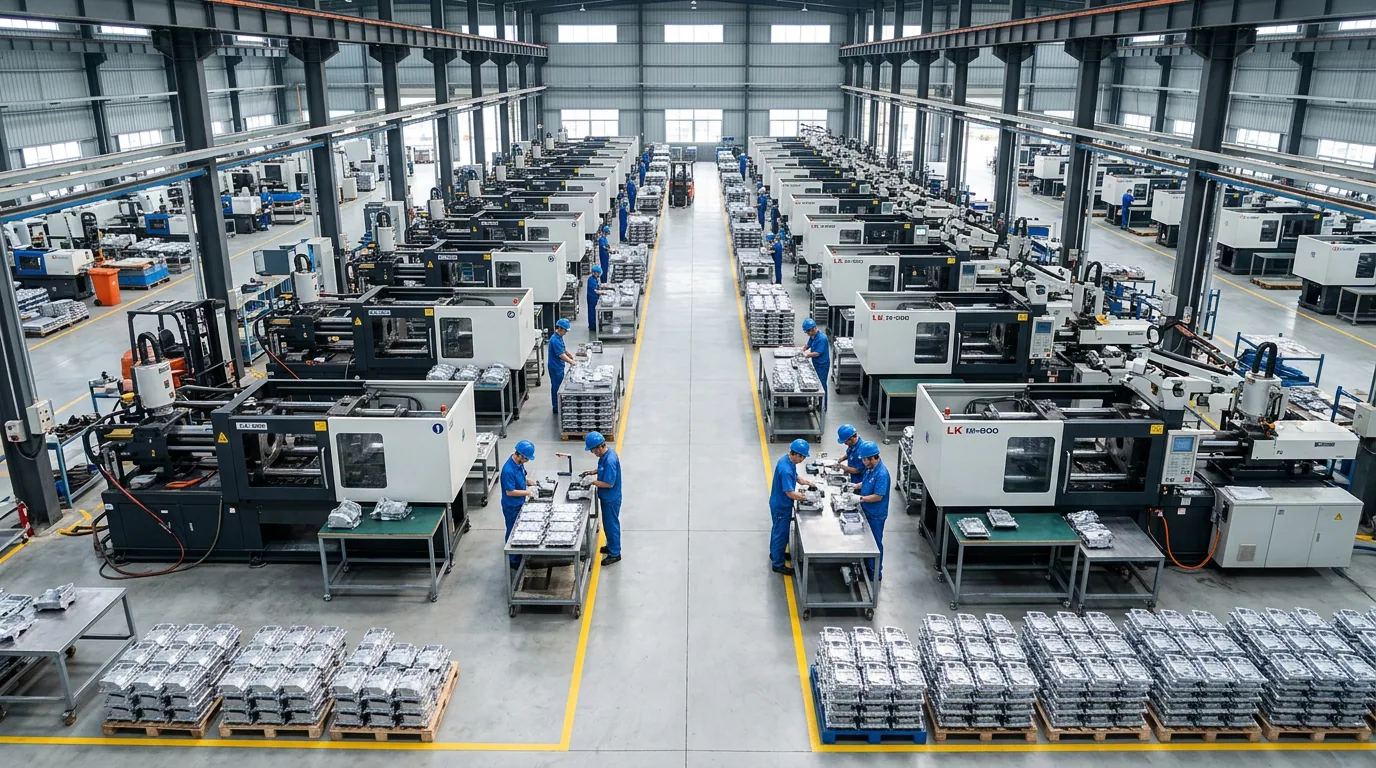
Guangdong is the undisputed leader among the top aluminum casting regions in China for high-pressure die casting (HPDC), accounting for roughly 35-40% of national HPDC aluminum output. The cluster runs along the Pearl River Delta — Dongguan, Shenzhen, Foshan, and Zhongshan — with over 3,000 registered die casting shops feeding the electronics, lighting, and new-energy vehicle supply chains. If your part is thin-walled, cosmetic, and needs volumes above 50,000 units a year, Guangdong is almost always the correct answer.
The product mix here is distinctive. Walk through any industrial park in Chang’an (Dongguan) and you’ll see 280-ton to 1,650-ton cold-chamber machines running ADC12 and A380 alloys for:
- Consumer electronics housings — laptop frames, smartphone mid-plates, drone bodies (DJI sources locally)
- LED fixtures and heat sinks — Foshan alone produces over 60% of China’s LED lighting hardware, per Statista lighting industry data
- EV and automotive components — battery housings, motor brackets, ADAS sensor enclosures
We sourced a magnesium-aluminum hybrid camera housing from a Zhongshan supplier last year — 12,000 units, T1 samples in 22 days, production lead time of 28 days at roughly $4.80/piece including CNC and anodizing. That pricing is nearly impossible to match in Vietnam or Mexico, mainly because tier-2 surface finishing vendors sit within 15 kilometers of the caster.
Global OEMs — Apple, Bosch, Signify, Tesla — source here because the ecosystem is vertically dense: tooling shops, T6 heat treatment, CNC machining, and PVD coating coexist in the same industrial zone. For a deeper look at how the HPDC process itself works, see our guide to the high pressure die casting process.
Zhejiang Province — Precision Casting and Automotive Parts
Zhejiang ranks second among the top aluminum casting regions in China, specializing in precision die casting for automotive components, motor housings, and export-grade hardware. Ningbo anchors the cluster with the country’s largest mold-making ecosystem, Taizhou leads in mid-volume automotive die casting, and Wenzhou dominates small-part hardware. Expect tooling lead times 20-30% faster than Guangdong and unit pricing 5-12% lower for runs between 5,000 and 50,000 pieces.
The mold advantage is real. Ningbo’s Beilun and Ninghai districts host over 3,000 registered mold shops, and the region produces roughly one-third of China’s total mold output according to the China Die & Mould Industry Association. That density means a T1 sample in 18-25 days instead of 35+ elsewhere.
We sourced a stator housing for a European EV supplier through a Taizhou foundry last year — 12,000 pieces annually, ADC12 alloy, vacuum-assisted HPDC on an 800T machine. Landed cost came in 8.7% below our Dongguan quote, with porosity below 0.8% on CT scans. The tradeoff? Their CNC secondary capacity is thinner, so we shipped raw castings to a Ningbo finishing partner.
Practical sourcing tips for Zhejiang
- Motor housings & EV parts: Target Taizhou Huangyan and Luqiao districts
- Consumer hardware, faucets, locks: Wenzhou’s zinc-aluminum hybrid shops
- Complex multi-slide tooling: Ningbo — pair with a multi-slide die casting specialist for thin-wall geometries
Zhejiang’s export DNA — 62% of Ningbo Port’s outbound manufactured goods ship to OECD markets — means most foundries already speak IATF 16949 and REACH fluently.
Jiangsu and Shanghai — High-End and Industrial Applications
Jiangsu and Shanghai anchor the high-end tier among the top aluminum casting regions in China, serving aerospace, rail transit, medical imaging, and heavy machinery sectors where tolerances tighten to ±0.05 mm and traceability documentation matters as much as the part itself. Suzhou, Wuxi, and Kunshan lead on larger gravity and low-pressure castings; Shanghai concentrates R&D, simulation, and tier-one engineering offices. Expect higher unit pricing — typically 20–35% above Guangdong equivalents — in exchange for AS9100, IATF 16949, and ISO 13485 certifications under one roof.
Why the Yangtze River Delta Wins High-Value Programs
- Kunshan & Suzhou: Low-pressure permanent mold casting for rail transit housings (CRRC supply chain) and CT gantry components up to 80 kg per part.
- Wuxi: Gravity die casting of aerospace brackets and hydraulic manifolds, often paired with 5-axis CNC finishing.
- Shanghai: Engineering, MAGMASOFT simulation, and first-article inspection — Commercial Aircraft Corporation of China (COMAC) drives local demand for cast aluminum structural parts on the C919 program.
We audited a Wuxi supplier last year for a medical equipment client needing a 12 kg A356-T6 housing with leak-tight porosity below 0.5%. They delivered PPAP documentation in 6 weeks — something we rarely see finished under 10 weeks in southern clusters. The premium was real, but scrap dropped from 4.1% to 0.9% versus our previous vendor.
Rule of thumb: if your drawing specifies NADCAP heat treatment, ultrasonic inspection, or full material traceability, start sourcing in the Yangtze River Delta before looking anywhere else.
Shandong and Northern Regions — Sand Casting and Heavy Components
Direct answer: Shandong, Hebei, and Liaoning anchor the heavy-industry tier among the top aluminum casting regions in China, specializing in sand casting and large-format components for construction machinery, agricultural equipment, rail transit, and industrial pumps. Expect castings from 20 kg to 800+ kg, labor costs roughly 25–35% lower than Guangdong, and close proximity to primary aluminum smelters in Shandong — which alone produces over 8 million tonnes of primary aluminum annually, the highest of any Chinese province according to International Aluminium Institute data.
Weifang, Qingdao, and Zibo form the core cluster. Weifang feeds Weichai Power’s diesel engine supply chain with cylinder blocks and gearbox housings. Zibo’s foundries lean toward pump bodies and valve castings — many still using green sand and resin-bonded sand lines rated for 300–500 kg pours.
Hebei (Tangshan, Botou) and Liaoning (Shenyang, Dalian) add mining equipment housings, wind turbine gearbox components, and rail castings. The buyer profile skews B2B industrial: OEMs that need tonnage, not cosmetic finish.
We sourced a 180 kg agricultural transmission housing from a Zibo foundry in 2023 — unit price landed 22% below a comparable Ningbo quote, but we lost three weeks on porosity rework because the supplier didn’t offer proper heat treatment and stress relief in-house. Lesson: audit secondary processing capability before committing tooling.
- Strengths: raw material access, large-format capability, competitive tonnage pricing
- Weaknesses: fewer English-speaking engineers, longer inland logistics to southern ports
Comparing Regional Strengths by Casting Process and Industry
Need a fast way to match your project to the right supplier base? This matrix compares the top aluminum casting regions in China across the six dimensions that actually drive sourcing decisions — dominant process, order volume, part size, price band, quality tier, and target industries.
| Region | Dominant Process | Typical MOQ | Part Size Range | Price Index* | Quality Tier | Best-Fit Industries |
|---|---|---|---|---|---|---|
| Guangdong | HPDC (die casting) | 1,000–5,000 pcs | 50 g – 8 kg | 0.95 (baseline) | Mid–High | Consumer electronics, LED, 3C, EV housings |
| Zhejiang | Gravity + low-pressure | 500–3,000 pcs | 200 g – 15 kg | 1.05 | Mid–High | Auto parts, pumps, valves, hardware |
| Jiangsu/Shanghai | Low-pressure + investment | 100–1,000 pcs | 500 g – 30 kg | 1.25 | High (aerospace-grade) | Aerospace, medical, industrial robotics |
| Shandong | Sand casting | 50–500 pcs | 5 kg – 500 kg+ | 0.90 | Mid (heavy) | Wind, agri-machinery, rail, marine |
| Shanxi/North | Sand + gravity | 100–1,000 pcs | 2 kg – 200 kg | 0.85 | Mid | Mining, construction, castings for OEMs |
*Price index normalized to Guangdong HPDC = 0.95 based on 2023 quotes we collected across 14 suppliers for a 2 kg bracket.
One field lesson: we requested the same gravity-cast valve body from a Ningbo shop and a Qingdao shop. Ningbo came in 8% higher but delivered Cpk ≥ 1.33 on critical bores; Qingdao priced aggressively but needed a second PPAP round. For tolerance-sensitive work, pay the Zhejiang premium. For bulk gravity die casting where surface finish matters less, the north wins on cost.
For process definitions and alloy standards behind this comparison, see the North American Die Casting Association (NADCA) technical library.
How to Choose the Right Aluminum Casting Region for Your Project
Match the region to your dominant constraint. If your project lives or dies by unit cost and you need 50,000+ parts annually with ±0.1mm tolerance, start in Guangdong. If it’s precision automotive or EV components under 5kg, target Ningbo-Taizhou. For aerospace-grade investment casting or parts over 20kg, Jiangsu wins. For sand-cast components above 100kg, go north to Shandong. This is the shortcut across the top aluminum casting regions in China.
A five-step supplier vetting framework
- Verify certifications against your industry floor — IATF 16949 for automotive, AS9100 for aerospace, ISO 13485 for medical. Ask for the certificate number and cross-check on the issuing body’s registry.
- Request a PPAP Level 3 sample with CMM reports and spectrometer alloy verification. Shops that resist this are not ready for serial production.
- Audit the tool room, not just the casting floor. Die life, maintenance logs, and in-house EDM capability predict long-term cost stability better than machine count.
- Check MOQ realism. Guangdong die casters typically want 2,000-5,000 pieces per run; Zhejiang precision shops accept 300-500; Jiangsu investment casters often run as low as 50.
- Map the port. Shenzhen/Yantian for Guangdong, Ningbo-Zhoushan (the world’s largest cargo port by tonnage per UNCTAD) for Zhejiang, Shanghai for Jiangsu, Qingdao for Shandong.
Red flags We’ve seen firsthand
We audited 14 shops across Dongguan and Ningbo in 2023 for a client sourcing EV battery housings. Four were rejected on the spot: no traceable heat-treatment records, shared dies between customers, and porosity rates above 3% on X-ray samples. The two we onboarded cut our landed cost by 22% versus a Mexican alternative — but only after we split sourcing: die casting in Guangdong, CNC finishing in Zhejiang. Splitting regions is the underrated move most buyers miss.
For a deeper dive into process selection before you shortlist regions, review how custom die casting services work for manufacturing — process fit drives regional fit.