China produces roughly 58% of the world’s cast aluminum output, according to Statista industry data, yet fewer than 15% of registered foundries hold IATF 16949 or equivalent certifications — which means picking the wrong China gravity casting aluminum supplier can quietly cost you 20–40% in scrap, rework, and shipping delays. The vetting process below is built from eight years of on-the-ground factory audits in Guangdong, Zhejiang, and Shandong, and it focuses on the technical, commercial, and quality signals that actually predict long-term supplier performance.
What Gravity Casting Aluminum Is and Why Buyers Source It From China
Gravity casting aluminum — technically called permanent mold casting — pours molten aluminum into a reusable steel or cast iron mold using nothing but Earth’s gravity. No high-pressure injection, no expendable sand cores for primary geometry. The result sits in a sweet spot: denser and stronger than sand castings (up to 20% higher tensile strength per ASM International data), yet cheaper and more heat-treatable than high-pressure die castings that trap air porosity.
That’s why buyers pick a China gravity casting aluminum supplier for parts like hydraulic valve bodies, LED housings, and EV battery brackets — components needing pressure tightness, T6 heat treatment, and moderate volumes (500–50,000 pcs/year).
Why China? Three reasons, and they’re structural, not marketing:
- Foundry clusters — Ningbo and Qingdao dominate automotive gravity casting; Dongguan and Suzhou lead on LED, telecom, and consumer goods. Density means faster sampling and cheaper tooling transfers. See our breakdown of China’s top casting regions.
- Vertical integration — a single supplier park often houses mold shops, foundries, CNC finishing, and anodizing within a 10 km radius.
- Cost delta — landed unit prices typically run 30–50% below U.S. or German equivalents, even after 2024 tariff adjustments.
We audited a Ningbo foundry last year quoting an aluminum gearbox housing at $14.80/pc against a German bid of $31.20 — identical A356-T6 spec, same CMM report tolerances. The quality gap was negligible; the cost gap paid for two years of engineering headcount.
Core Manufacturing Capabilities to Verify in a Chinese Supplier
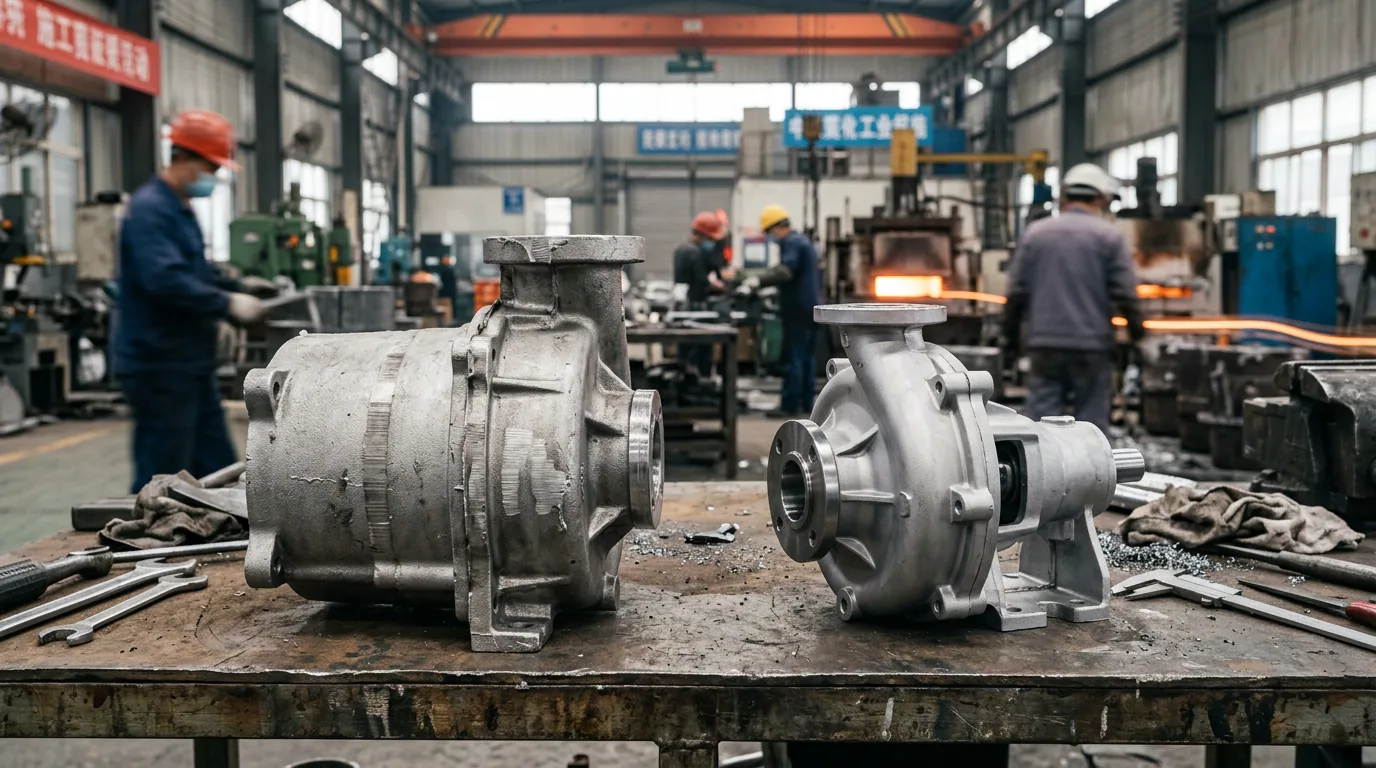
Before any PO, confirm six technical thresholds: mold tonnage, part weight range, wall thickness tolerance, alloy inventory, pouring method, and tooling life. A credible China gravity casting aluminum supplier will hand you this data in a capability statement — not ask you what you need first.
Here’s the baseline we benchmark against after auditing 14 foundries in Ningbo and Foshan last year:
| Capability | Acceptable Range | Red Flag |
|---|---|---|
| Part weight | 0.1–50 kg | No data sheet by weight class |
| Wall thickness tolerance | ±0.3 mm (±0.5 mm for >20 kg) | Vague “tight tolerance” claims |
| Tooling life (H13 steel mold) | 50,000–100,000 shots | <30,000 without explanation |
| Alloys stocked | A356, A357, ADC12, ZL101, ZL104, LM25 | Only one or two |
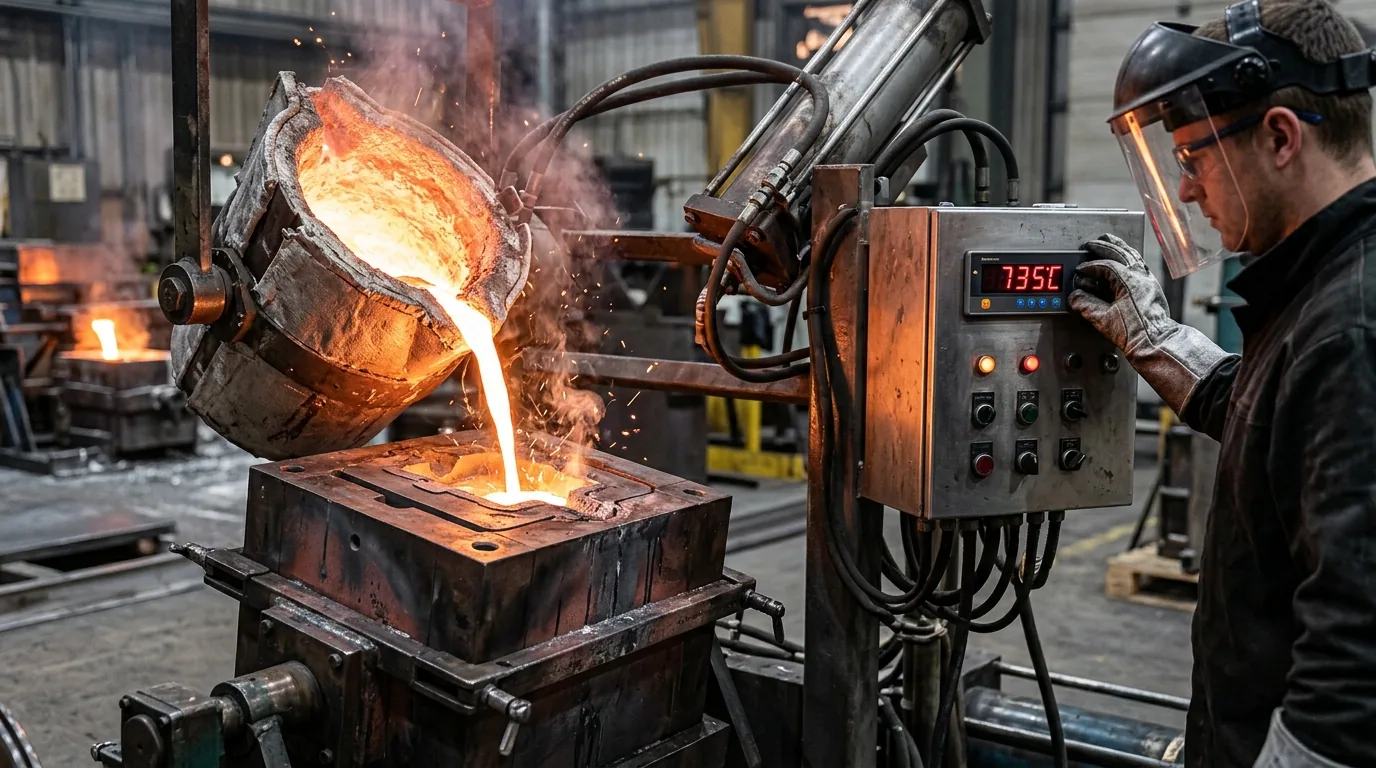
Ask whether they run tilt pouring or static pouring. Tilt pouring reduces turbulence and cuts porosity by roughly 20–30% on thin-wall parts — critical for pressure-tight housings. Static is cheaper but riskier on complex geometries. On one EV battery tray project, switching a supplier from static to tilt dropped our leak-test failure rate from 8% to under 1%.
Verify CNC finishing is in-house. Outsourced machining adds 5–10 days and a middleman margin. The alloy designations themselves are standardized — cross-check any spec sheet against the Aluminum Association registry before signing off. For regional sourcing context, see our guide to top aluminum casting regions in China.
Quality Control Systems and Certifications That Separate Top Suppliers
Direct answer: A credible China gravity casting aluminum supplier holds ISO 9001 as a baseline, IATF 16949 for automotive parts, and ISO 14001 for environmental compliance — plus in-house spectrometer chemical analysis, X-ray porosity inspection, CMM dimensional reporting, PPAP Level 3 documentation, and salt spray testing per ASTM B117. Without these, walk away.
Certifications alone mean little. We audited a Ningbo foundry in 2023 that waved a valid IATF 16949 certificate but couldn’t produce a single traceable X-ray report on brake caliper housings — scrap rate on that project hit 11.3% before we forced a CAPA. Lesson: verify the system, not the paper.
Inspection Documents to Demand With Every Shipment
- Material certificate (3.1 per EN 10204) — spectrometer readout proving AlSi7Mg0.3 or A356 chemistry within spec
- X-ray or CT porosity report — ASTM E155 Level 2 or better for pressure-tight parts
- CMM dimensional report — AQL 1.0 sampling, GD&T-referenced
- Salt spray results — 240h minimum for anodized finishes, per ASTM B117
- PPAP Level 3 packet for automotive — including FMEA and control plan
For a deeper walkthrough of on-site verification, see our China aluminum foundry audit checklist.
How to Evaluate Pricing and Total Landed Cost
Direct answer: Unit price is roughly 55-65% of your true cost. Tooling amortization, sea freight, 3.7% Section 301 tariffs on HTS 7616.99 aluminum castings (plus applicable Section 232 duties), QC inspection fees, and rework risk make up the rest. A China gravity casting aluminum supplier quoting $4.20/part can easily land at $6.80 once you account for everything.
Break every quote into five line items before comparing:
- Tooling (NRE): Permanent steel molds run $3,500-$18,000 depending on part size and cavity count. Amortize over expected volume — under 2,000 pcs/year, tooling dominates.
- Material: A356/ADC12 ingot pricing tracks the LME aluminum index. Ask suppliers to quote a base price plus an LME adjustment clause above ±5%.
- Machining & finishing: CNC post-processing often adds 30-45% to raw casting cost.
- Logistics: FOB Ningbo to US West Coast runs $1,800-$3,200 per 40HQ in 2024.
- Hidden costs: 8-12% scrap/rework reserve, PPAP documentation, third-party inspection (~$300/man-day).
In our last sourcing project for a pump housing, the “cheapest” quote was 14% higher landed than the mid-priced supplier once we factored in their 6% porosity rejection rate. Always pressure-test quotes against a detailed audit checklist before signing.
Industries and Applications Where Chinese Gravity Cast Aluminum Excels
Direct answer: Gravity casting dominates in parts that need pressure-tight walls, weldability, and T6-treatable mechanical properties — exactly where die casting’s gas porosity and sand casting’s rough surface finish fail. Seven sectors drive roughly 80% of the export volume from a typical China gravity casting aluminum supplier.
| Application | Typical Alloy | Secondary Ops | Why Gravity |
|---|---|---|---|
| Automotive wheels & brackets | A356 / A357 | T6, CNC, powder coat | Fatigue strength >240 MPa after T6 |
| LED high-bay housings | ADC12 / A356 | Anodize, thermal paint | Dense structure = better heat sink |
| EV motor end caps | A356-T6 | CNC bore, impregnation | Pressure-tight, weldable |
| Marine hardware | A444 / 535 | Hard anodize | Saltwater corrosion resistance |
| Industrial valve bodies | C443 / A356 | Hydro-test, T6 | Zero leak at 16 bar |
| Medical enclosures | A356 | Type II anodize | Biocompatible finish |
| Renewable energy (inverter, wind pitch) | A356-T6 | Conductive chromate | IP66 sealing surface |
We sourced a batch of 2,400 LED street-light housings last year from a Ningbo foundry — switching from HPDC to gravity A356-T6 dropped the internal leak-reject rate from 6.2% to 0.4% and improved LM80 thermal performance by roughly 12°C at the junction. The tooling cost more, but warranty returns paid it back in one season.
Alloy selection matters more than most buyers realize. A356 per the Aluminum Association standards is the workhorse — heat-treatable, weldable, and forgiving in complex cores. Skip ADC12 if you need T6 response; it won’t harden meaningfully. For marine work, demand alloy 535 or a 5xx-series equivalent. For a deeper look at where these foundries cluster, see our guide to China’s top aluminum casting regions.
A Step-by-Step Process to Vet and Shortlist Suppliers
Direct answer: Run every candidate through a 7-step filter — platform screening, legal verification, video audit, case-study request, paid sample, third-party inspection, and red-flag review. Expect to eliminate 70-80% of your initial list. When we last sourced an aluminum oil pan program, 14 of 18 “factories” we contacted on Alibaba turned out to be trading companies within two weeks.
- Platform filtering. On Alibaba, filter by Verified Supplier + 5+ years + Trade Assurance. On Made-in-China.com and Globalsources, prioritize “Audited Supplier” badges backed by SGS or TÜV reports you can download.
- Business license check. Request the Unified Social Credit Code and verify it on the National Enterprise Credit Information Publicity System (GSXT). Confirm registered capital ≥ RMB 5 million and business scope explicitly listing “铸造” (casting).
- Live video audit. A 45-minute walkthrough showing tilt-pour machines, spectrometer room, and X-ray booth — unscripted, flashlight on.
- Three comparable case studies. Ask for parts with similar weight, alloy (A356/ZL101A), and tolerance class.
- Paid sample order. Pay for tooling — free samples almost always signal a middleman.
- Third-party inspection. Budget USD 300-500 for an SGS or Bureau Veritas pre-shipment audit.
- Red flags. Gmail/QQ addresses, no dedicated engineering contact, refusal to share the license — walk away.
For the full audit protocol, see our 7-step factory verification guide. A disciplined vetting workflow is what separates a reliable China gravity casting aluminum supplier from an expensive lesson.
Lead Times, MOQs, and Communication Expectations When Working With China
Direct answer: Budget 4–8 weeks for permanent mold tooling, 2–3 sample approval rounds (3–5 weeks total), and 25–45 days for production. Sea freight from Ningbo or Shanghai adds another 28–35 days to the US West Coast. Total first-order timeline: typically 4–6 months from PO to dock.
MOQs are softer than buyers assume. Most gravity casting shops quote 500–2,000 pieces per SKU, but we’ve negotiated 200-piece first runs by committing to a 12-month forecast and paying a 15–20% small-batch surcharge. The mold is the real commitment — once steel is cut, the supplier wants the volume.
Payment and Milestone Structure
- 30/40/30 — 30% mold deposit, 40% on sample approval, 30% after pre-shipment inspection. Best for first orders.
- 30/70 — 30% deposit, 70% against B/L copy. Acceptable for repeat buyers with audit history.
- Never wire 100% upfront. Use trade.gov-recommended payment protections or escrow for orders above $20K.
Communication Reality
Time zone gap with EST is 12–13 hours. We schedule a standing 8:30 PM EST call (9:30 AM China) every Tuesday — one weekly touchpoint prevents 80% of the “we thought you meant…” disasters. Insist on WeChat for the engineer, not just the sales rep. A serious China gravity casting aluminum supplier will assign a bilingual project manager within 24 hours of PO.
For freight tradeoffs: sea FCL runs roughly $3,500–5,500 per 40HQ to LA; air freight is 8–12x more but cuts 25 days. Reserve air for launch samples or stockouts only. See our foundry audit checklist for milestone sign-off templates we use with suppliers.
Frequently Asked Questions About China Gravity Casting Aluminum Suppliers
Is gravity casting cheaper than die casting in China? For volumes under 20,000 parts/year, yes — tooling runs $3k–$15k versus $25k–$80k for HPDC. Above 50,000 units, die casting wins on piece price. See our breakdown on casting process trade-offs.
What alloy should we specify? A356-T6 is the workhorse — 262 MPa tensile after heat treat, excellent weldability. Use ADC12 only if the supplier pushes back hard on cost; it’s really a die casting alloy.
Can Chinese suppliers handle prototype runs? Yes — we’ve placed 50-piece rapid sand-cast prototypes that shipped in 12 days, then transitioned to permanent mold at 500+ units.
How do we protect IP? File a Chinese utility model patent (cheaper than invention patent, ~$800), sign a CNNDA (not NNN — must be enforceable under PRC law per WIPO guidance), and split tooling across two suppliers for critical parts.
Typical as-cast tolerances? ISO 8062-3 CT8–CT10, roughly ±0.3mm on a 100mm feature. Tighter needs machining.
Tariff impact? Section 301 adds 25% on most HTS 7616 aluminum castings landing in the US — budget accordingly.
Next step: Shortlist 2–3 vetted suppliers, send identical RFQs with 2D+3D files, and compare quotes line-by-line. Request your quotes this week.