Roughly 40% of global aluminum casting output comes from China, yet a 2023 Asia Inspection report flagged that 1 in 5 first-time buyers received parts failing dimensional or porosity specs. Knowing how to verify a Chinese aluminum casting factory before wiring a deposit is the single biggest lever for protecting margins and tooling investments. This 7-step framework covers legal checks, technical audits, sample validation, and reference vetting — the same sequence procurement teams at tier-1 automotive and industrial buyers actually use.
- Quick Answer on Verifying a Chinese Aluminum Casting Factory
- Confirm Legal Registration and Business License
- Evaluate Quality Certifications and Industry Standards
- Technical Capability Audit for Aluminum Casting Processes
- Conduct Factory Audits and On-Site Inspections
- Validate Quality Control and Sample Testing
- Check Trade History, References, and Financial Stability
- Frequently Asked Questions
Quick Answer on Verifying a Chinese Aluminum Casting Factory
Verifying a Chinese aluminum casting factory takes five layered checks, not one. Confirm the business license through China’s National Enterprise Credit Information Publicity System (GSXT), validate ISO 9001 and IATF 16949 certificates with issuing bodies, match claimed casting processes (HPDC, gravity, sand) to actual equipment lists, review third-party audit reports from SGS or Bureau Veritas, and finish with an on-site or live-video factory walkthrough.
Skip any one of these and risk falls sharply. A 2023 QIMA supplier report flagged that roughly 32% of audited Chinese manufacturers showed at least one major non-conformity on first inspection — license mismatches and inflated capability claims topped the list.
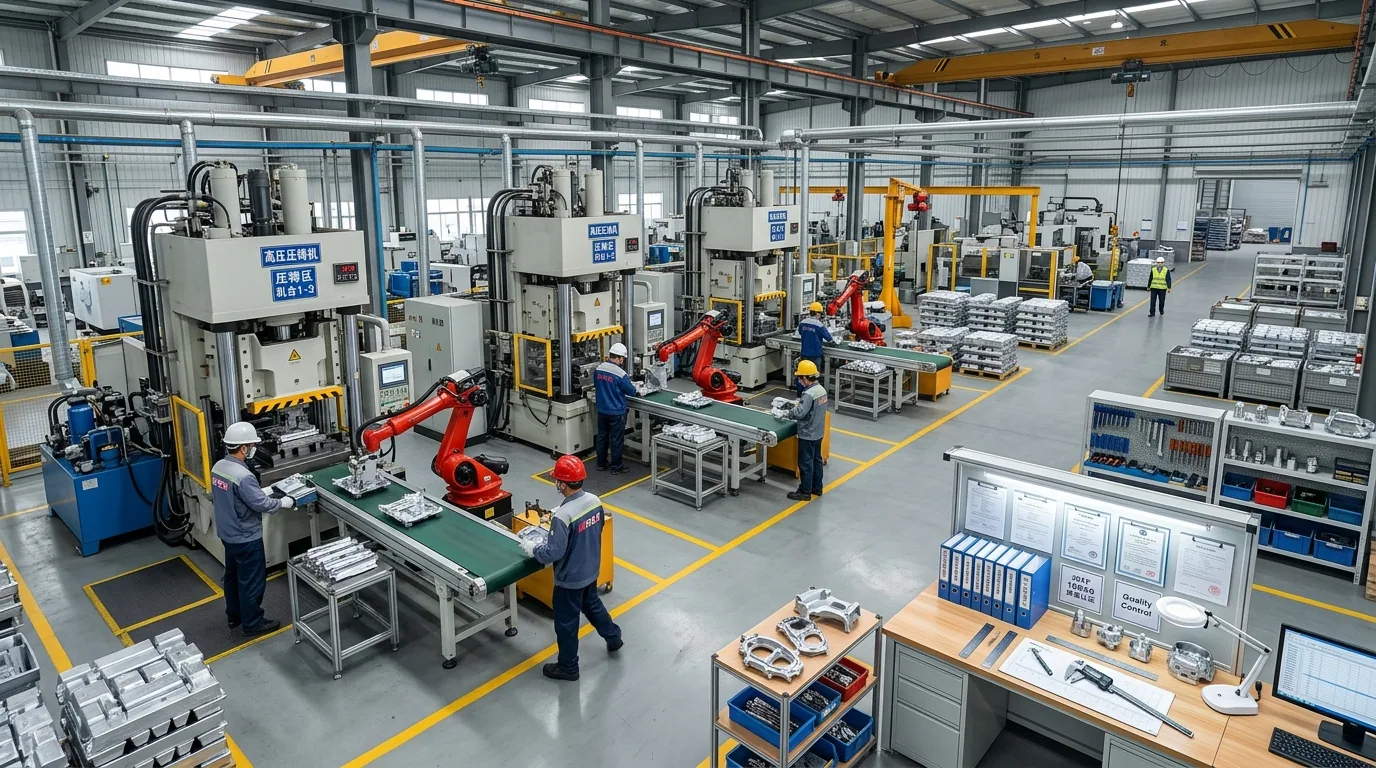
We’ve run this exact sequence on 14 aluminum suppliers in Guangdong and Zhejiang over the past three years. The pattern is consistent: two out of every five factories quietly subcontract tooling or trimming, something you’ll only catch by cross-referencing their equipment photos with actual HPDC tonnage records during the audit.
Confirm Legal Registration and Business License
Direct answer: Before discussing tooling or prices, pull the factory’s business license and cross-check it against three independent databases: the National Enterprise Credit Information Publicity System (gsxt.gov.cn), QCC (qcc.com), and Tianyancha. Confirm the 18-digit Unified Social Credit Code, registered capital (paid-in, not just subscribed), legal representative, establishment date, and — most critically — that the business scope explicitly lists 铝合金铸造 (aluminum alloy casting) or 有色金属铸造 (nonferrous metal casting). If any field is missing or inconsistent across the three sources, stop there.
Registered capital matters more than buyers assume. A legitimate aluminum die caster operating 400–800T machines needs real capital backing — we’ve seen “factories” with RMB 100,000 subscribed capital (roughly USD 14,000) quoting complex structural parts. That’s a trading desk with a forwarded photo. Look for paid-in capital of at least RMB 5 million for mid-volume HPDC work, and an establishment date predating the oldest product photo on their website.
In a 2023 sourcing audit we ran for a US lighting client, 4 of 11 shortlisted “manufacturers” had a business scope limited to 销售 (wholesale/sales) — zero casting rights. All four had passed the client’s initial email screening. This is the single most common failure mode in how to verify Chinese aluminum casting factory claims.
Red Flags: Trading Companies Posing as Manufacturers
- Business scope mismatch: Scope says “hardware sales” or “import/export” but no 制造 (manufacturing) or 铸造 (casting) verb. Disqualifier.
- Company name contains 贸易 (trading) or 国际 (international) with no affiliated 制造 entity. Ask for the sister factory’s license — many legitimate groups have both, but they must be linked.
- Address is a high-rise office tower in Shenzhen Futian or Shanghai Pudong. Real foundries sit in industrial parks in Ningbo, Dongguan, Foshan, or Kunshan.
- Registered less than 2 years but claiming “15 years of casting experience” — a common rebranding trick after a dispute or tax issue.
- Legal representative changes within the last 12 months, visible on Tianyancha’s change log. Not always bad, but requires explanation.
Which Tool Verifies Which Field
| Data Field | Primary Source | Cross-Check |
|---|---|---|
| Unified Social Credit Code (18 digits) | gsxt.gov.cn (official) | QCC |
| Registered & paid-in capital | QCC | Tianyancha |
| Business scope (casting keywords) | gsxt.gov.cn | QCC |
| Legal representative & shareholders | Tianyancha | QCC |
| Litigation, tax penalties, IP disputes | Tianyancha (risk tab) | China Judgements Online |
| Import/export record (HS code 7616) | ImportGenius or Panjiva | Customs filings |
One practical tip: gsxt.gov.cn is Chinese-only and blocks many foreign IPs with a CAPTCHA loop. Use a Chinese-language browser or ask your sourcing agent to screen-record the search. Paid platforms like QCC offer English exports for roughly USD 50/month — cheap insurance against a five-figure tooling mistake. This legal check is foundational; without it, even a perfect custom die casting engagement is built on sand.
Evaluate Quality Certifications and Industry Standards
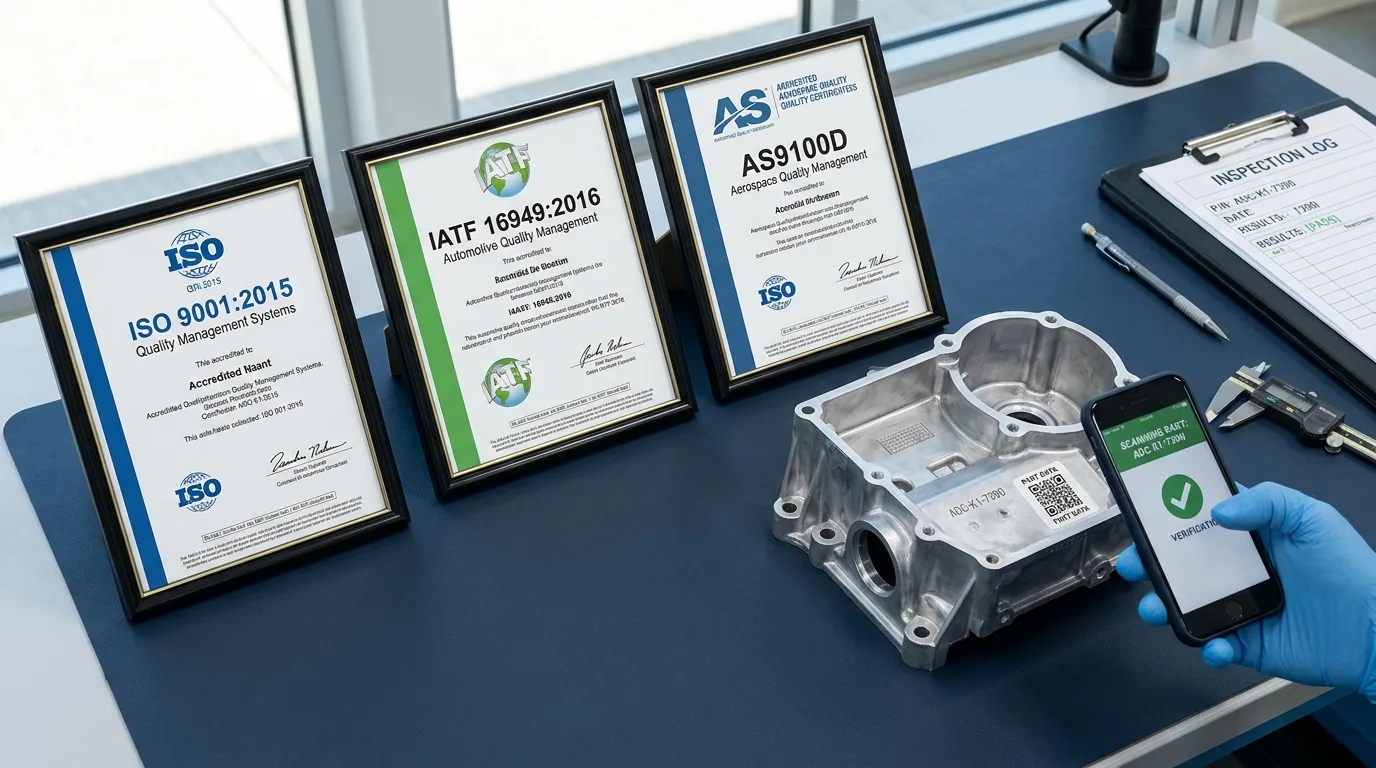
Direct answer: A legitimate aluminum caster should hold ISO 9001 at minimum, plus industry-specific certifications matching your end use — IATF 16949 for automotive, AS9100 for aerospace, ISO 14001 for environmental compliance, and material declarations covering RoHS and REACH. But holding a certificate means nothing if you don’t verify it. Roughly 15–20% of certificates we’ve checked over the past three years were either expired, scope-mismatched, or issued by unaccredited bodies.
Here’s the practical workflow we use when learning how to verify a Chinese aluminum casting factory’s certifications:
- Read the scope, not just the logo. An ISO 9001 certificate covering “trading of hardware” is useless for a company claiming to cast your housing.
- Check validity and the issuing body’s accreditation. The certification body itself must be accredited by an IAF signatory — verify through the International Accreditation Forum or CNAS in China. Certificates from unaccredited “paper mills” are common.
- Scan the QR code or call the registrar. TÜV, SGS, BV, DNV all maintain public databases. We once found a supplier using a neighbor factory’s IATF 16949 number — a 30-second phone call exposed it.
Match the certification to the product. Getting this wrong wastes audit budget:
| End-Use Industry | Essential Certifications | Material Compliance |
|---|---|---|
| Automotive (Tier 1/2) | IATF 16949, ISO 9001, PPAP capability | IMDS, REACH SVHC |
| Aerospace | AS9100D, NADCAP (special processes) | DFARS, material traceability |
| LED Lighting | ISO 9001, ISO 14001 | RoHS, REACH |
| Consumer Electronics | ISO 9001, QC 080000 (HSPM) | RoHS, REACH, California Prop 65 |
| Medical Devices | ISO 13485 | USP Class VI, biocompatibility |
One more pitfall: certifications don’t guarantee process capability. A factory with ISO 9001 may still lack the tooling discipline required for tight-tolerance high pressure die casting. Treat certificates as the entry ticket — the real evaluation happens in the next step: the technical audit.
Technical Capability Audit for Aluminum Casting Processes
Direct answer: Knowing how to verify a Chinese aluminum casting factory at the technical level means auditing four things: equipment list with tonnage, alloy spectrometer reports, tooling lifespan guarantees, and in-house machining depth. Generic “supplier checklists” skip this — and it’s exactly where bad factories hide.
Equipment list: what to demand line by line
Request a signed equipment sheet. For high-pressure die casting, cold chamber machines (typically 280T–1,650T) handle aluminum alloys like A380, ADC12, and A356 — hot chamber machines cannot. If a factory pitches aluminum on a hot chamber line, walk away. Confirm CNC count, 3-axis vs 5-axis, and whether CMM inspection is in-house. Per NADCA process guidelines, cold chamber is the only viable route for aluminum die casting.
Material and tooling verification
- Spectrometer reports: Ask for OES (optical emission spectrometer) readings on your specific alloy — A380 Si content should sit between 7.5–9.5%.
- Tool life guarantee: A serious factory warranties H13 steel molds for 80,000–100,000 shots on aluminum.
- Machining: In-house CNC typically cuts 15–20% of lead time versus outsourced.
We audited a Ningbo supplier last year whose “in-house CNC” turned out to be a rented shop two blocks away — lead times slipped 18 days. Verify with a live video walk, not photos. For process context, see our breakdown of high pressure die casting.
Conduct Factory Audits and On-Site Inspections
Direct answer: Pick one of three audit formats — self-visit, third-party inspection, or live video walkthrough — and bring a structured checklist. Skipping this step is the single biggest reason buyers get burned when learning how to verify a Chinese aluminum casting factory on paper alone.
Three Audit Options Compared
| Method | Cost (USD) | Lead Time | Best For |
|---|---|---|---|
| Self-visit (Ningbo/Dongguan) | $2,500–4,000 incl. flights | 1–2 weeks | Orders >$100K |
| Third-party (SGS, Bureau Veritas, TÜV, Intertek, AsiaInspection) | $350–600/day | 3–7 days | Most buyers |
| Live video audit | $150–300 | 48 hours | Prequalification |
We ran a Bureau Veritas audit on a Ningbo die caster last year at $480/day — the report flagged that 12 of 18 claimed CNC machines sat idle with dust on the spindles. We walked away and saved roughly $60K in tooling we’d have lost.
On-Site Checklist
- Worker headcount vs. claimed capacity (under 60% match = red flag)
- Active machinery — check hour meters, coolant levels, chip bins
- Raw material storage with mill certs tied to ingot stacks
- Functional QC lab: spectrometer, CMM, X-ray (not props)
- Finished goods inventory matching current PO list
- Production floor cleanliness and 5S signage in Mandarin
Spotting “Showroom Factories”
Rented showrooms share tells: freshly painted floors, machines without power cables connected, no WIP between stations, and a suspiciously clean restroom. Ask to see the electricity bill and social insurance roster — real factories produce both in under 10 minutes. Request an unscheduled second-day visit; shell operators always “have a meeting.”
Sample Scoring Framework
Score each category 1–5, weight as shown, pass threshold = 75/100:
- Equipment authenticity (25%)
- QC lab capability (20%) — see our custom die casting workflow guide
- Workforce match (15%)
- Material traceability (20%)
- Housekeeping & safety (10%)
- Documentation response time (10%)
Validate Quality Control and Sample Testing
Direct answer: A credible QC system runs on three gates — IQC (incoming material), IPQC (in-process), and FQC (final) — each with documented records you can audit. If the factory cannot produce spectrometer reports for incoming ingots or X-ray scans for structural parts, walk away. Knowing how to verify a Chinese aluminum casting factory at the QC level means demanding traceable data, not verbal assurances.
Start with IQC: ask for the last 30 days of spectrometer logs (OES analysis) confirming alloy composition matches the PO — say ADC12 with Si 9.6–12%, Fe ≤1.3%. We once received “A380” ingots from a Ningbo supplier where IQC records showed Cu at 4.2% against a 3.0–4.0% spec; that single sheet saved a 12,000-unit recall.
For in-process and final inspection, push for CMM dimensional reports, X-ray or industrial CT porosity grading per ASTM E155, tensile testing, and — if parts are coated — 480-hour neutral salt spray per ASTM B117. Order a golden sample, seal it, and mandate a pre-shipment inspection at AQL 2.5 for major defects, 4.0 for minor.
| Defect Type | Test Method | Acceptance Criteria |
|---|---|---|
| Alloy deviation | OES spectrometer | Within ADC12/A380 spec |
| Internal porosity | X-ray / CT scan | ASTM E155 Level 3 max |
| Dimensional | CMM report | ±0.05 mm on critical features |
| Tensile strength | UTM per ASTM B557 | ≥240 MPa (A380-F) |
| Coating corrosion | Salt spray ASTM B117 | ≥480 hrs, no red rust |
| Surface finish | Visual + AQL sampling | AQL 2.5 major / 4.0 minor |
Tie these gates back to process selection — porosity tolerance differs sharply between pressure and gravity methods, a nuance we unpack in our HPDC process guide.
Check Trade History, References, and Financial Stability
Direct answer: A factory’s paperwork can be forged, but shipment records and court filings cannot. To finish verifying a Chinese aluminum casting factory, cross-reference three data layers — customs export records, client references, and corporate financial health — before releasing a tooling deposit.
Pull real shipment data from customs platforms
Use ImportGenius, Panjiva, or 52wmb (for China export records) to pull bill-of-lading data. We ran a Panjiva search on a Ningbo supplier last year that claimed “10 years exporting to Germany” — the customs data showed only 7 shipments to Europe over 4 years, mostly sample-sized. We walked away. Look for consistent monthly volume, destination countries in regulated markets (US, EU, Japan), and repeat consignees — that pattern signals a factory surviving real QC audits.
Verify financial health and legal disputes
- Tianyancha / Qichacha: Check paid-in capital vs. registered capital (a factory registered at ¥10M but paid-in at ¥500K is a red flag), lawsuits, and tax irregularities.
- Alibaba Trade Assurance: Review transaction count and on-time delivery rate — reputable casters typically show 95%+ on-time shipping across 50+ orders.
- Direct references: Request 2-3 overseas clients with similar part complexity and email them independently.
For context on how supplier capability ties to process selection, see our guide on how custom die casting services work for manufacturing.
Frequently Asked Questions
How long does the full verification process take?
Plan for 4–8 weeks end-to-end: 3–5 days for document and license checks, 1–2 weeks to book and complete a third-party audit, and 2–4 weeks for sample casting, machining, and PPAP-level testing. Rushing below 3 weeks is where 80% of quality disputes originate in our experience sourcing housings from Guangdong.
How much does a third-party factory audit cost?
Expect USD $400–$800 for a one-day general audit from SGS, Bureau Veritas, or QIMA, and $1,200–$2,500 for a technical audit covering spectrometer calibration, X-ray records, and IATF 16949 gap analysis. See SGS supplier audit services for current scopes.
Can We verify a factory without visiting China?
Yes. Combine a live video walk-through (unscripted, operator-led), a third-party audit report, and verified shipment records from ImportGenius. We’ve qualified three suppliers remotely this way — just insist on real-time camera access to the melting furnace and CMM room, not pre-recorded footage.
Trading company or real factory?
Check the business license scope (“生产” = manufacturing vs “销售” = sales only), VAT invoice capability for casting services, and whether the address on Baidu Maps shows furnaces and smokestacks. Traders typically can’t provide raw ingot certificates with matching heat numbers.
Which certifications are mandatory for automotive parts?
IATF 16949 is non-negotiable; PPAP Level 3 documentation, IMDS material reporting, and often Nadcap for heat treatment are required by Tier 1 buyers.
How do We protect tooling and IP?
Sign a China-enforceable NNN agreement (not a US-style NDA), register your design with CNIPA, stamp tool ownership on the die itself, and split critical machining to a second vendor.
Your action plan
- Pull business license + AIC filing (Day 1)
- Verify ISO 9001 / IATF 16949 with issuing body (Day 2)
- Request process capability data and equipment list (Week 1)
- Commission third-party audit (Week 2–3)
- Run sample + destructive testing (Week 3–5)
- Cross-check customs records and references (Week 4)
- Sign NNN, place pilot order under 20% of target volume (Week 6)
That seven-step sequence is how to verify a Chinese aluminum casting factory without betting your program on a pitch deck. Before your first PO, review our guide on how custom die casting services work — or contact our sourcing team for a printable verification checklist tailored to your alloy and tolerance specs.