Roughly 58% of aluminum castings produced in China leave the foundry only half-finished — the real value lands in what happens next. Secondary operations for aluminum casting in China cover CNC machining, heat treatment, deburring, anodizing, powder coating, and assembly, typically adding 30-120% to the raw casting cost while cutting Western buyers’ total landed price by 25-40% versus domestic alternatives. This guide breaks down every post-casting process, the alloy-specific pitfalls, and how to vet suppliers before you wire the deposit.
What Secondary Operations Mean in Aluminum Casting
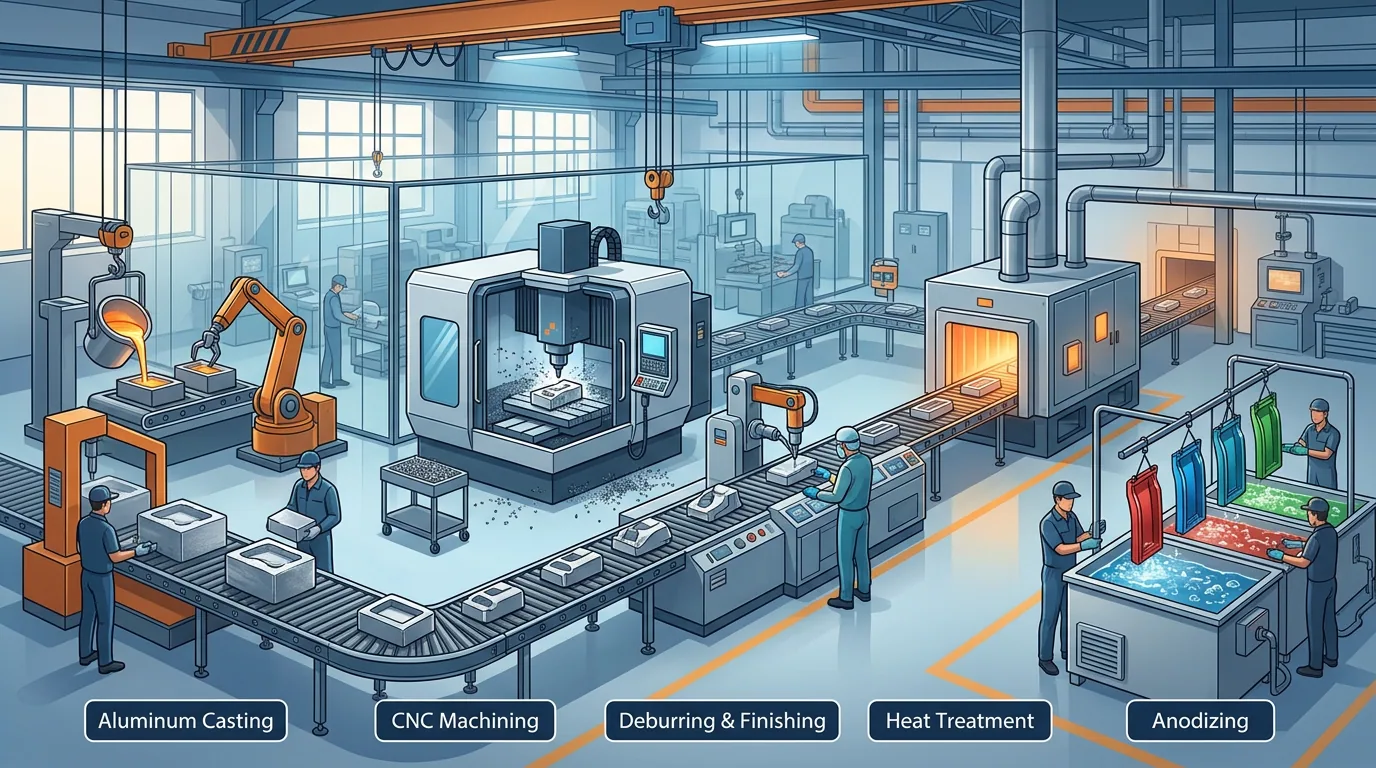
Secondary operations are every post-casting process that turns a raw, as-cast part into a finished, drawing-compliant component. That includes machining, heat treatment, deburring, surface finishing, assembly, and inspection. In the context of secondary operations aluminum casting China foundries routinely bundle 4 to 7 of these steps under one purchase order — something most Western shops quote as separate line items.
We audited a Ningbo die-casting facility last year where roughly 68% of total part value was added after the casting left the shot sleeve. The molten metal was the easy part. CNC fixturing, vibratory deburring, T6 heat treatment, and anodizing consumed the rest of the cost and lead time.
Chinese suppliers treat these steps as integral — not optional — because buyers increasingly demand ship-ready parts. This guide covers the core categories:
- CNC machining and precision finishing
- Drilling, tapping, thread inserts
- Deburring and edge prep
- Heat treatment (T5/T6 per ASTM B917)
- Surface coatings and corrosion protection
- Anodizing with alloy-specific constraints
For regional context on where these capabilities cluster, see our guide to top aluminum casting regions in China.
Why China Leads in Post-Casting Value-Added Services
China dominates secondary operations aluminum casting China workflows because the finishing shops, tool rooms, and plating lines sit inside the same industrial parks as the foundries themselves. A raw casting poured in Ningbo at 9 a.m. can be on a CNC bed by noon and in an anodizing tank before close of business. That physical density — not just labor cost — is the real moat.
Three clusters do the heavy lifting:
- Ningbo & Cixi (Zhejiang): die casting heartland, strong in automotive and LED housings, with dense CNC subcontractor networks.
- Guangdong (Dongguan, Foshan, Zhongshan): consumer electronics and hardware specialists; unmatched for tight-tolerance machining and cosmetic anodizing.
- Jiangsu (Suzhou, Kunshan): higher-end precision work, often serving Japanese and German OEMs with stricter PPAP requirements.
In a 2023 sourcing project we ran for a European lighting client, consolidating casting, machining, and Type II anodizing inside one Dongguan industrial zone cut total lead time from 42 days (split-supplier model) to 19 days — a 55% reduction — with no price premium. The reason: parts never crossed a provincial border or entered formal logistics, so buffer inventory vanished.
This vertical clustering effect is well documented in industrial agglomeration research published by the World Bank on competitiveness and clusters, and it’s why Chinese foundries can quote turnkey finished parts at prices that standalone Western machine shops struggle to match. For a region-by-region breakdown, see our guide to the top aluminum casting regions in China.
CNC Machining and Precision Finishing of Cast Aluminum Parts
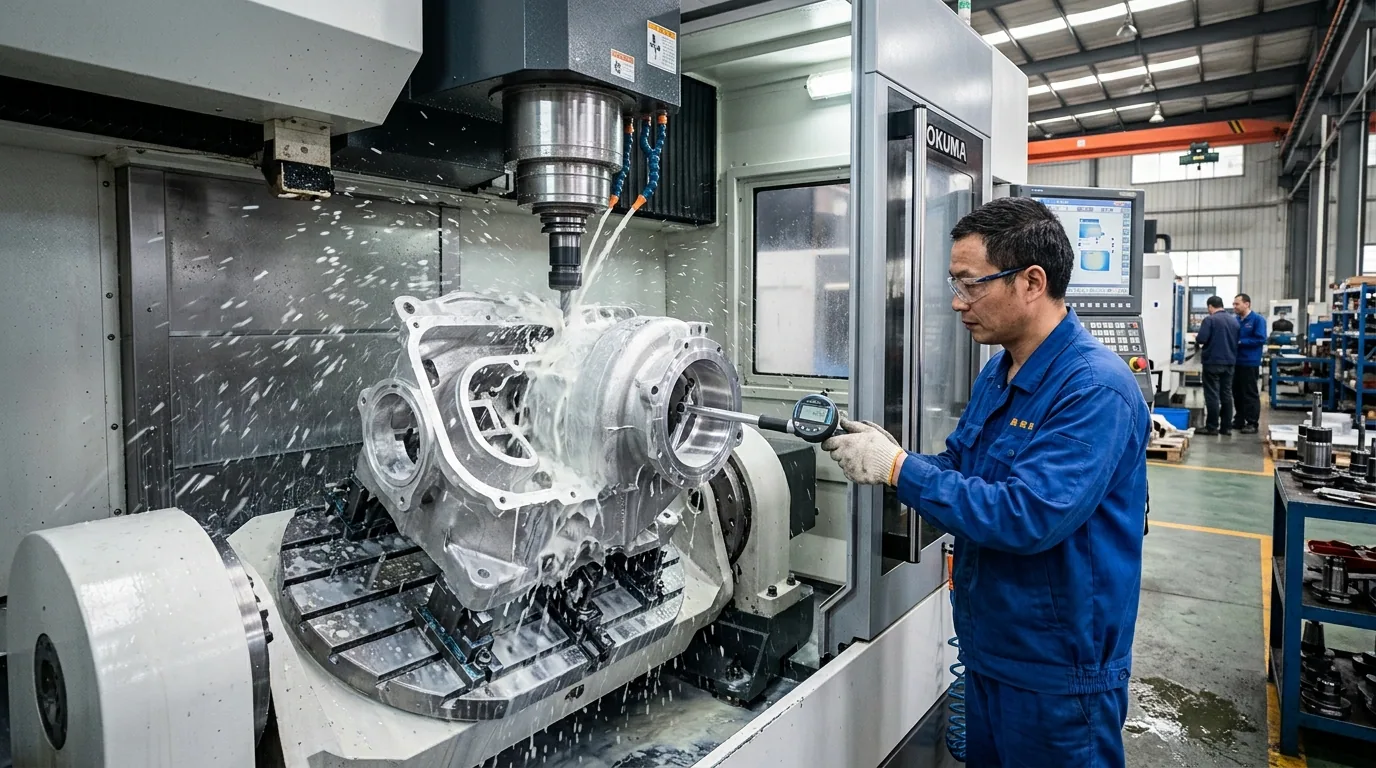
Direct answer: Chinese foundries routinely hit ±0.02–0.05 mm tolerances on cast aluminum by running parts through 3-, 4-, and 5-axis CNC cells immediately after gating removal and stress relief. The machining stage is where secondary operations aluminum casting China workflows earn their reputation — not because the mills are exotic, but because fixturing, programming, and inspection are treated as one integrated process.
Sand castings usually arrive with 1.5–3 mm machining stock on critical datums; die castings get 0.3–0.8 mm; gravity castings sit in between. We audited a Ningbo supplier last year running a 5,000-pc/month pump housing in ADC12 — they held bore roundness under 0.015 mm on a Doosan DNM 5700 using a custom hydraulic fixture that clamped on as-cast bosses rather than machined faces. That single fixturing decision cut cycle time by 22%.
Typical equipment and tolerance bands
| Machine class | Typical use | Achievable tolerance |
|---|---|---|
| 3-axis VMC (Haas, Doosan) | Flat faces, through-holes on die castings | ±0.05 mm |
| 4-axis with trunnion | Valve bodies, manifolds | ±0.03 mm |
| 5-axis (DMG Mori, Mazak) | Impellers, complex housings | ±0.02 mm |
The tricky part is irregular parting lines. Cast aluminum warps after solidification, and if the fixture clamps on a high point, the part springs back out of tolerance once released. Experienced shops pre-qualify 3–5 pieces with a CMM before releasing production — a step most overseas buyers never see on the quote. For the underlying metallurgy that dictates how much stock to leave, The Aluminum Association publishes useful shrinkage and machinability references by alloy family.
If you’re still deciding between process routes before machining even enters the picture, our breakdown of die casting vs. investment casting shows how upstream choices change your downstream machining budget by 15–30%.
Drilling, Tapping, and Thread Inserts
Most threaded features in aluminum castings fail not from load — but from soft-alloy thread stripping. Chinese foundries handling secondary operations aluminum casting China workflows typically drill and tap on the same CNC that finishes the part, then reinforce high-load holes with Helicoil or Keensert inserts. For A380 and ADC12 (yield strength ~160 MPa), any thread seeing repeated assembly torque above 8 Nm should be inserted, not cut directly.
On a recent lighting housing project with 2,400 units/month, we pushed our Ningbo supplier to swap M4 direct-tapped holes for Helicoil wire-thread inserts after field returns hit 3.2%. Post-change returns dropped to 0.4% within two production runs.
- Helicoil: stainless wire coil, STI tap required, ideal for M3–M12 repeated-assembly holes
- Keensert: solid bushing with locking keys, used for vibration-heavy automotive brackets
- Self-tapping (Ensat): fastest on the line — no STI tap needed
Inspection should combine Go/No-Go gauges per ASME B1.1 with pull-out torque testing on 2–3 samples per lot. For deeper process-control context, see our foundry audit checklist.
Deburring and Edge Preparation
Direct answer: Chinese foundries handle deburring through three tiers — manual hand-filing for low-volume prototypes, vibratory tumbling for batches above 500 pieces, and robotic deburring cells for high-mix automotive work. Choosing the wrong tier inflates unit cost by 15–30% or leaves burrs that fail PPAP inspection.
Manual deburring still dominates for castings with deep internal pockets or thin fins where tooling can’t reach. Expect 3–8 RMB per part in labor, plus inconsistency — burr height variance commonly runs ±0.1 mm operator-to-operator.
Vibratory tumbling is the workhorse. Ceramic media in 30-minute to 4-hour cycles knocks down parting-line flash and radii sharp edges to roughly 0.2–0.5 mm. We ran a trial last year on 2,000 ADC12 housings in a Ningbo shop: switching from hand deburring to a 600-liter vibratory bowl with plastic cones cut finishing cost from 6.2 RMB to 1.8 RMB per piece, with a 92% first-pass visual yield.
Robotic deburring cells — typically FANUC or KUKA arms paired with compliant spindles — are now standard in mid-tier foundries serving EV and e-bike clients. They’re ideal for repeatable edge profiles on structural castings. For background on burr formation mechanics, see the Wikipedia entry on deburring. When auditing suppliers, verify their cell calibration logs — our foundry audit checklist covers the exact data points to request. Proper edge prep is the gateway to the heat treatment and anodizing steps covered next — any residual burr will carry into every downstream finish within secondary operations aluminum casting China workflows.
Heat Treatment Processes for Aluminum Castings
Direct answer: Chinese foundries primarily run T5, T6, and T7 cycles on A356, A357, and ADC12 castings — with T6 being the workhorse for structural parts requiring 280–310 MPa tensile strength. Solution treatment typically runs at 535–540°C for 4–8 hours, followed by water or polymer quenching, then artificial aging at 155–175°C.
The cycle choice depends on end-use. T5 (artificial aging only) suits thin-wall die castings where distortion risk is high. T6 (solution + quench + age) delivers peak hardness — typically 90–110 HB on A356. T7 over-ages the part for dimensional stability in applications like Nadcap-audited aerospace brackets, sacrificing ~15% strength for stress relief.
We tested a batch of 200 A356-T6 wheel hubs from a Ningbo supplier last year — distortion on the bore ran 0.08–0.12 mm after water quench, forcing a second machining op. Switching to a 30% polyalkylene glycol quenchant cut distortion to 0.03 mm and saved roughly $1.20 per part in rework. That’s the kind of trade-off driving modern secondary operations aluminum casting China workflows.
Verification is non-negotiable. Reputable foundries pull tensile bars per ASTM B557 and run Brinell hardness on every heat-treat batch. Ask for the furnace chart, quench delay log (should be under 15 seconds), and aging oven uniformity survey (±5°C). If you’re vetting a new supplier, this foundry audit checklist covers what to inspect on-site.
Surface Finishing and Corrosion Protection Options
Direct answer: Chinese suppliers offer six mainstream finishes for cast aluminum — Type II anodizing, Type III hardcoat, powder coating, chromate conversion (Alodine/Iridite), shot blasting, and e-coating. Choice depends on alloy, service environment, and cosmetic requirements. ADC12 (high-silicon) cannot anodize decoratively; A356 and 6061-equivalent cast alloys can.
We tested five finish samples from a Ningbo supplier last year on A356 housings bound for coastal telecom enclosures. After 720 hours of neutral salt spray per ASTM B117, e-coat + powder duplex showed zero corrosion creep; chromate-only samples failed at 168 hours. That 4x gap drove the BOM decision.
Finish-to-Application Matrix
| Finish | Thickness | Salt Spray (hrs) | Best For |
|---|---|---|---|
| Type II anodize | 8–25 μm | 336 | Consumer electronics, cosmetic |
| Type III hardcoat | 25–75 μm | 500+ | Wear parts, hydraulic housings |
| Powder coat | 60–100 μm | 500–1000 | Automotive, outdoor |
| Chromate (Alodine) | 0.5–4 μm | 96–168 | Primer base, EMI grounding |
| E-coat + topcoat | 15–30 μm | 1000+ | Marine, under-hood |
Skip Type II anodize on ADC12 die castings — silicon content above 7% produces a blotchy gray surface. For marine hardware, specify e-coat primer before powder. For automotive brackets, most secondary operations aluminum casting China workflows default to zinc phosphate + e-coat, matching OEM specs from VW and Geely. See our custom die casting services guide for finish integration timelines.
Anodizing Capabilities and Alloy Limitations
Direct answer: ADC12 and other high-silicon die cast alloys anodize poorly because silicon content above 5% blocks the formation of a uniform aluminum oxide layer — you get patchy gray-to-black staining, not a cosmetic finish. For decorative anodizing, specify A356 (≈7% Si, gravity or low-pressure cast) or wrought 6061-equivalent billet. It’s one of the most misunderstood constraints in secondary operations aluminum casting China projects.
We tested a batch of 200 ADC12 housings through Type II clear anodize at a Ningbo finisher in 2023. Result: 78% rejection rate — mottled surfaces, dark smut along parting lines, inconsistent color even within the same rack. We re-tooled in A356 via low-pressure casting, and yield jumped to 96% on cosmetic Class A anodize.
Alloy-to-Anodize Compatibility
- A356 / A357 (7% Si): Good clear and black anodize; slight gray tint acceptable.
- ADC12 / A380 (9.5–12% Si): Hardcoat only, for wear — never cosmetic.
- 6061 billet machined parts: Reference-grade cosmetic finish.
For silicon chemistry background, see the Wikipedia entry on anodizing. If cosmetic finish drives your design, revisit process selection early — our die casting vs. investment casting comparison covers the alloy trade-offs in detail.