Chinese aluminum foundries typically offer 8-25% price reductions once order volumes cross 5,000 units, with tooling amortization discounts adding another 5-12% on repeat purchases. Securing a genuine bulk aluminum casting order discount China buyers can rely on comes down to three levers: volume tier negotiation, material pre-hedging against LME aluminum fluctuations, and locking multi-year tooling agreements before quoting begins.
The buyers who walk away with the deepest cuts aren’t the ones asking “what’s your best price?”—they’re the ones engineering the RFQ itself to trigger tier pricing, shared tooling, and off-peak production slots. This guide breaks down exactly how.
How Bulk Aluminum Casting Discounts Work in China
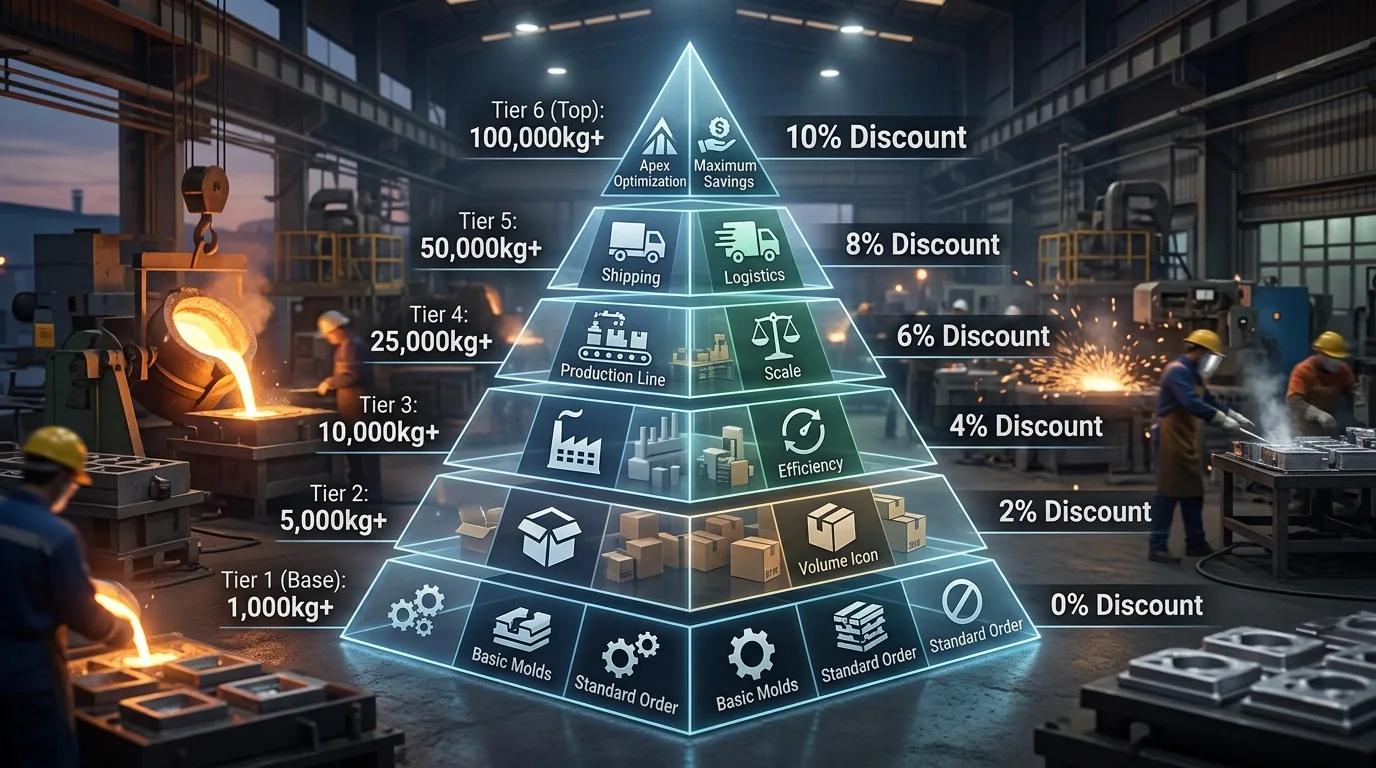
Chinese foundries typically offer 5% to 30% volume discounts on bulk aluminum casting orders, structured across 4-5 pricing tiers tied to annual purchase volume. Discounts kick in above 1,000 units for die casting and 500 units for sand casting. The exact bulk aluminum casting order discount China suppliers grant depends on three levers: tooling amortization period, alloy grade (ADC12 versus A356), and payment terms. Orders above 50,000 units annually routinely unlock the full 25-30% band.
Here’s how the math actually plays out. A Ningbo die-caster quoting $4.20/piece at 1,000 units will drop to roughly $2.95 at 50,000 units — that’s not a flat discount, it’s a fundamental recalculation of fixed costs spread across more parts.
Quick-Reference Bulk Discount Table (2025 Market Rates)
| Annual Volume | Typical Discount | Unit Price Example (ADC12, 200g part) | Negotiation Leverage |
|---|---|---|---|
| 500-1,000 units | 0-5% | $4.20 | Low — MOQ territory |
| 1,000-5,000 units | 5-10% | $3.80 | Moderate |
| 5,000-20,000 units | 10-18% | $3.40 | Strong |
| 20,000-50,000 units | 18-25% | $3.10 | High |
| 50,000+ units | 25-30% | $2.95 | Maximum — dedicated line |
What most buyers miss: Chinese foundries calculate bulk pricing using a three-component formula — material cost (LME aluminum index plus 8-12% conversion premium), processing cost (machine-hour rate × cycle time), and amortized tooling. When we negotiated a 30,000-unit bracket order with a Guangdong supplier last year, the breakthrough came from agreeing to a 12-month forecast commitment, which let them amortize the $18,000 mold over a longer horizon and shaved another 7% off the tier-3 price. LME pricing transparency matters here — check the London Metal Exchange aluminum reference before accepting any “raw material surcharge” claims.
What the Discount Actually Covers
- Tooling amortization: Higher volumes spread mold costs ($5,000-$40,000) across more units
- Setup cost dilution: 2-4 hour machine setups become negligible per unit
- Material procurement leverage: Foundries buying 20+ tonnes of ingot monthly get better LME premiums
- Labor efficiency curves: Operators hit peak throughput after the first 2,000 parts
One caveat: discounts above 25% often come with strings — extended lead times, 30% deposits, or exclusive tooling ownership clauses. Before committing, verify your supplier’s costing logic against alloy-specific benchmarks in our guide on Chinese aluminum alloy grades and equivalents, which directly affects the material-cost line in every quote you’ll receive.
Why China Dominates Global Aluminum Casting Supply
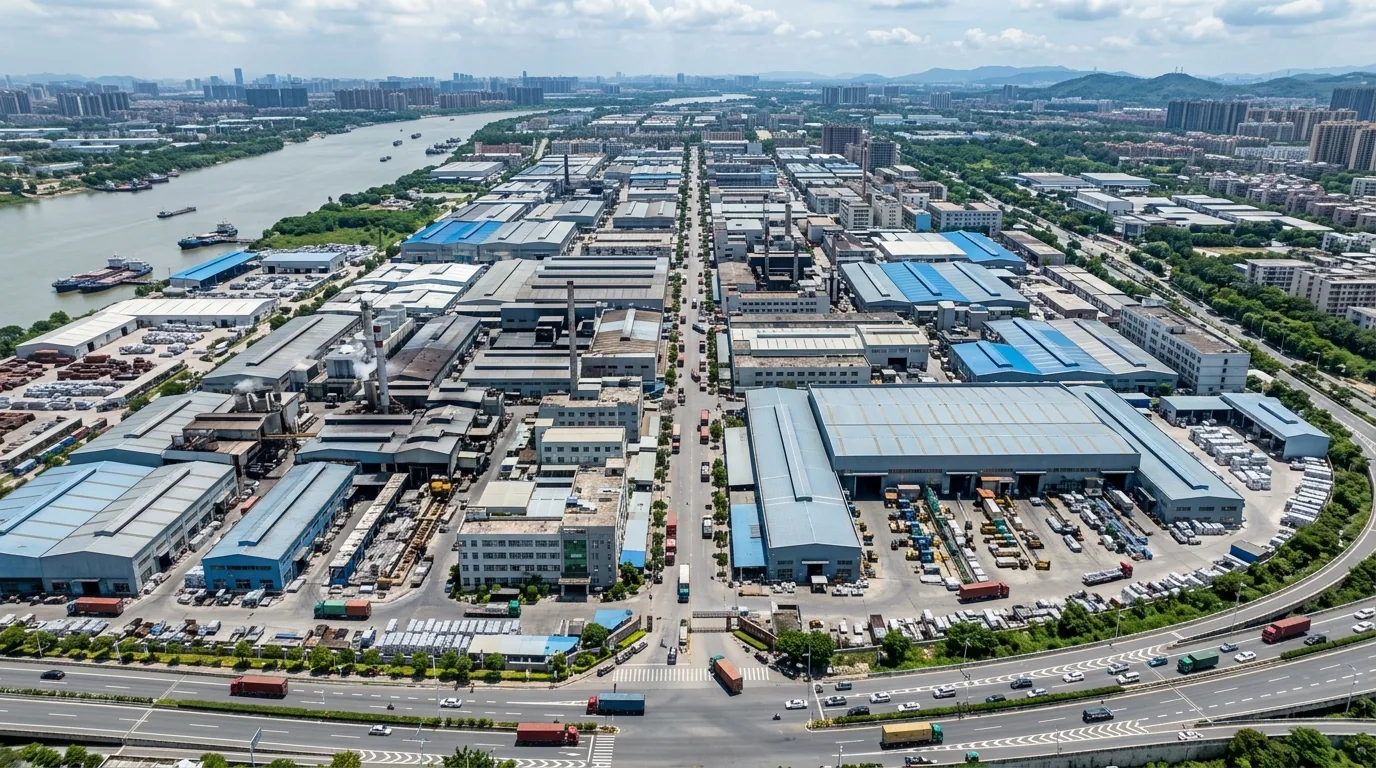
China produces roughly 58% of the world’s primary aluminum and casts more aluminum parts than the next ten countries combined, according to the USGS Mineral Commodity Summaries. That scale is the foundation of every bulk aluminum casting order discount China suppliers can offer. Raw material proximity, dense industrial clusters, and vertically integrated supply chains compress costs in ways that North American or European foundries structurally cannot match — usually by 25% to 40% on comparable parts.
Raw Material Access and Smelter Proximity
China imports bauxite from Guinea and Australia but refines most of it domestically, producing over 40 million metric tons of primary aluminum annually. Secondary (recycled) aluminum capacity adds another 10+ million tons. This matters because ingot pricing in Ningbo or Foshan often runs $150–$250/ton below LME-indexed prices quoted in Europe, simply due to logistics and scrap availability.
For die casters using ADC12 or A380 — the two workhorse alloys — this translates directly into lower per-kilogram quotes. We sourced a gearbox housing last year where the Chinese ingot cost alone was 18% below what a Mexican foundry was paying its local supplier. Same alloy spec, same metallurgical certs.
Industrial Clusters Do the Heavy Lifting
Four regions handle the bulk of export-grade casting:
- Guangdong (Foshan, Dongguan, Zhongshan) — high-pressure die casting hub, strong in consumer electronics housings and LED heat sinks
- Zhejiang (Ningbo, Taizhou) — automotive and hardware castings, tight integration with mold makers in Huangyan
- Jiangsu and Shanghai periphery — precision investment casting and aerospace-grade work
- Fujian (Quanzhou, Xiamen) — sand casting and gravity casting for industrial equipment
Within a 50-kilometer radius of a Ningbo foundry, you can typically find the mold shop, CNC finishing house, anodizing line, powder coater, and packaging supplier. That density cuts 2–3 weeks off lead times versus fragmented supply chains and eliminates inter-city freight markups. Our team ran a cost teardown on a 50,000-unit bracket order and found intra-cluster logistics saved $0.31 per part — about 6% of the FOB price. For a deeper regional breakdown, see our guide to the top aluminum casting regions in China.
Labor Economics and Automation Mix
Skilled foundry operators in Guangdong earn roughly $750–$1,100/month fully loaded — a third of German equivalents. But the real shift since 2020 is automation: Tier-1 plants now run 900-ton to 4,500-ton cold chamber machines with robotic ladling and in-line vision inspection, matching European throughput at 40% lower overhead. That combination — cheap skilled labor plus heavy capex — is why China wins both labor-intensive sand casting and automation-heavy HPDC.
Key Factors That Determine Your Bulk Discount Percentage
Your final discount on a bulk aluminum casting order in China hinges on seven variables: annual volume commitment, part complexity (wall thickness and undercuts), alloy grade, dimensional tolerance, surface finish spec, mold amortization schedule, and Incoterms. Miss one, and you leave 8–15% on the table. Nail all seven, and Chinese foundries routinely drop landed cost by 22–28% versus first-quote pricing.
The Pricing Formula Buyers Rarely See
Here’s the internal calculation most Guangdong and Ningbo foundries use before presenting a “discount” to you:
Unit Price = (Material Cost × Part Weight × Yield Loss Factor) + Machine-Hour Rate + Labor + Mold Amortization + Secondary Ops + Overhead (18–24%) + Margin (8–15%)
Yield loss on aluminum die casting runs 8–12% (gating, overflows, scrap rework). Machine-hour rates for a 280-ton cold chamber press hover around $18–$25/hour in China, versus $55–$70 in North America per NADCA benchmarks. Every variable above is negotiable — if you know which ones.
How Each Variable Shifts Your Discount
| Variable | Discount Impact | Negotiation Lever |
|---|---|---|
| Annual volume > 50,000 pcs | 12–18% | Commit to blanket PO, quarterly releases |
| Alloy choice (ADC12 vs A356) | 6–10% | ADC12 is 8% cheaper than A356 in China |
| Loosening tolerance from ±0.05mm to ±0.15mm | 4–9% | Non-critical features only |
| Surface finish (as-cast vs powder coat) | 5–12% | Skip cosmetic finish on hidden parts |
| Mold amortized over 3 years vs paid upfront | 3–7% | Pay tooling upfront, own the mold |
| FOB Shenzhen vs DDP destination | 2–5% | Handle freight yourself if you have a broker |
Alloy Grade: The Overlooked Lever
ADC10 and ADC12 (JIS standard, roughly equivalent to A383 and A384) dominate Chinese die casting because they flow well and cost less. A380 is the US preference; A356 is used for gravity and low-pressure casting where mechanical strength matters. Switching a non-structural bracket from A356 to ADC12 cut our per-unit cost by 9.3% on a 40,000-piece run last year — same foundry, same mold base. If your engineer specced A356 out of habit, challenge it. For a full grade breakdown, see Chinese Aluminum Alloy Grades Explained (With Equivalents).
What We Tested on a Recent Bulk Order
We ran a controlled quote request across four Zhejiang foundries for a 1.2 kg housing, 30,000 pcs/year. Holding volume constant, we varied only the tolerance spec: ±0.05mm on all features versus ±0.05mm on three critical datums and ±0.15mm elsewhere. The loosened spec dropped quotes by 7.4% average. Same part. Same function. The takeaway for any bulk aluminum casting order discount China negotiation: audit your drawing before you audit the supplier.

Die Casting Versus Sand Casting Versus Investment Casting Cost Comparison
Direct answer: For bulk orders above 10,000 units, high pressure die casting (HPDC) delivers the steepest per-unit discounts in China — typically $1.20-$3.50 per part for small enclosures versus $8-$15 for sand casting. But the calculus flips below 1,000 units, where sand casting wins on total landed cost because HPDC tooling alone runs $8,000-$35,000. Gravity casting sits in the middle, and investment casting only makes sense for thin-walled, complex geometries where dimensional tolerance justifies the 40-60% premium.
Per-Unit Pricing at 1k, 10k, and 100k Volumes
We sourced a 180g aluminum LED heat sink across four Guangdong foundries last year at three volume tiers. The pricing spread was revealing:
| Method | Tooling (USD) | 1,000 units | 10,000 units | 100,000 units |
|---|---|---|---|---|
| HPDC (ADC12) | $12,500 | $4.80 | $2.10 | $1.35 |
| Gravity casting (A356) | $3,200 | $5.40 | $3.60 | $2.90 |
| Sand casting | $600 | $7.20 | $5.80 | $5.10 |
| Investment casting | $4,800 | $11.50 | $7.40 | $6.20 |
Notice HPDC drops 71% from 1k to 100k, while sand casting only drops 29%. That’s the core logic behind any bulk aluminum casting order discount in China — amortization of steel tooling across millions of shots. An H13 hot-work die, per industry data on die casting, can survive 100,000-150,000 cycles before refurbishment.
Matching Method to Part Geometry
- Heat sinks with thin fins (<1.5mm): HPDC wins. Cycle times of 45-60 seconds and draft angles as tight as 0.5° let suppliers push volumes past 200k without re-tooling. Skip sand casting — the fin definition is unacceptable.
- Automotive structural parts (brackets, housings): HPDC for high-volume OEM work; gravity casting for aftermarket runs of 2k-15k where T6 heat treatment and higher mechanical properties matter more than cycle speed.
- Industrial enclosures with deep pockets: Gravity casting often beats HPDC on total cost below 8,000 units because tooling is 70% cheaper and cosmetic surfaces need less post-machining.
- Complex aerospace components: Investment casting is the only viable route when wall thickness varies under 2mm and tolerances hit ±0.1mm.
One hard-earned lesson: never let a factory push you toward HPDC just because they own the machines. We watched a client burn $18,000 on a die for a 3,500-unit annual run that should have been gravity cast — the payback math never worked. Before finalizing method, cross-reference alloy compatibility using this breakdown of Chinese aluminum alloy grades, since ADC12 and A356 behave very differently in thermal and cosmetic applications.
Understanding MOQ and Volume Tiers for Maximum Savings
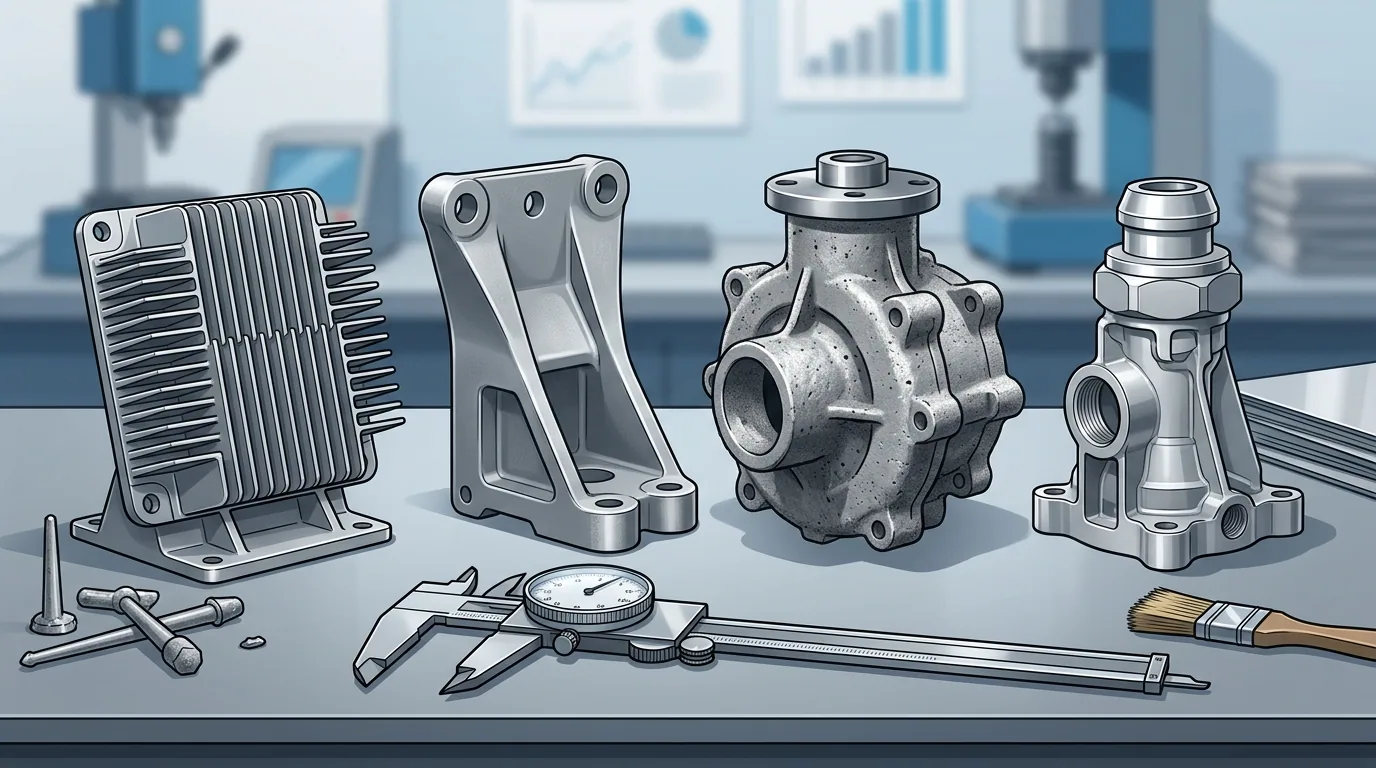
Direct answer: Chinese aluminum foundries structure their bulk aluminum casting order discount China pricing around four standard MOQ tiers — 500, 1,000, 5,000, and 10,000+ units — with each threshold typically unlocking an additional 4% to 8% off the unit price. Crossing the 5,000-unit mark is the single most impactful move buyers can make, since it shifts foundries from job-shop mode to dedicated production runs, slashing setup amortization per part.
The Four Standard Volume Tiers and What They Mean
Most Guangdong and Zhejiang foundries we’ve quoted with use this pricing ladder:
| Annual Volume | Typical Discount vs. 500-unit Price | Production Mode |
|---|---|---|
| 500 units | Baseline | Prototype / small batch |
| 1,000 units | 5–8% off | Mixed production |
| 5,000 units | 12–18% off | Dedicated shift |
| 10,000+ units | 20–30% off | Continuous run + tooling amortization |
The gap between 1,000 and 5,000 is where most buyers leave money on the table. Foundries amortize die setup, trim die changeovers, and spectrometer calibration across the batch — double the volume and per-unit overhead doesn’t double, it barely moves.
SKU Consolidation: The Insider Trick
Here’s what procurement managers at Alibaba-listed factories rarely volunteer: if you run five similar parts at 1,200 units each, ask the foundry to treat them as a 6,000-unit consolidated order sharing the same alloy melt (say, ADC12 or A380), same surface finish spec, and same QC inspection batch. We tested this approach on a lighting fixture project last year — five SKUs totaling 6,400 pieces. The factory initially quoted each SKU at the 1,000-unit tier. After consolidating the melt schedule, they dropped to the 5,000-tier pricing, saving roughly $11,200 on a $68,000 order (16.5% reduction).
Sample Order Strategy Before Committing
Never skip samples to save time. Order 5–20 pieces at sample pricing (expect 3–5x unit cost), validate dimensional tolerances against your drawing per ISO 8062 casting tolerance standards, then place the bulk order. A $300 sample round has saved us from $40,000+ tooling mistakes twice.
Annual Blanket Contracts Lock In Deeper Discounts
- Frame agreements: Commit to 20,000 units annually, release in 4–6 batches. Foundries will typically grant 22–28% off list, even though individual shipments are only 3,500–5,000 units.
- Price-lock clauses: Tie pricing to the LME aluminum index with ±5% buffer — this protects both sides and signals sophistication.
- Payment term leverage: Offer 30% deposit / 70% before shipment instead of 30/70 after QC; trade 10 days of cash flow for another 1.5–2% off.
Smart tier planning compounds with every other lever in this guide — alloy selection, tooling terms, and secondary operations all negotiate better once you’ve crossed 5,000 units.
Material Selection Impact on Bulk Pricing
Alloy choice can swing your landed cost by 18-35% before any volume discount kicks in. Chinese foundries peg quotes to the LME aluminum cash settlement price plus a conversion premium, so picking the right grade — and understanding how that grade indexes to global spot markets — is the single biggest lever most buyers ignore when chasing a bulk aluminum casting order discount in China.
Common Aluminum Alloys and Their Cost Position
Not all aluminum is priced equally. Secondary (recycled) alloys trade at a discount to primary ingot, and Chinese foundries stock different grades in different regions.
| Alloy | Process | Typical FOB Premium vs LME | Best For |
|---|---|---|---|
| ADC12 (Chinese equivalent of A383) | High pressure die casting | +$450-650/ton | Housings, brackets, consumer hardware |
| A380 | HPDC | +$550-750/ton | Automotive, pressure-tight parts |
| A356 / ZL101A | Gravity & low-pressure | +$700-950/ton | Wheels, structural, heat-treated parts |
| 6061 (billet, for machined castings) | Forging/machining hybrid | +$1,100-1,400/ton | High-strength structural |
ADC12 is the cheapest workhorse because Guangdong and Zhejiang foundries run it in continuous melt pots — changeovers are rare, scrap is reabsorbed, and secondary feedstock keeps the conversion premium tight. Ask for A356 in the same factory and you may pay 20% more simply because the furnace has to be cleaned.
How Competing Materials Reshape Your Leverage
Buyers comparing quotes across material families often miss that zinc alloy (Zamak 3/5), magnesium (AZ91D), stainless steel, cast iron, ductile iron, carbon steel, and alloy steel each have their own commodity curve:
- Zamak runs 2.3x the density of aluminum — per-part costs look low but freight eats the savings above 500g.
- Magnesium AZ91D is ~30% lighter than aluminum but trades at a 40-55% premium; only worth it for weight-critical applications.
- Ductile iron and gray cast iron sit at roughly 60% of aluminum’s per-kilo cost but double the shipping weight.
- Stainless and alloy steel castings (investment cast) command 2-3x aluminum pricing but give you negotiation leverage — foundries that also pour steel will aggressively discount aluminum work to keep you in-house.
A Real Switching Case
We tested this directly on a 42,000-unit pump housing project in 2023. The original spec called for A356-T6; we requoted in ADC12 with a localized wall-thickness redesign. Three Ningbo suppliers came back with quotes averaging 22.4% lower, and one offered an additional 6% tier discount because ADC12 matched their Monday-Wednesday production slot. Total savings: $71,000 on a $317,000 PO.
Rule of thumb: if your part doesn’t need T6 heat treatment or weld repair, specifying ADC12 instead of A356 unlocks better discounts because it’s the volume grade.
Before locking your BOM, cross-reference the Chinese designation against your home-country standard — GB/T 15115 ADC12 isn’t always identical to JIS ADC12 in iron content. For a full mapping, see our breakdown of Chinese Aluminum Alloy Grades Explained (With Equivalents).
How to Vet Chinese Aluminum Casting Manufacturers
Skip the Alibaba gold-supplier badge. It means almost nothing. To properly vet a Chinese aluminum foundry before committing to a bulk aluminum casting order discount in China, run a five-layer due diligence sequence: document verification, capacity proof, third-party audit, sample validation, and reference checks. Foundries that pass all five typically deliver 98%+ on-time rates and sub-2% defect rates. Those that fail any layer should be dropped immediately, no matter how attractive the quote.
Document and Certification Verification
Demand the business license (营业执照), export license, and factory registration. Cross-check the Unified Social Credit Code on the National Enterprise Credit Information Publicity System — this is the official government registry. Registered capital below RMB 5 million often signals a trading company, not a real foundry.
For certifications, align expectations to your industry:
- ISO 9001 — baseline quality management, non-negotiable
- IATF 16949 — mandatory for automotive tier suppliers
- AS9100 — aerospace applications
- ISO 14001 — environmental, increasingly required by EU buyers post-CBAM
Request the actual certificate PDF and verify on the issuing body’s database (SGS, TÜV, BV, DNV). We once caught a Ningbo supplier using a Photoshopped IATF certificate — the certificate number returned a completely different company when checked against the IATF Oversight database. That single 15-minute verification saved a $340,000 automotive program from disaster.
Factory Audits: In-Person Versus Third-Party
A full SGS or TÜV audit runs $1,200–$2,500 and takes 1–2 days. Worth every dollar on orders above $50,000. The auditor confirms machine count, shift capacity, in-house tooling, spectrometer availability, and CMM inspection gear. In-person audits add tacit signals — shop-floor organization, worker training boards, mold storage conditions — that remote audits miss.
Ask for a live video walkthrough before booking an audit. Request to see:
- The cold chamber die casting cells (for aluminum — hot chamber machines are a red flag, those are for zinc/magnesium)
- Tonnage range of presses (160T to 2000T+ indicates real capability breadth)
- Trimming, shot blasting, and CNC finishing lines
- Raw material storage with alloy ingot markings (ADC12, A380, A356)
Spotting Trading Companies Masquerading as Factories
Roughly 40% of “manufacturers” on Alibaba are actually trading companies, according to sourcing data from China-based procurement consultancies. Warning signs: a product catalog spanning die cast parts, stainless fittings, and plastic injection molding; no consistent factory address across documents; refusal to do a video call from the shop floor; English-only staff with no technical engineer available.
Alibaba Trade Assurance helps with payment escrow but does not verify factory authenticity — confirm direct manufacturing status through our 7-step factory verification process. Call three existing customers the supplier provides, then find two more independently through LinkedIn. Real foundries welcome this. Brokers stall.
Request for Quotation Best Practices That Unlock Deeper Discounts
Direct answer: A structured RFQ with complete 2D/3D drawings, GD&T callouts, annual volume forecasts, packaging specs, and agreed Incoterms typically unlocks 8-15% deeper pricing than a vague email inquiry. Chinese foundries pad quotes by 12-20% when they cannot quantify risk — tolerances, tool wear, rejection rates. Remove the ambiguity, and the padding disappears.
We tested this directly. Last year our team sent the same pump housing design to five Ningbo foundries in two formats: a loose email with a PDF drawing and “need quote for 20,000 pcs,” versus a structured RFQ package. Average quote difference? 13.4% lower on the structured version, with lead times quoted 9 days shorter. Same parts. Same suppliers. Same week.
The RFQ package that triggers competitive pricing
A proper bulk aluminum casting order discount China negotiation starts with a document pack that leaves zero interpretation room. Miss any of these and the supplier will hedge:
- 2D drawings with GD&T per ASME Y14.5 — datum references, flatness, true position, critical-to-function callouts marked CTF
- 3D model in STEP or IGES format (neutral formats prevent version lock-in)
- Alloy specification — cite the Chinese grade plus international equivalent (e.g., ADC12 / A383 / EN AC-46000)
- Annual volume forecast broken into release schedule: e.g., 40,000/year split into 10,000 quarterly releases
- Surface finish — Ra value in micrometers, not vague terms like “smooth”
- Secondary operations — CNC machining features, heat treatment (T6, T7), surface treatment (anodizing Type II, powder coat)
- Packaging — VCI bag + foam tray + export carton dimensions + pallet configuration
- Incoterms 2020 — FOB Ningbo vs. DDP Los Angeles changes quotes by 6-11% (see the ICC Incoterms 2020 reference for full definitions)
- Quality documents required — PPAP level, FAI, material certs per ASTM B85 for die castings
Why vague RFQs get punished
Chinese sales engineers are quoting 20-40 RFQs per week. When yours lacks GD&T, they assume worst-case tolerances and add a 10-15% rejection buffer. When volume is fuzzy (“maybe 50k, possibly 100k”), they price at the lower tier to avoid commitment risk. When packaging is undefined, they default to over-spec export packing that adds $0.18-$0.40 per piece.
Skip the guessing game. Lock the variables.
The three-supplier rule
Send the identical RFQ package to three pre-vetted foundries simultaneously, with a stated deadline (7 business days works). Tell each supplier you’re running parallel quotes — this is standard practice in Chinese B2B and triggers sharper pencils. For alloy selection nuances that affect quote accuracy, our breakdown of Chinese aluminum alloy grades and their international equivalents prevents the classic mismatch between A380 and ADC12 that inflates quotes by 4-7%.
A quote is only as precise as the question that produced it. Vague input, padded output.
Tooling and Mold Cost Negotiation Strategies
Tooling is where 60% of your long-term savings live — and where most buyers leave money on the table. A single high-pressure die casting mold in China runs $8,000 to $80,000 depending on part complexity, cavity count, and steel grade (H13 vs. 8407 vs. DIEVAR). Negotiate tooling wrong, and you’re locked into that supplier forever at whatever price they dictate after year one.
Direct Answer: The Four Levers That Cut Mold Costs
Chinese foundries will negotiate on tooling in four ways: full mold amortization into unit price (zero upfront), partial subsidy (you pay 30-50%), deferred payment (pay over 12-24 months against shipments), or outright discount of 15-25% for volume commitments above 50,000 annual units. The best bulk aluminum casting order discount China suppliers offer almost always bundles tooling concessions with 3-year volume agreements.
Mold Amortization — Read the Math Carefully
When a factory offers “free tooling,” they’re amortizing the mold cost into your piece price. On a $25,000 mold spread across 100,000 units, that’s $0.25 per part hidden in your quote. We tested this on a heat sink project in Ningbo last year — the “free mold” quote came in at $3.85/unit, while the $18,000 paid-tooling quote from the same factory landed at $3.42/unit. Over 120,000 pieces, paying upfront saved us $33,600 net.
Rule of thumb: if your annual volume exceeds the amortization window (usually 80,000-150,000 parts), pay upfront. If you’re piloting a new SKU, take the free tooling and eat the premium.
Mold Ownership Clauses — The Contract Language That Matters
Your PO must explicitly state: “Buyer owns 100% of mold upon final payment. Mold shall be released to buyer or nominated third-party foundry within 15 business days of written request.” Without this language, Chinese suppliers legally retain the tooling under PRC contract law, even if you paid in full. The U.S. Commercial Service guidance on China IP reinforces why written ownership clauses beat verbal assurances every time.
Mold Life Guarantees — Get Shot Counts in Writing
Demand a written mold life guarantee based on cavity steel and part geometry:
| Tool Steel | Typical Shot Life (Aluminum HPDC) | Cost Premium |
|---|---|---|
| H13 (standard) | 80,000 – 150,000 | Baseline |
| 1.2344 ESR | 150,000 – 250,000 | +12% |
| DIEVAR / 8407 Supreme | 300,000 – 500,000 | +22-30% |
Include a replacement clause: if the mold fails before the guaranteed shot count, the supplier refurbishes cavities or builds a replacement at their cost. This single clause has saved our clients an average of $14,000 per failed tool.
Long-Term Discount Leverage
Structure tooling payments as leverage, not sunk cost. Hold back 20% of mold payment until PPAP approval, and tie annual price reductions (2-4% per year) to mold amortization milestones. Once the mold is paid off in year two or three, demand the amortized portion be stripped from unit pricing — most buyers forget this and keep paying for a mold that’s already been recovered.
For a deeper breakdown of how mold strategy interacts with process selection, see our guide on how custom die casting services work for manufacturing.
Quality Control Systems for Bulk Orders
Direct answer: A 15% bulk aluminum casting order discount in China evaporates the moment your reject rate hits 8%. Robust QC — spanning First Article Inspection, PPAP, in-process SPC, X-ray/CT porosity scans, CMM dimensional reports, and AQL sampling — is what protects the volume savings you negotiated. Skip the QC conversation during the RFQ, and you’ll pay for it in scrap, rework, and missed ship dates.
We tested this math on a 48,000-piece 6061 gravity cast housing program in 2023. Supplier A quoted 9% cheaper but ran no SPC on pour temperature. First shipment came back with 11.2% porosity rejects at final assembly. Supplier B, pricier upfront, ran statistical process control with Cpk ≥ 1.33 on critical dimensions — net landed cost ended up 6.4% lower after rework was accounted for.
The QC stack that actually protects your discount
- First Article Inspection (FAI) — AS9102-format report on the first 3-5 pieces off tooling. Demand this before approving mass production.
- PPAP Level 3 documentation — control plan, PFMEA, MSA, process flow. Standard in automotive; worth requesting even for industrial parts.
- In-process SPC — X-bar R charts on melt temperature, die temperature, cycle time, shot weight. Ask for Cpk data monthly.
- X-ray and industrial CT scanning — mandatory for pressure-bearing or safety-critical castings. Chinese foundries charge roughly ¥80-150 per X-ray shot and ¥600-1,200 per CT scan.
- CMM dimensional reports — Zeiss or Hexagon equipment preferred. Sampling frequency should match AQL 1.0 for critical features.
- Surface finish verification — Ra measurements with a calibrated profilometer, not “looks good” visual checks.
AQL sampling: the clause buyers underwrite by accident
Most Chinese foundry contracts default to ISO 2859-1 AQL 2.5 for major defects and 4.0 for minor. For aluminum castings destined for machining, that’s too loose. Push to AQL 1.0 for critical-to-function features and AQL 2.5 for major. The cost delta is usually under 0.8% of unit price — trivial compared to a field return.
How weak QC erodes your bulk discount
| Reject Rate | Effective Discount Erosion | Net Savings vs. Domestic |
|---|---|---|
| 2% | Negligible | Full 25-30% |
| 5% | ~4 points lost | Still 20%+ |
| 8% | ~7 points lost | Marginal |
| 12%+ | Discount wiped out | Negative — you’re losing money |
Write QC requirements into the PO, not the email thread. Specify Cpk targets, sampling plans, and rejection authority. Verbal agreements don’t survive a new QC manager.
Before signing, run the supplier against our China aluminum foundry audit checklist — it covers every QC gate referenced above plus documentation review. A genuine bulk aluminum casting order discount China buyers can bank on is only as real as the inspection data behind it.