The right aluminum die casting surface finish is the cheapest one that satisfies three separate specs: an as-cast roughness the die can hold, a cosmetic class the customer will accept, and a coating system that survives the corrosion test. Buyers who confuse those three requirements pay for polishing they did not need, or accept a paint system that fails salt spray in the second year.
Key Takeaways
- As-cast HPDC surfaces land at Ra 1.6-3.2 µm from a polished die; the die texture, not the alloy, sets the baseline.
- Blasting and vibratory finishing change appearance and remove flash, but they cannot hide porosity that reaches the skin.
- Anodizing high-silicon die casting alloys such as ADC12 gives uneven color; A356 or a painted finish is usually the better answer.
- Powder coat delivers 60-120 µm of film and the best salt spray result, provided the casting is properly pretreated.
- Gloss is measured in units at 60 degrees, not described as “matte” or “shiny” on a drawing.
- Every finish should carry an acceptance metric: Ra, film thickness, adhesion class or salt spray hours.
What “Surface Finish” Actually Means on a Casting
Three different requirements travel under one phrase, and they are specified in three different units. Roughness is a micro-profile measured in micrometers. Appearance is a cosmetic class defined by what an inspector can see from a stated distance under stated light. Protection is a coating system defined by film thickness and hours of salt spray. A aluminum die casting surface finish specification that names only one of the three leaves the other two to the supplier’s habit.
Roughness is expressed as Ra, the arithmetic mean deviation of the profile. A die casting rarely needs better than Ra 1.6 µm as-cast, and asking for Ra 0.8 µm usually means polishing rather than casting, with the labor that follows. Appearance classes are usually written as A, B and C: class A is a face the end user sees in normal use, class B is seen at an angle or in a secondary position, and class C is internal or hidden. Protection is a coating stack, and its acceptance is a number of hours in a salt spray cabinet. The full range of options HKX offers sits on one surface finishes page, grouped by process family rather than by part.
Why the die sets the floor
Molten aluminum replicates the die surface almost exactly. A die polished to a mirror finish produces a part at the low end of the as-cast range; a die with a spark-eroded or bead-blasted texture produces a deliberately rougher, more uniform surface that hides flow marks. According to the North American Die Casting Association, surface texture is agreed at the tooling stage, which is why it belongs on the die drawing rather than in a finishing note added after the first samples.
What the casting process adds
Flow marks, cold shuts, die lines at the parting line, ejector pin marks and water marks from the spray cycle all appear on the as-cast skin. Some are cosmetic only. Others, such as a cold shut, indicate a filling problem that no finishing operation will remove.
As-Cast Finish: What the Die Delivers
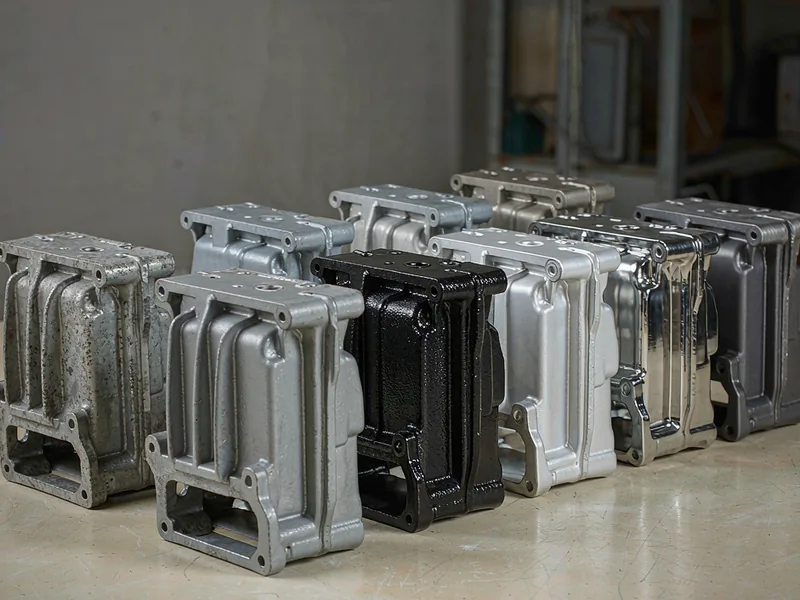
An HPDC part leaves the die at Ra 1.6-3.2 µm on the cavity side and rougher on core pins and slides. That is already smoother than sand casting and comparable to a machined surface at a much lower cost, which is why so many LED lamp housings ship with nothing more than a blast and a powder coat. The as-cast skin is also the densest part of the section, so removing it for cosmetic reasons has a metallurgical cost.
Die texture and its limits
Toolmakers texture a cavity for two reasons: to hide flow lines and to control gloss after coating. A fine bead blast on the steel gives a uniform satin part; a coarse texture gives a deliberate grain that powder coat follows. Texture is normally agreed on a standard scale, so both sides measure the same surface. What texture cannot do is remove a defect. If the fill pattern produces a cold shut at a boss, the texture simply makes it a matte cold shut.
Where as-cast is the right answer
Internal brackets, housings hidden inside an assembly and parts that will be painted anyway should stay as-cast. Specifying a cosmetic class on a face nobody sees is the most common way buyers add cost without adding value. The exception is a part whose as-cast skin must be preserved for corrosion or conductivity reasons, where blasting may be excluded on purpose. Ask for the roughness the appearance needs, then stop.
Mechanical Finishing: Blasting, Vibratory and Polishing
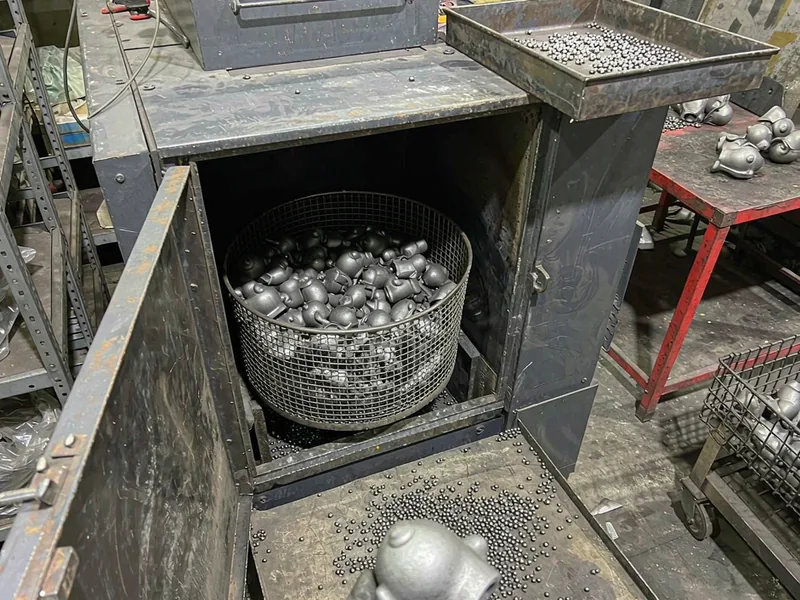
Mechanical operations change the surface by removing material or by peening it. They are the workhorses of a aluminum die casting surface finish line: fast, repeatable and cheap per part, and they remove the small amount of flash and die line that trimming leaves behind.
Shot blasting and tumble blasting
Steel shot or ceramic beads strike the surface and produce a uniform matte at Ra 2-5 µm. Blasting removes loose flash, blends die lines and prepares the surface for coating by cleaning residue and raising roughness. It also peens the skin, which closes small surface pores but does not remove internal porosity. Over-blasting rounds edges and can open pores just below the skin, so time and media size belong in the work instruction.
Vibratory finishing
Parts tumble in a ceramic or plastic media bed with a compound that keeps the media clean. Vibratory finishing deburrs edges, breaks sharp corners and reaches Ra 0.8-2.0 µm depending on media and cycle time, typically 20-45 minutes. It reaches internal edges a blast cabinet cannot, which makes it the standard choice for parts with cross-holes and machined pockets.
Polishing and buffing
Polishing cuts the profile to Ra 0.2-0.8 µm and is almost always manual. It is the only route to a decorative mirror finish on a die casting, and it exposes every near-surface pore because it removes the skin that hid them. Budget polishing as a labor operation with a defined reject rate, not as a treatment with a fixed price.
| Operation | Ra achieved | Material removed | Cost index | Best for | Watch-out |
|---|---|---|---|---|---|
| As-cast from die | 1.6-3.2 µm | None | 1 | Hidden faces, painted parts | Flow marks and die lines visible |
| Shot blast | 2.0-5.0 µm | Trace, peening | 1.2 | Uniform matte before coating | Rounds edges, can open surface pores |
| Tumble blast | 2.5-6.0 µm | Trace, peening | 1.1 | High volume small parts | Masks internal features |
| Vibratory finish | 0.8-2.0 µm | 0.02-0.05 mm | 1.5 | Deburring, edge break | Media lodging in blind holes |
| Polishing | 0.2-0.8 µm | 0.05-0.15 mm | 3.5 | Decorative mirror faces | Reveals porosity, labor intensive |
| Brushing | 0.4-1.2 µm | 0.02-0.05 mm | 2.0 | Directional grain on flat faces | Direction must be specified |
The cost index is relative to as-cast and is what most finish arguments are really about. Moving a hidden bracket from as-cast to vibratory finishing buys nothing the customer will see. Moving a visible cover from as-cast to blast plus powder coat buys a durable, uniform appearance for a modest step, which is why that pair dominates lighting and enclosure work.
Chemical and Electrochemical Finishing
Chemical routes change the surface chemistry rather than the profile, and they are where most specification mistakes happen on aluminum castings, because die casting alloys are not the alloys the anodizing literature was written for.
Anodizing and the silicon problem
ADC12 and A380 carry 7.5-12% silicon. In an anodizing bath the aluminum matrix oxidizes while the silicon particles do not, so the coating grows unevenly and the part takes a dark, mottled, sometimes chalky appearance. Thin sulfuric anodizing at 5-15 µm is possible and gives useful wear resistance, but color matching across lots is difficult and deep black is unrealistic. According to the reference on anodizing, the oxide grows from the aluminum substrate, which is why a second-phase particle interrupts it. Where a decorative anodized finish is mandatory, the design should move to a low-silicon alloy such as A356 in a low pressure or gravity process, as covered in the guide to weldable and anodizable die casting alloys.
Conversion coating
A chromate or chrome-free conversion coating adds 0.3-1 µm, converts the surface to a mixed oxide, and provides a bond layer for paint plus short-term corrosion protection. Hexavalent chromium is restricted under RoHS, so most production now uses a titanium or zirconium based chemistry. The visible result is a faint iridescent or clear film; the functional result is doubling salt spray hours under a paint film.
Electrocoating
E-coat deposits a 15-25 µm epoxy film electrophoretically, which throws into recesses and edges far better than spray. It is normally a primer under powder, and it is the reason a complex housing with internal pockets can pass a long salt spray test without manual touch-up.
Organic Coatings: Powder versus Wet Paint
Organic coatings supply the color, the gloss and most of the corrosion protection, and they are the part of an aluminum die casting surface finish specification most often written by marketing rather than engineering. The two families behave differently on a casting, and the casting’s porosity matters to both.
Powder coating
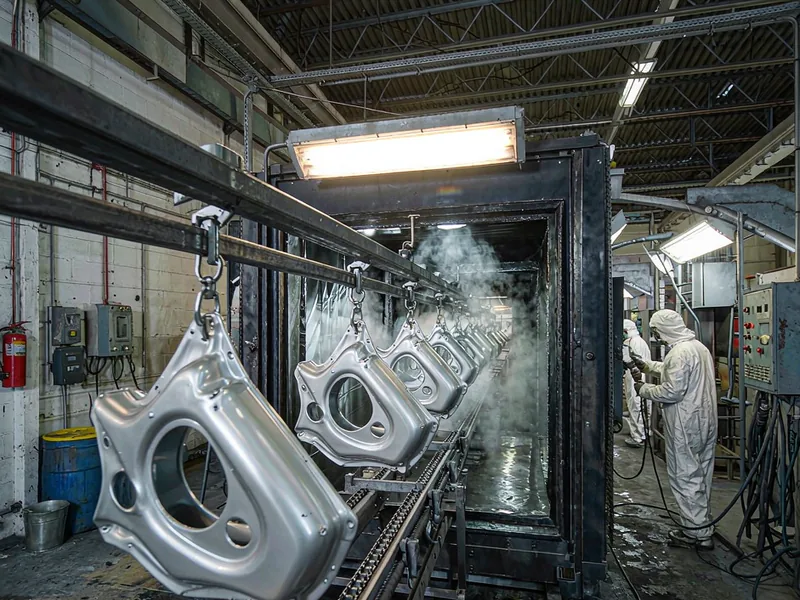
Powder is sprayed electrostatically and cured at 180-200 °C, producing a 60-120 µm film in one pass. It gives the best combination of hardness, edge coverage and salt spray hours per unit of cost, and it hides minor surface variation because the film is thick. The risk is outgassing: air and volatiles trapped in casting porosity expand during cure and blow pinholes through the film. A degassing preheat or a thicker film with a primer layer usually solves it, and the subject deserves its own treatment.
Wet paint
Liquid paint gives 20-40 µm per coat, better color control, and the ability to match a specific RAL or Pantone reference across production batches. It is thinner, so it follows the casting surface more closely and shows die lines that powder would bridge. Wet paint also requires a primer on aluminum for adhesion and corrosion, which adds a stage and a cure.
Which one wins
For outdoor lighting and enclosures, powder wins on durability and film build. For a color-critical consumer face or a low-temperature substrate, wet paint wins on matching. The decision belongs with the corrosion requirement and the appearance tolerance, not with the finishing line’s preference.
Choosing the Finish: A Decision Table with Acceptance Metrics
The useful question is not which finish looks best but which finish satisfies the service environment at the lowest total cost. That means matching the environment to a coating stack, then writing an acceptance test that a supplier can pass or fail. An aluminum die casting surface finish decision made this way is auditable, and it survives a supplier change.
Start from the environment
Indoor dry, indoor humid, outdoor sheltered, outdoor exposed and coastal or chemical are five different requirements. Indoor dry parts can stay as-cast or blasted. Outdoor exposed parts need a conversion coating plus powder. Coastal parts need a primer layer, a thicker film, and a salt spray target that reflects the chloride load. Writing “painted” against all five is how a program discovers corrosion in the field.
Then write the metric
Every aluminum die casting surface finish spec should carry at least one number. Roughness in Ra, film thickness in micrometers, adhesion as a cross-hatch class under ASTM D3359, gloss in units at 60 degrees, and corrosion as hours to red rust under neutral salt spray per ASTM B117. A drawing with those five numbers can be quoted, inspected and disputed rationally.
| Application | Recommended stack | Acceptance metric | Watch-out |
|---|---|---|---|
| Indoor bracket, hidden | As-cast, blast to clean | Visual, no loose flash | Do not specify cosmetic class |
| Indoor enclosure, visible | Blast + powder, 70-90 µm | Gloss 20-35 GU, adhesion 4B min | Outgassing pinholes on thick sections |
| Outdoor LED housing | Conversion coat + powder, 80-120 µm | 500 h NSS, no blister, adhesion 4B | Edge coverage on fin tips |
| Coastal or marine fixture | Conversion coat + e-coat + powder | 720-1,000 h NSS | Salt trap in blind holes |
| Decorative trim, color critical | Polish + wet paint with primer | Gloss 80+ GU, color within Delta E 1.0 | Die lines telegraph through thin film |
| Wear or conductivity face | Thin sulfuric anodize 5-15 µm, or bare | Coating thickness, contact resistance | Masking of threaded holes |
Note how the acceptance columns do the work. A powder coat called out as “black, matte” cannot be rejected when it arrives semi-gloss, because no number was written. A powder coat called out as “black, 70-90 µm, 20-35 GU at 60 degrees, adhesion 4B, 500 hours NSS” can be checked in ten minutes and rejected on evidence. The second version also prices more predictably, because the finishing line knows what it must hold.
Where Finishing Fails, and How HKX Controls It
Finishing defects are usually casting defects in disguise, which is why the two operations should be specified together. A aluminum die casting surface finish line inherits everything the die and the shot profile produced, and it can only hide a limited amount of it.
Blistering after cure traces back to porosity or to moisture trapped in a blind hole. Pinholes trace back to outgassing from a thick section. Adhesion loss traces back to die release agent or weak pretreatment. Color variation traces back to alloy chemistry between heats, which a spectrum check at the furnace would have caught. Each has a process cause upstream and each looks like a finishing problem at the end of the line.
At HKX, the finishing line is booked with the casting job rather than after it. A new housing starts with the cosmetic class and the salt spray target written into the process sheet, and the die texture is then chosen to suit the coating that follows: a fine bead blast for a 90 µm powder film, a polished cavity only where a wet paint topcoat has to stay thin. Parts are degreased and conversion coated in line, with bath temperature, concentration and rinse conductivity logged per shift, and film thickness checked on every rack against the drawing. Adhesion is verified by cross-hatch on a coupon from each lot, and salt spray panels are pulled at 250-hour intervals against ASTM B117. Because blasting, vibratory finishing, coating and assembly sit in the same plant, a blister found at cure can be traced back to a die location and a shot profile the same week, and the first article report ships with roughness, film build, gloss and adhesion results attached.
Frequently Asked Questions
What is the smoothest finish possible on an aluminum die casting?
Polishing reaches Ra 0.2-0.8 µm, and a mirror-polished die can deliver Ra 1.0-1.6 µm as-cast. Below that, the part stops being a casting and becomes a machined component with the labor cost to match.
Can die castings be anodized to a consistent color?
Only within limits. High-silicon alloys such as ADC12 anodize unevenly and darken, and lot-to-lot color varies with silicon morphology. For decorative color, use a low-silicon alloy in low pressure or gravity casting, or choose a painted finish instead.
Why does powder coat sometimes show pinholes?
Air and volatiles trapped in casting porosity expand at cure temperature and rupture the film. A degassing preheat before coating, a thicker film over a primer, or a casting change that reduces porosity in that section will fix it.
How many salt spray hours should I specify?
Indoor parts rarely need a test. Outdoor exposed parts typically call for 500 hours of neutral salt spray, coastal parts 720-1,000 hours, and automotive underhood parts follow the OEM specification instead. Ask for the test report.
Does blasting weaken the casting?
Blasting peens the surface and generally raises fatigue resistance at the skin. The risk is dimensional and cosmetic: an over-long cycle rounds edges and can open near-surface pores, so media size and cycle time belong in the work instruction.
Should the finish be quoted with the casting or separately?
Quote both ways. A combined price hides the finishing cost and makes it hard to compare suppliers who finish in-house against those who subcontract. Separate lines also show when a surface requirement is driving the price.
Author: HKX Engineering Team
HKX — Ningbo Hexin Mould Co., Ltd., an aluminum die casting manufacturer in Ningbo, China, with 30+ years of tooling experience, in-house machining and finishing, ISO 9001 and IATF 16949 certification, and customers in more than 20 countries.
Talk to the HKX Engineering Team
Send a drawing with the cosmetic class, the service environment and any salt spray target, and HKX will return a finish specification rather than a preference: die texture, mechanical preparation, coating stack, film thickness, gloss range and the acceptance test for each. HKX runs blasting, vibratory finishing, conversion coating, painting and assembly in-house, so the finish and the casting are quoted as one process with one owner. Buyers also receive a first article report with roughness, film thickness, adhesion and salt spray results attached. To have a aluminum die casting surface finish reviewed against your application, contact our engineering team.