Zamak 3 vs Zamak 5: Zinc Alloy Selection Guide
Choose the wrong zinc alloy and the part fails in the field — or costs more than it should. The decision between Zamak 3 vs Zamak 5 appears on almost every zinc die casting RFQ, and it is rarely as simple as picking “the stronger one.” Both alloys share the same zinc-aluminum-magnesium base, run on identical hot-chamber equipment, and take plating beautifully. The copper in Zamak 5 changes everything else: strength, hardness, ductility, aging behavior, and finishing response. This guide walks through the shared chemistry, the real property numbers, the trade-offs in finishing and long-term stability, and the selection logic we apply when a customer asks us to lock a grade before tooling starts. Both alloys pour thin, plate bright, and machine clean — the question is which trade fits your part, your loads, and your finish spec.
Key Takeaways
- Zamak 3 is the default choice for zinc die casting: best ductility, impact strength, and dimensional stability.
- Zamak 5 adds about 1% copper, lifting tensile strength roughly 15% and hardness about 10%.
- Zamak 3 plates more uniformly and holds its dimensions better over years of service.
- Zamak 5 suits brackets, handles, and gears where load or wear exceeds what Zamak 3 carries.
- Both alloys melt, machine, plate, and recycle the same way — the differences are mechanical, not logistical.
What the Two Alloys Share
Zamak 3 and Zamak 5 are both zinc-aluminum alloys standardized in ASTM B86, with aluminum near 4%, magnesium traces, and zinc as the balance. They melt around 380–390 °C, which lets foundries run them in hot chamber die casting machines. The metal sits in a heated gooseneck and shots into the die in milliseconds, giving some of the fastest cycle times in the casting industry.
That low pouring temperature buys real advantages. Die steel lasts for hundreds of thousands of shots. Wall sections can drop to 0.5 mm on small parts. Cast surfaces come out smooth enough that many components go straight from trim press to plating with no machining at all. Both alloys also fill fine detail — threads, knurls, logos — better than aluminum or magnesium can.
From a purchasing standpoint the two grades behave identically. Melting practice, scrap handling, machine setup, and secondary operations do not change between them. That is exactly why the selection deserves care: nothing in the supply chain forces the decision, so it has to come from the loads, the environment, and the finish.
Mechanical Properties Compared

The table below lists typical as-cast properties drawn from ASTM B86 data. Copper is the only meaningful chemistry difference, and it drives every mechanical row that follows.
| Property | Zamak 3 (AG40A) | Zamak 5 (AC41A) |
|---|---|---|
| Aluminum (%) | 3.7–4.3 | 3.7–4.3 |
| Copper (%) | ≤ 0.10 | 0.75–1.25 |
| Magnesium (%) | 0.02–0.05 | 0.03–0.08 |
| Tensile strength (MPa) | ~280 | ~330 |
| Yield strength (MPa) | ~210 | ~265 |
| Elongation (%) | ~10 | ~7 |
| Hardness (HB) | ~82 | ~91 |
Typical as-cast values per ASTM B86 data. Impact strength and creep behavior change with temperature, so verify against service conditions.
Read the table as a trade, not a ranking. Zamak 5 buys strength and hardness with the copper addition. Zamak 3 keeps the ductility and the stability that copper slowly takes away. Neither alloy is “better” — they are tuned for different failure modes.
Where Zamak 3 Wins
Ductility is the headline. With roughly 10% elongation, Zamak 3 bends, dents, and absorbs impact instead of cracking. Snap-fit features, latches, and anything dropped in service belong here. Impact strength stays high at room temperature and degrades less than Zamak 5 when parts see cold garages or outdoor enclosures.
Aging stability matters just as much. Zinc alloys grow and creep slowly over years, and copper accelerates that drift at room temperature. A Zamak 3 part cast today will hold its critical dimensions longer, which protects close-tolerance assemblies and sliding fits. For precision housings and anything with a press fit, that alone settles the question.
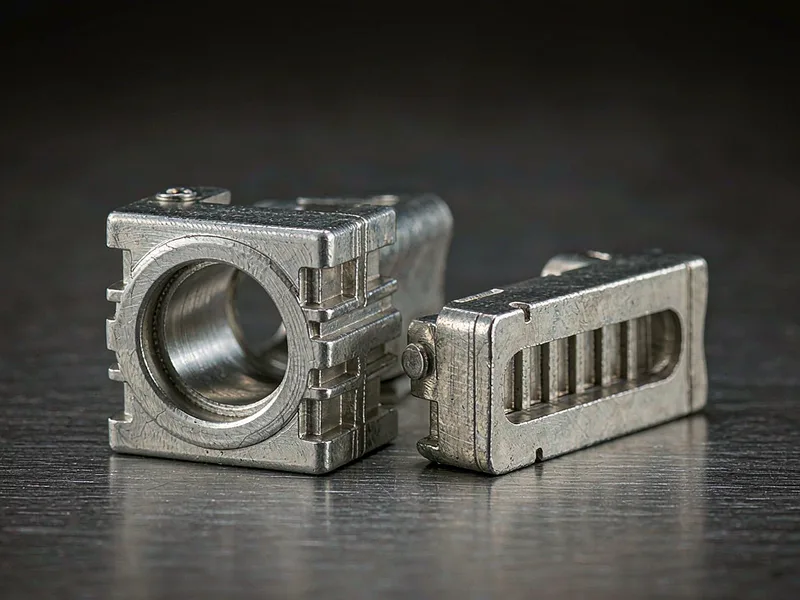
Finishing gives Zamak 3 another edge. Its copper-free surface plates with bright, uniform chrome and nickel layers, and paint adhesion stays consistent across large lots. Decorative hardware, plumbing trim, and consumer electronics skins overwhelmingly run Zamak 3 for exactly this reason.
Where Zamak 5 Wins
Strength is the case for Zamak 5. Tensile and yield numbers run about 15–25% higher, and hardness climbs to roughly 91 HB. When the part carries static load, resists thread stripping, or survives abrasive contact, that margin converts directly into smaller sections and lighter parts. A Zamak 5 bracket can be thinner than a Zamak 3 bracket doing the same job.
Creep resistance improves with copper too. Under sustained load at moderately elevated temperature, Zamak 5 relaxes more slowly than Zamak 3. Fasteners, gears, and loaded bosses hold torque longer. Keep expectations realistic, though: sustained service above roughly 100 °C is the practical ceiling for both grades, and beyond it you should be quoting a different alloy family.
Wear behavior rounds out the list. The harder surface of Zamak 5 scuffs and gall less in sliding contacts, which is why it appears in cam plates, latching mechanisms, and low-speed gearing where Zamak 3 would wear visibly within months.
Cost, Finishing, and How to Decide
Alloy price barely separates the grades — copper adds a few percent to the ingot cost, and everything downstream matches. Machine cycles, tooling, and finishing equipment are identical. Any cost difference you see on a quote usually traces to scrap allowances or plating thickness, not to the alloy itself. Decide on engineering grounds and the budget will follow.
Our working rule is simple. Start with Zamak 3 as the default. Move to Zamak 5 only when a specific feature needs its strength, hardness, or creep margin — and document which feature drove the change. When customers ask us to arbitrate Zamak 3 vs Zamak 5 on a new drawing, we stress the part on paper first, because the copper decision should follow the load path, never the habit of the last project.

Send us the drawing and the service environment. We will recommend one grade, state the reason in writing, and quote both so the trade is visible. That keeps the decision auditable when the program scales.
External Links
- North American Die Casting Association (NADCA) — industry data and design guides covering zinc alloy properties and die casting practice.
- International Organization for Standardization (ISO) — publisher of ISO 301, the ingot chemistry standard behind consistent zinc ingot supply.
- ASM International — reference handbooks for zinc casting alloy data, aging behavior, and finishing guidance.
FAQ
Which is stronger, Zamak 3 or Zamak 5?
Zamak 5. Its copper addition raises tensile strength from roughly 280 MPa to 330 MPa and hardness from about 82 HB to 91 HB. The trade is lower elongation and slightly faster dimensional drift over time.
Zamak 3 vs Zamak 5 for plated parts — which should I pick?
Zamak 3. Its copper-free surface plates brighter and more uniformly, which matters for decorative chrome and nickel finishes. Zamak 5 plates acceptably but shows more color variation across large batches.
Is Zamak 5 more expensive than Zamak 3?
Only slightly. The copper premium is small, and processing costs are identical. On a finished-part quote the difference is usually a rounding error next to finishing and volume effects.
What is the maximum service temperature for Zamak 5?
Plan for sustained service up to about 100 °C. Short excursions higher are tolerable, but long exposure above that range accelerates creep and aging. Higher-temperature needs call for ZA-8 or an aluminum alloy instead.
Can both zinc alloys hold thin walls and fine detail?
Yes. Both fill 0.5 mm walls and crisp detail equally well. Wall thickness is set by flow length and part size, not by the choice between these two grades.