Most powder coating aluminum casting failures are decided before the part reaches the booth. Adhesion depends on a clean, correctly converted aluminum surface, and pinholes depend on what the casting does when it is heated to cure temperature. Get pretreatment and outgassing right and a standard polyester powder will pass 1,000 hours of salt spray; get either wrong and the best powder on the market will peel in a season.
Key Takeaways
- Adhesion is a surface-chemistry result, not a powder brand result; a poorly pretreated casting fails within one weather cycle.
- Aluminum castings need a dedicated pretreatment line: alkaline degrease, etch, desmut for silicon, then a conversion coating.
- Chrome-free titanium or zirconium conversion coatings now match chromate for paint adhesion under a powder film.
- Pinholes are outgassing from casting porosity, and a 200-220 °C degassing bake before coating removes most of them.
- Film build of 80-120 µm covers casting texture; below 60 µm the profile telegraphs through the finish.
- Acceptance needs numbers: 4B cross-hatch adhesion, 500-1,000 hours neutral salt spray, and creep under 2 mm from a scribe.
Why Powder Fails on Aluminum Castings
Powder adheres by mechanical key plus chemical bonding to a conversion layer, and it cures into a crosslinked film. Anything that interferes with either step shows up later as a peel, a blister or a pinhole. Die castings present four specific interferences that sheet metal and extrusion do not: a cast skin with release agent on it, a silicon-rich smut after etching, internal porosity that vents on heating, and a rough surface that hides all three.
Die release agent and handling soils
Every shot carries a film of die release agent, and some of it stays on the part after trimming. Silicone-based agents are the worst case because they are designed to be non-stick. A casting that looks clean can still carry enough residue to drop adhesion from 5B to 1B, so degreasing is a chemical process with a control range, not a rinse.
Silicon smut after etching
ADC12 and A380 contain 7.5-12% silicon. An acid etch dissolves the aluminum matrix faster than the silicon phase, leaving a grey-black smut of silicon particles on the surface. That smut blocks the conversion coating from reaching the metal, and the powder then bonds to a loose layer. A desmut step, usually nitric or fluoride based, is mandatory on high-silicon die casting alloys and is often the missing stage on a line built for steel.
Porosity that vents at cure
A powder film cures at 180-200 °C part temperature. Air and moisture trapped in connected porosity expand at that temperature, travel through the melting film and rupture it, leaving a pinhole or a crater. The defect appears minutes after the part leaves the oven, which is why it is so often blamed on the powder batch rather than on the casting.
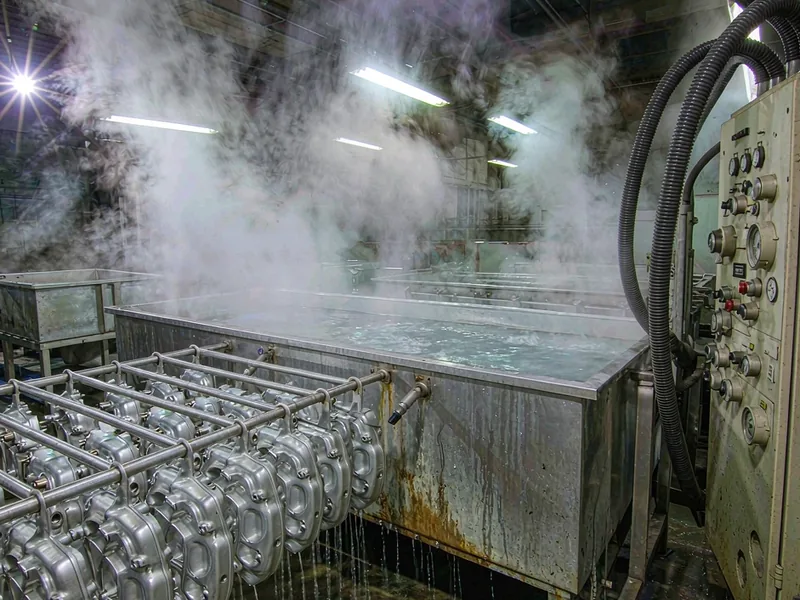
The Pretreatment Sequence, Stage by Stage
A powder coating aluminum casting line needs eight stages before the booth, and each one has a control parameter that can be logged. The ranges below are typical for a conveyor line running die cast housings at 2-6 m/min.
| Stage | Chemistry | Temperature | Time | Control parameter |
|---|---|---|---|---|
| 1 Pre-degrease | Alkaline, pH 9-11 | 50-60 °C | 2-4 min | Free alkalinity, 2-5 pt |
| 2 Degrease | Alkaline, pH 10-12 | 55-65 °C | 3-5 min | Concentration 3-6%, oil separation |
| 3 Rinse 1 | Tap water | Ambient | 30-60 s | Conductivity under 500 µS/cm |
| 4 Etch / deoxidize | Acid, pH 1.5-3 | 25-40 °C | 1-3 min | 1-3 µm removal, dissolved aluminum |
| 5 Desmut | Nitric or fluoride based | Ambient | 30-90 s | No visible smut after rinse |
| 6 Conversion coat | Ti / Zr, chrome-free | 25-40 °C | 45-90 s | pH 3.5-4.5, coat weight 20-60 mg/m² |
| 7 DI rinse | Deionized water | Ambient | 20-40 s | Conductivity under 30 µS/cm |
| 8 Dry-off | Hot air oven | 80-120 °C | 8-12 min | Part fully dry, no water spots |
The stages that get skipped
Desmut and DI rinse are the two most often omitted when a line is stretched for capacity. Skipping desmut leaves silicon on the surface and produces a coating that looks right and fails adhesion after humidity. Skipping the DI rinse leaves tap-water salts that bloom under the film in salt spray. Both defects appear 200 hours into a test, long after the parts have shipped.
Why two rinses, not one
The first rinse after the alkaline stage carries drag-out, and its purpose is to remove most of the cleaner before the etch. The second rinse protects the conversion bath from acid carry-over. A single rinse tries to do both jobs and contaminates both baths, which shows up as a conversion coating weight that drifts down through the shift.
Racking and jig design
A powder coating aluminum casting job is only as good as its rack. Parts need to hang so that solution drains from every pocket, because a puddle of cleaner left in a blind hole becomes a pinhole or a blister at cure. Contact points should sit on a non-visible face and carry enough spring pressure to maintain the electrical ground the corona gun needs. Racks are stripped on a schedule, since a build-up of cured powder insulates the contact and causes uneven film. The wider range of options, from blasting to anodizing, is grouped on the surface finishes page for comparison.
Conversion Coating: Chrome-Free versus Chromate
The conversion coating is the bond layer, typically 20-60 mg/m² of coating weight, and it is the stage where aluminum differs most from steel. Chromate conversion coatings based on hexavalent chromium gave excellent adhesion and self-healing corrosion protection, and they are now restricted in most markets because of hexavalent chromium toxicity. The replacement chemistries are trivalent chromium and titanium or zirconium-based films.
What the chrome-free film does well
A Ti/Zr film gives a consistent bond layer, works at near-neutral pH, and produces less sludge than chromate. Under a 90 µm polyester powder, a properly applied Ti/Zr coating supports 720-1,000 hours of neutral salt spray on an aluminum casting, which covers most outdoor enclosure specifications. It also keeps the part conductive enough for grounding in many designs, unlike a thick anodized layer.
Where it needs help
Chrome-free films are thinner and less self-healing than chromate, so scribe creep is the weak point. On a coastal or marine part, a primer layer or an e-coat under the powder is the practical answer, and the specification should say so. Buyers who compare pretreatment quotes often find the difference is exactly this: one supplier includes a primer, the other relies on the conversion coat alone.
Why the aluminum surface matters at all
Aluminum forms a natural oxide within minutes of leaving a rinse, and that oxide is stable, thin and electrically insulating. A conversion coating displaces part of it and grows a film that the powder can bond to chemically, which is why the window between the last rinse and the dry-off oven matters. The corrosion behavior of the base alloy also sets the ceiling on what any coating can achieve, as covered in the guide to how cast aluminum alloys corrode. A copper-bearing alloy in a wet chloride environment will always be the harder substrate, and the specification for powder coating aluminum casting parts should reflect that with a thicker film or a primer.
Reading a pretreatment certificate
Ask for the conversion coating weight, the bath pH and the rinse conductivity from the production shift, not just a pass certificate. Those three numbers tell you whether the line was in control when your parts went through, and they are the first thing to review when an adhesion complaint arrives.
Outgassing and Pinholes: Process Fixes That Work
In powder coating aluminum casting work, outgassing is the most common cosmetic complaint and the one with the clearest set of countermeasures. Each option trades cost against the size and location of the porosity, and the right choice depends on how visible the surface is.
Degassing bake before pretreatment
Baking the casting at 200-220 °C for 20-40 minutes before coating drives off moisture and lets surface-connected porosity vent while there is no film to damage. It adds a process step and a handling move, and it is the most effective single fix. On thick sections, the bake also needs enough soak time for the core to reach temperature.
Film build and primer
A thicker film bridges small pores more reliably than a thin one, which is why 80-120 µm is the practical range for castings against 60-80 µm on sheet. A powder primer applied first, partially cured, then covered with a topcoat, gives two chances to seal a pore and is the standard approach on visible Class A faces.
Lower cure, hotter part control
Cure schedules are usually written as a metal temperature and a hold time, not an oven setting. Running the oven hotter to increase line speed raises the part temperature overshoot and makes outgassing worse. A low-temperature cure powder that fully crosslinks at 170 °C part temperature reduces the driving force for venting without sacrificing chemical resistance.
Thick sections need a longer soak
A 12 mm boss takes far longer to reach 200 °C than a 2.5 mm wall, and the gas inside it arrives at the surface later. That is why pinholes cluster on thick sections and at rib junctions, the same locations where shrinkage porosity forms. Extending the degassing soak until the heaviest section is at temperature, verified with a contact probe rather than a timer, removes more of the problem than raising the set point. On a part with both thin walls and a heavy boss, the bake schedule should be written against the boss.
Powder Selection and Application
The powder has to match the environment, and the gun settings have to match the geometry. A powder coating aluminum casting job with deep pockets and tall fins needs different application settings from a flat cover, and the difference is measurable in film thickness distribution.
Chemistry by environment
Polyester with TGIC or a TGIC-free polyester urethane is the default for outdoor parts because it resists ultraviolet light. Epoxy gives better chemical resistance and hardness but chalks in sunlight, so it belongs indoors or under a topcoat. Fluoropolymer powders such as PVDF hold color for decades on architectural work and require a primer plus a higher cure temperature.
Corona versus tribo, and the Faraday effect
Corona guns are fast and forgiving on flat faces. Inside a recess, the electric field is shielded and powder deposition drops, which is the Faraday cage effect. Reducing voltage, increasing gun distance or switching to a tribo gun that charges powder by friction improves coverage in pockets and around fin roots. On a cast housing with internal ribs, film thickness inside the pocket can otherwise fall below 40 µm and fail salt spray at the worst possible place.
Film thickness targets
Measure on the part, not on a flat coupon. Specify 80-120 µm on visible faces, 60 µm minimum in recesses, and check fin tips and edges where the film thins. A coating thickness gauge with the correct probe for aluminum, calibrated against a shim on the same substrate, is the only way to settle a film argument.
Recovered powder and batch control
Reclaim is normal in a booth with good extraction, and it is also where color and chemistry drift enters a powder coating aluminum casting program. Recovered powder picks up fines, and fines charge differently, so the ratio of virgin to reclaim needs a limit, commonly 20-30%. A booth that runs reclaim without that limit produces film that looks right and cures slightly differently from batch to batch, which shows up as gloss variation on the same part number. According to the reference on powder coating, the process relies on electrostatic charging of dry particles, which explains why fines and moisture change deposition before they change appearance.
Adhesion and Corrosion Testing: What to Write on the Drawing
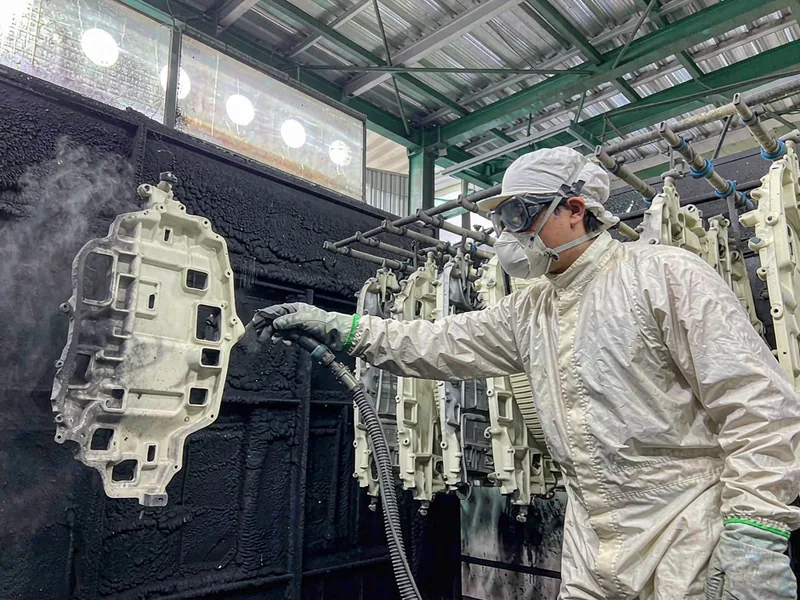
For powder coating aluminum casting programs, a coating specification without test methods is only a preference. The tests below catch the failures described earlier, and together they take less than a day on a first article.
| Test | Standard | Method | Typical acceptance |
|---|---|---|---|
| Cross-hatch adhesion | ASTM D3359, method B | 6 cuts each way, tape pull | 4B minimum, 5B on visible faces |
| Cross-cut | ISO 2409 | Lattice cut, brush | Class 0-1 |
| Impact resistance | ASTM D2794 | Direct, 2 kg from 50 cm | No cracking or detachment |
| Neutral salt spray | ASTM B117 | 5% NaCl, 35 °C, scribed panel | 500 h outdoor, 1,000 h coastal, creep under 2 mm |
| Humidity | ASTM D2247 | 100% RH, 38 °C | 500 h, no blister or loss of adhesion |
| Solvent rub | ASTM D5402 | MEK double rub | 50 rubs, no softening |
The scribe is the honest test
Unscribed salt spray flatters every coating. A scribed panel exposes the failure mode that matters in service: how far corrosion creeps sideways from a scratch or a damaged edge. Specify scribe creep, measured in millimeters from the line, and photograph the panel at 250-hour intervals so both sides are looking at the same evidence.
At HKX, powder coating runs on the same site as the casting, which changes how a defect gets resolved. A housing destined for a coastal installation is quoted with a Ti/Zr conversion coat, a degassing bake and 100-120 µm of polyester, and the pretreatment stage is booked with the casting order rather than after it. Bath temperature, pH and rinse conductivity are logged each shift, coat weight is checked on a coupon per rack, and cure is verified with a datalogger on the part rather than an oven dial, with the schedule written against the heaviest section. Adhesion is tested by cross-hatch on every lot against ASTM D3359, and salt spray panels are pulled at 250-hour intervals against ASTM B117 until the specified hours are reached. When a blister appears, the record identifies whether it came from a die location or a rinse tank, and the report ships with the parts.
Frequently Asked Questions
Why does powder coating peel off aluminum castings?
Almost always because the conversion coating did not form on clean metal. Release agent, silicon smut or tap-water salts sit between the aluminum and the film, and the powder bonds to that layer instead. A cross-hatch test on a production coupon finds it before the parts ship.
Can I powder coat over casting porosity?
Yes, within limits. Small dispersed porosity is covered by an 80-120 µm film, especially with a degassing bake first. A cluster of connected pores in a visible face will still blow through, and that is a casting fix, not a coating fix.
Do I need a primer under powder on a casting?
For indoor parts, no. For coastal, marine or automotive underhood service, a primer or e-coat under the topcoat is the reliable way to reach 720-1,000 hours of salt spray, because it adds a second barrier at the scribe where chrome-free films are weakest.
How thick should powder be on a die casting?
80-120 µm on visible faces and at least 60 µm in recesses. Thinner films telegraph the casting texture and lose corrosion resistance; much thicker films chip at edges and can crack on impact.
Is chrome-free pretreatment as good as chromate?
For adhesion under powder, yes. For scribe creep in severe service it is slightly weaker, which is why the primer layer exists. Chromate remains the performance reference, and it is restricted in most markets for toxicity reasons.
How long does a powder coated casting last outdoors?
A polyester powder over a proper conversion coat typically holds color and gloss for 5-10 years in a temperate climate, and longer with a fluoropolymer topcoat. Coastal exposure shortens that unless the film build and primer are increased.
Author: HKX Engineering Team
HKX — Ningbo Hexin Mould Co., Ltd., an aluminum die casting manufacturer in Ningbo, China, with 30+ years of tooling experience, in-house machining and finishing, ISO 9001 and IATF 16949 certification, and customers in more than 20 countries.
Talk to the HKX Engineering Team
Send the drawing with the service environment and any salt spray target, and HKX will return a coating specification with the pretreatment stages, conversion coating weight, film build and test methods written out, so the requirement can be quoted and inspected rather than assumed. Outdoor housings such as explosion proof lamp housings are quoted with the degassing bake and the primer decision included. The first article report carries cross-hatch results, film thickness maps and salt spray photographs. For a powder coating aluminum casting review before the next order, contact our engineering team.