Does Aluminum Rust? Corrosion Behavior of Cast Alloys
Does aluminum rust? Not the way iron does, and that distinction matters for every cast part you specify. Rust is iron oxide, and it flakes off, exposing fresh metal to more damage. Aluminum behaves differently. It reacts with oxygen at once and builds a thin oxide skin. That skin seals the surface and slows further attack. So an aluminum die casting does not rot away the way a steel bracket does. But no rust does not mean no corrosion. Aluminum can still pit, stain, and fail in the wrong environment. This guide explains what really happens, how cast alloys differ from pure aluminum, and how to protect parts in service. Knowing this distinction changes how you specify finishes, materials, and inspections for cast parts.
Key Takeaways
- Aluminum does not rust because rust is iron oxide; aluminum forms a clear, protective oxide instead.
- The natural oxide layer is only a few nanometers thick, yet it rebuilds itself within seconds when scratched.
- Cast alloys with copper, like ADC12 and A380, resist corrosion less than low-copper grades such as A360.
- Chlorides, strong acids, and strong alkalis are the real threats, not ordinary air or rain.
- Anodizing, powder coating, and chromate conversion add a durable barrier where bare oxide is not enough.
Why Aluminum Does Not Rust Like Iron
Rust is a specific compound: hydrated iron oxide. It forms a loose, flaky crust that falls away and leaves bare metal behind. That cycle repeats until the steel is gone. Aluminum never follows that path.
When aluminum meets oxygen, it forms aluminum oxide almost instantly. That layer is hard, thin, and tightly bonded. It does not flake. If you scratch it, a new layer forms in seconds. This self-repair is why aluminum is called passive.
The word rust still trips people up. The question does aluminum rust gets asked on almost every new project we quote. The accurate answer is no. Aluminum corrodes, but it does not rust in the iron sense.
Metals like iron and steel need paint or plating to survive outdoors. Aluminum often needs neither. That is why bare aluminum railings and window frames last for decades with no finish at all. The oxide does the work, and it never stops renewing itself.
Does Aluminum Rust or Just Corrode?
Corrosion is the broad term, and aluminum is not immune to it. The difference is speed and shape. Instead of a uniform, spreading crust, aluminum tends to corrode at small spots. Those spots are called pits.
Pitting starts when the oxide layer breaks down in one place. Chlorides do this well. Road salt, sea spray, and coastal air all carry chloride ions that punch through the protective skin. Once a pit opens, it can deepen while the surface around it stays bright.
That contrast fools people. A part can look clean and still hide deep pits. For load-bearing castings, pitting matters because it concentrates stress and can start a crack. It is the main corrosion mode to design against.

How Cast Alloys Change the Picture
Pure aluminum resists corrosion well, but almost no casting uses pure aluminum. Foundries add silicon, copper, magnesium, and iron to reach strength and castability. Each addition shifts corrosion behavior.
Copper is the biggest factor. It raises strength and hardness, which is why ADC12 and A380 rely on it. That same copper seeds tiny galvanic cells in wet service. The result is faster pitting and a lower tolerance for chloride exposure.
Low-copper and copper-free grades behave much better outdoors. A360, A365, and A514 trade a little strength for real gains in wet and salt environments. If a part will see weather, that trade is usually worth it.
Silicon is mostly neutral, though high-silicon alloys can show a slightly rougher oxide. Iron helps the die but lowers ductility, so keep it near the low end of the window when corrosion matters.
Zinc and tin also lower performance when they creep above spec. Both stay in the alloy only in small amounts for a reason. A tight chemistry window is not just about strength; it protects corrosion resistance too.
Corrosion Types That Do Attack Aluminum
Four modes cover most real failures. Pitting is the common one. Galvanic corrosion appears when aluminum touches a more noble metal in a wet joint. Crevice corrosion hides in trapped gaps. Alkaline or acidic attack dissolves the oxide outright.
Galvanic risk deserves special care in castings, because parts often bolt to steel. In any electrolyte, aluminum becomes the anode and gives up metal to protect the steel. The fix is simple but easy to skip: isolate the joint with a coating, a gasket, or a non-conductive fastener.
Crevice corrosion is easy to overlook because it hides. Water trapped under a gasket, a bolt head, or a labeling sticker keeps oxygen away from the metal. That low-oxygen pocket becomes an anode while the open surface stays a cathode. The gap corrodes fast while the rest of the part looks fine.
| Environment | Corrosion risk | Protection needed |
|---|---|---|
| Dry indoor air | Very low | None |
| Occasional fresh water | Low | Optional coating |
| Coastal salt air | High | Coating plus regular washing |
| Road salt splash | High | Powder coat and steel isolation |
| Strong alkaline cleaner, pH above 9 | Severe | Avoid; use neutral cleaners |
| Acidic solution, pH below 4 | Severe | Barrier coating or different alloy |
| High-copper ADC12 in wet service | Elevated | Switch to low-copper alloy |
Note how the risk jumps with chemistry and contact, not with time alone. A dry indoor casting can last decades with no protection. The same part beside a salty road may pit within a few seasons.
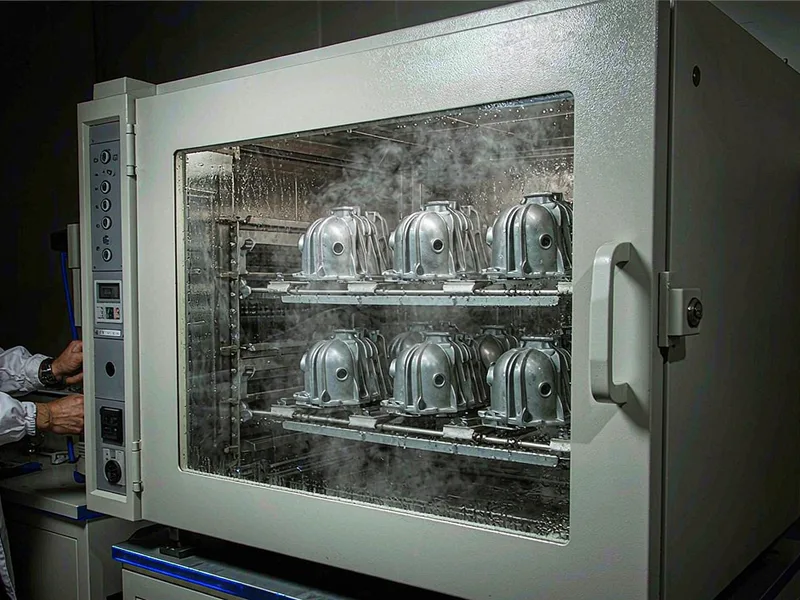
How to Protect Cast Aluminum Parts
Protection starts at material selection. Match the alloy to the environment first. Choose a low-copper grade for wet, salt, or outdoor duty. Keep copper-bearing alloys for dry, protected service.
Next, add a barrier when the oxide is not enough. Anodizing thickens the natural layer and adds real hardness. Powder coating seals the surface and takes color. Chromate conversion gives a conductive, corrosion-resistant base for painted parts.
Finally, control contact and drainage. Avoid trapping water in pockets. Isolate aluminum from steel, stainless, and copper with washers or coatings. Wash salt off exposed surfaces on a schedule. These steps cost little and remove the conditions that start most corrosion failures.
Design also plays a role. Give pockets a drain path so water cannot sit. Round edges so coatings cover them fully. Specify a coating thickness and test it, because a thin spot is where corrosion starts.
External Links
- ASTM B85 — the US specification for aluminum-alloy die castings, listing the copper-bearing grades that drive corrosion behavior.
- ASM International — publishes corrosion handbooks and alloy data that explain how each element shifts performance.
- International Organization for Standardization (ISO) — source of ISO corrosion and coating standards used across global supply chains.
FAQ
Does aluminum rust in water?
No, it does not rust. Aluminum forms a protective oxide layer instead. In fresh water the layer holds up well, so corrosion is slow. In salt water, chlorides break the layer down and pitting becomes a real risk.
Does aluminum rust in salt air?
It still does not rust, but salt air is the toughest common environment for cast aluminum. Chlorides drive pitting, and copper-bearing alloys suffer more. Choose a low-copper grade and add a coating for coastal service.
Why does some aluminum turn white or black?
White powder is aluminum oxide buildup from mild corrosion. Dark or black staining often comes from copper in the alloy or from contact with steel in wet conditions. Both are surface effects, not rust.
Is cast aluminum more corrosion resistant than steel?
Usually yes. Aluminum builds a stable, self-healing oxide, while steel rusts and flakes. Aluminum can still pit in chlorides, and it loses in galvanic contact with steel, so isolation and coatings still matter.
Can anodizing stop aluminum corrosion?
Anodizing greatly improves protection by thickening the oxide layer. On high-copper casting alloys the finish looks dark and uneven, so use a low-copper grade for anodized parts. Powder coating is often a better fit for castings.