A straight aluminum casting process comparison answers three questions before it discusses anything else: how thin the wall is, how many parts you need per year, and whether the part must hold pressure or take a full heat treatment. High-pressure die casting (HPDC) wins on thin walls, tight tolerances and volume. Low-pressure die casting (LPDC) wins on density, pressure tightness and heat-treatable strength. Gravity casting wins on large, thick-walled parts at low volume. Everything else in this guide is detail hung on that frame.
Key Takeaways
- HPDC holds 1.5-4 mm walls, roughly ±0.1-0.25 mm tolerances and 60-120 second cycles, and becomes the lowest piece route above about 10,000 parts a year.
- LPDC fills from below at 0.2-0.6 bar, delivering denser metal and full T6 capability that conventional HPDC cannot match.
- Gravity casting needs 3 mm walls and looser tolerances, but carries the smallest tooling commitment and feeds thick sections best.
- HPDC traps gas during the shot; solution treating a standard HPDC part usually causes surface blisters, so a T6 requirement is often a process decision, not an alloy decision.
- Leak tightness is designed in, not inspected in. If a housing must pass a pressure decay test, the process choice sets most of your scrap rate before the first shot.
- Choose the process before you ask for quotation. A quote built on the wrong process is not a cheap quote, it is a re-quote six weeks later.
The Three Routes in Plain Terms
Every aluminum casting route moves liquid metal into a steel or sand cavity. The difference is how hard the metal is pushed, and that single variable drives wall thickness, internal soundness, tooling life and cycle time.
High-pressure die casting
Molten aluminum is ladled into a shot sleeve and driven into a hardened steel die at 30-80 m/s gate speed and 500-1,200 bar intensification pressure. The die is water cooled, the part ejects in seconds, and the same cavity repeats thousands of times a day. Thin walls fill before the metal freezes, which is why HPDC can hold a 1.5 mm rib that no other route can cast reliably.
Low-pressure die casting
LPDC keeps a sealed furnace under the die and pushes metal upward through a riser tube at 0.2-0.6 bar. Fill is calm and bottom-up, so oxide skins stay in the riser instead of the part, and the metal stays connected to a liquid reservoir while it solidifies. That feeding path is what makes LPDC parts pressure tight and heat treatable.
Gravity casting
Gravity casting, including permanent mold and sand casting, lets metal fall into the cavity under its own weight. Fill speed is low, tooling is simple, and almost any wall thickness can be poured. The trade is dimensional control, surface finish and labor per part.
The Comparison Table Buyers Actually Need
Most public aluminum casting process comparison tables list the same four rows and stop. The rows below are the ones that change a purchasing decision, because each one maps to a line item in your total cost.
| Criterion | HPDC | LPDC | Gravity (permanent mold) |
|---|---|---|---|
| Practical minimum wall | 1.5 mm (2.0 mm for long runs) | 3.0-4.0 mm | 3.0 mm cast, 4-5 mm typical |
| Linear tolerance (ISO 8062) | CT5-CT6 on small features | CT6-CT7 | CT7-CT9 |
| As-cast surface | Ra 1.6-3.2 µm | Ra 3.2-6.3 µm | Ra 6.3-12.5 µm |
| Cycle time | 60-120 s | 4-10 min | 5-20 min |
| Tooling life | 80,000-150,000 shots (H13) | 100,000+ pours (cast iron) | 50,000-100,000 pours |
| Economic annual volume | 10,000+ parts | 2,000-50,000 parts | 200-10,000 parts |
| T6 heat treatment | Not standard (blister risk) | Yes | Yes |
| Pressure tightness | Needs vacuum or impregnation | Inherent | Good with riser design |
| Typical added machining | 0.3-0.5 mm stock | 1.0-2.0 mm stock | 1.5-3.0 mm stock |
Read the last three rows together and the economics become obvious. A process that holds tighter tolerances removes machining passes; a process that needs 3 mm of stock adds them back. Two suppliers can quote the same drawing and land 30% apart simply because one priced HPDC and the other priced gravity.
Volume and Tooling Decide More Than Geometry
Tooling is a fixed cost that has to be repaid part by part. This is where most first-time buyers misjudge the decision: they send a 500-part annual requirement to a high-pressure die caster, receive a piece price inflated by die amortization, and conclude that HPDC is expensive. It is not expensive at that volume. It is simply the wrong route for that volume. Any aluminum casting process comparison that stops at cycle time makes the same mistake.
The break-even shape
An HPDC die for a mid-size housing represents a large fixed commitment and a very low marginal cost per shot. Gravity tooling is the opposite: modest fixed cost, high labor and low output per hour. Plotted against annual volume, the two curves cross somewhere between 3,000 and 10,000 parts. Below the crossing point, gravity or LPDC wins on landed piece cost. Above it, HPDC wins by a margin that widens every year the program runs, because the die is already paid for.
Volume is rarely flat
Model year two and year three, not just year one. A part that doubles in the second year justifies a die that looks expensive today. A part that ships 800 units once and never again does not. LPDC sits between the two and absorbs the awkward middle: programs that need real mechanical properties but cannot fund a full HPDC die and cell.

Where Each Route Fails Downstream
Every process has a characteristic failure mode, and in an aluminum casting process comparison the failure mode matters more than the headline capability. Failures show up after machining, after coating, or at the customer’s leak test station, which is the most expensive place to find them.
HPDC: trapped gas
The same high-speed fill that makes thin walls possible also folds air into the cavity. Some of it escapes through vents, the rest stays as gas porosity. Machine the surface and the pores open; run the part through a cure oven or a paint line and the gas expands and blisters the skin. Vacuum assistance and squeeze pins reduce the problem, but they raise tooling cost and cycle time. According to the North American Die Casting Association, porosity control remains the defining process variable for structural die castings.
LPDC: slow and shape-limited
Calm filling gives density, but the riser must stay liquid until the part freezes, which limits how thin and how intricate the geometry can be. Sharp internal corners and long 2 mm ribs are hard to fill. LPDC also needs the part to be designed around a feeding direction, so draft and riser placement constrain the shape earlier in the design cycle.
Gravity: tolerance drift
Gravity castings move. Solidification shrinkage, mold coat wear and manual pouring variation all show up in dimensional spread, which is why ISO 8062-3 assigns them coarser CT grades than pressure routes. Budget the extra stock and the extra machining pass, or the first article inspection will send you back to the drawing.
How HKX Runs a Process Selection Review
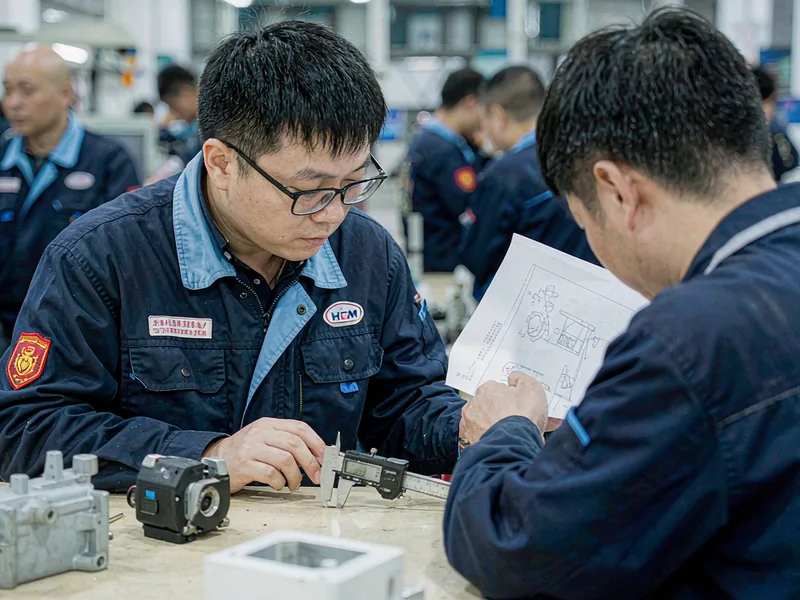
At HKX, process selection happens before quotation, and it is a structured review rather than a gut call. A customer drawing arrives with a nominal wall, a tolerance block and often no stated process. The engineering team at the Ningbo plant works through five checks in sequence, and any one of them can override the others.
The first check is a wall thickness scan. HKX engineers map the thinnest section of the part against projected flow length. If the ratio falls outside what a 30-80 m/s gate can fill before freeze, the part is not an HPDC part no matter what the customer assumed. The second check is volume, because a tooling investment has to amortize against a real annual requirement and a realistic program life. The third check is the sealing requirement: if the drawing calls for a pressure decay or helium test, the review moves toward LPDC or toward vacuum-assisted HPDC with a documented porosity acceptance level.
The fourth check is thermal. If the drawing specifies T6, HKX reviews whether the geometry can be fed from a riser and whether the customer will accept the added stock for the machining that follows. Standard HPDC parts are supplied in F or T5 temper; solution treating them is where blister complaints originate. The fifth check is the downstream chain: machining stock, coating compatibility, and assembly datum. A housing that needs a 0.05 mm bearing bore will be machined anyway, which changes the tolerance argument and sometimes shifts the decision back toward a cheaper casting route.
That review produces a one-page process recommendation with the assumptions written down: alloy, wall, CT grade, porosity acceptance, stock allowance and inspection plan. Buyers get it before they get a number, so the number means something.
A Five-Question Decision Sequence
Buyers do not need a metallurgy degree to narrow the field. Run these five questions in order; the answer usually collapses to one route by question three.
- What is the thinnest functional wall? Below 2.5 mm, gravity casting is out. Below 1.8 mm, only HPDC can fill it reliably.
- What is the honest annual volume, including year two? Under 3,000 parts, gravity is usually the commercial answer. Between 3,000 and 10,000, LPDC often fits. Above 10,000, HPDC takes over.
- Must the part hold air or fluid without impregnation? If yes, LPDC leads. Vacuum HPDC can qualify, but only with an agreed porosity acceptance criterion and a validated leak test.
- Does the part need T6 or T7 properties? If yes, HPDC is excluded unless the design uses a vacuum or pore-free variant. LPDC and gravity both accept full heat treatment.
- How much machining follows the casting? Heavy machining reduces the value of tight as-cast tolerances. Light machining raises it, and can push the decision toward HPDC even at moderate volume.
Two further considerations belong in the same conversation but rarely change the route: cosmetic class and coating. A visible Class A surface with a powder coat topcoat is easier on HPDC because the as-cast skin is already fine. A part that will be anodized for color match is harder, because the silicon-rich die casting alloys respond unevenly to anodizing.
Matching the Route to Product Families
The same aluminum casting process comparison plays out differently across product families, and there are recognizable patterns.
| Part type | Recommended route | Why it wins | Watch-out |
|---|---|---|---|
| Motor end cover, 1.8 mm wall, high volume | HPDC, vacuum optional | Fastest cycle at thin wall, stable bore position | Gas porosity on the ejector side; keep critical bores out of the last-fill zone |
| Cylinder head, T6, pressure tested | LPDC | Riser feeding gives density and heat-treatable strength | Longer cycle; riser yield reduces material efficiency |
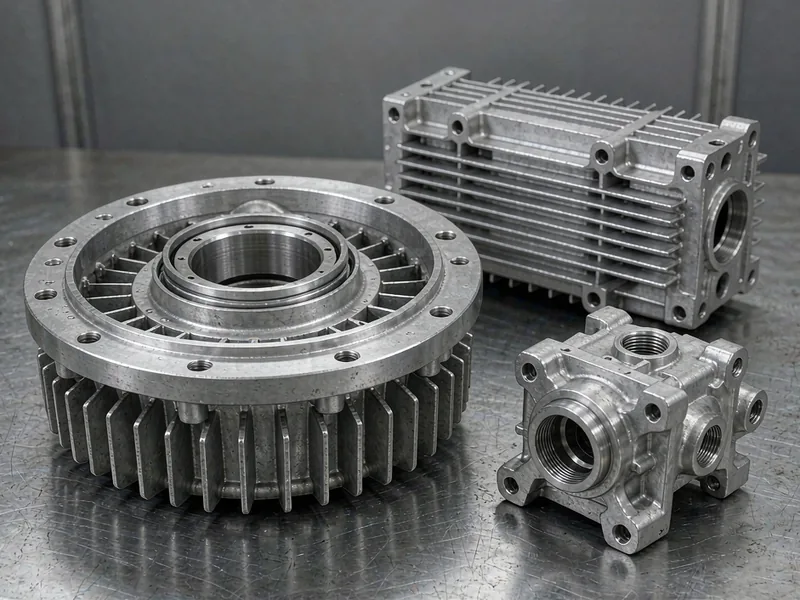
| LED housing with heat-sink fins | HPDC | Fin geometry only fills at high gate speed | Fin tips fill last; vent them or accept short fins |
| Valve body, helium leak test | LPDC or gravity | Pressure tightness designed in, not inspected in | Wall should be 4 mm or more for reliable feeding |
| Gearbox housing, 8 mm walls, low volume | Gravity, permanent mold | Modest tooling, thick sections feed well | Loose tolerances; budget machining stock |
| Fatigue-loaded structural bracket | LPDC with T6 | Dense microstructure plus full heat treatment | Needs a written radiographic acceptance criterion |
Automotive housings and covers
Motor end covers, clutch covers, throttle bodies and oil pump housings are classic HPDC parts: thin walls, high volume, tight bore positions and a need for dimensional repeatability across hundreds of thousands of units. HKX produces aluminum motor end covers on cold chamber machines in the 160-2,500 t range, with the bearing bore and the mounting face finished in-house.
Lighting and outdoor enclosures
LED housings and street lamp heads combine a cosmetic face with a thermal requirement. HPDC gives the surface finish and the wall control, while the heat sink geometry is designed into the casting rather than bolted on. The same logic applies across the lighting die casting range.
Pressure-tight and load-bearing parts
Valve bodies, pump housings and structural brackets that see fatigue loading belong in LPDC or gravity, with a heat treatment and a documented radiographic acceptance level. For these parts the casting route is a safety decision, not a cost decision, and should be recorded that way in the specification.
Large, thick-walled industrial parts
Machine bases, gearbox housings and large brackets rarely justify a die. Gravity casting with a permanent mold or a sand mold keeps tooling modest and handles 10 mm sections without internal shrinkage voids.
Writing an RFQ That Produces Comparable Quotes
A useful aluminum casting process comparison ends with a quotation you can audit. Five foundries quoting the same drawing can return prices spread across a wide band, and in most cases the spread is process mismatch rather than commercial strategy. An RFQ that forces the process onto the table collapses that spread.
State the required process, or explicitly invite the supplier to recommend one with justification. Include the drawing with GD&T, the alloy designation (ADC12, A380 or A356, for example, as defined in ASTM B85/B85M), annual volume and order frequency, the machining plan, the surface and coating requirement, any pressure test specification, the applicable certification regime, an acceptable porosity standard, tooling ownership, and the first article documentation you expect.
Two items buyers routinely leave out are the porosity acceptance standard and tooling ownership. Both should be in writing before the first payment, because both become disputes later. If the drawing is silent on porosity, ask the supplier to propose a level and reference it to a recognized radiographic standard, so that acceptance is measurable rather than visual.
Ask for tooling and piece price separately. With those two numbers, break-even is arithmetic you can do yourself, and you stop relying on a supplier’s recommendation about which process suits you. Our manufacturing process overview shows what each route looks like inside the plant, and the guide to minimum wall thickness in aluminum die casting covers the geometry limits in more depth.
Frequently Asked Questions
Is HPDC always cheaper than LPDC at high volume?
In a like-for-like aluminum casting process comparison, above roughly 10,000 parts a year, HPDC usually delivers the lowest landed piece cost because cycle time is measured in seconds rather than minutes. The exception is a part that then fails leak testing: scrap and rework can erase the piece price advantage, so total cost has to include the yield of the chosen route.
Can an HPDC part be heat treated to T6?
Conventional HPDC castings contain trapped gas, and solution treatment at 500 °C or above expands that gas and blisters the surface. Vacuum-assisted and pore-free variants can be treated, but the process must be qualified on the actual geometry. If T6 is a hard requirement, LPDC or gravity casting is the lower-risk route.
Which process gives the best surface finish?
HPDC produces the finest as-cast skin, typically Ra 1.6-3.2 µm, because the metal is pressed against a polished die surface. LPDC and gravity castings from metal molds sit in the Ra 3.2-6.3 µm range and often need blasting or coating before appearance matters.
How thin can walls go in each process?
HPDC can hold 1.5 mm on short flow paths and 2.0 mm on long ones. LPDC rarely goes below 3 mm without filling problems. Gravity casting needs 3 mm minimum and 4-5 mm for reliable fill in production.
Do I need different tooling if I switch process later?
Yes. A die built for 500-1,200 bar intensification pressure cannot be reused on a low-pressure machine, and vice versa. Tooling is the largest single commitment in the decision, which is why the process should be settled before the die is cut rather than after the first samples.
What should the drawing specify if the process is still open?
Specify functional requirements rather than process: wall limits, tolerance class, porosity acceptance, pressure test, heat treatment temper and surface finish. Add a note that the supplier may propose an alternative process with justification. That keeps competition on the requirements instead of on hidden assumptions.
Author: HKX Engineering Team
HKX — Ningbo Hexin Mould Co., Ltd., an aluminum die casting manufacturer in Ningbo, China, with 30+ years of tooling experience, in-house machining and finishing, ISO 9001 and IATF 16949 certification, and customers in more than 20 countries.
Talk to the HKX Engineering Team
The aluminum casting process comparison above is the same review HKX runs on every new drawing. Send a drawing with the wall thickness, annual volume and any sealing or heat treatment requirement, and HKX will return a written process recommendation before a quotation: the route, the alloy, the CT grade, the porosity acceptance level and the machining stock allowance. Buyers who settle the process first spend less time in re-quotes and less money on dies that turn out to be the wrong tool for the part. To start that review, contact our engineering team and include the target volume and the inspection standard the part has to meet.