Intensification Pressure: Why the Third Phase of HPDC Matters
Die casting intensification pressure is the squeeze that turns a filled cavity into a sound part. In high pressure die casting, the shot has three phases: slow shot, fast shot, and intensification. The first two get all the attention. The third one decides whether your casting is dense or full of internal voids. Intensification pressure is applied at the very end of the shot, after the cavity fills. It packs the shrinking metal and holds it tight while the gate freezes. Get it right and you get a pressure-tight, machinable part. Get it wrong and you get porosity that only shows up after machining, coating, or leak testing. This guide explains what the third phase does, how to set it, and how to tell when it is working.
Key Takeaways
- Die casting intensification pressure is the final squeeze applied after the cavity fills, and it packs metal against shrinkage.
- Typical intensification pressure runs 500 to 1,100 bar at the metal, depending on alloy and part requirement.
- Timing matters more than the peak number. Squeeze too late and the gate has already sealed.
- Good intensification cuts shrink porosity and raises pressure tightness without changing cycle time.
- You verify it with shot curves, X-ray, and sectioning — not with the pressure gauge alone.
What the Third Phase Actually Does
The shot sleeve fills with metal during the slow shot phase. The plunger moves slowly to push air out ahead of the metal. Then the fast shot accelerates the plunger, and the cavity fills in tens of milliseconds. At that moment the cavity is full but the metal is still loose and hot.
Now the third phase begins. The intensifier multiplies hydraulic pressure and drives the plunger forward a few more millimeters. That small movement compacts the biscuit and pushes metal through the runner into the cavity. The pressure holds the metal against the die walls while it solidifies.
Without that squeeze, the metal shrinks freely as it cools. Aluminum shrinks about 6 percent by volume from liquid to solid. The shrinkage has to go somewhere. It shows up as porosity in the last areas to freeze — usually thick sections and hot spots away from the gate.
So the third phase is not about filling the part. It is about feeding it. Die casting intensification pressure keeps a reservoir of metal under pressure so the casting can draw from it as it shrinks.
How Intensification Pressure Is Set
The setpoint comes from the intensification ratio of the machine and the hydraulic pressure you command. A machine with a 1:20 intensification ratio turns 100 bar of hydraulic pressure into 2,000 bar at the plunger tip. Plunger area then converts that into metal pressure inside the cavity.
The number you actually control is the metal pressure at the gate, not the gauge reading. We calculate it from plunger force divided by projected area of the casting, runner, and overflow. That is the figure that fits on a process sheet.
Typical working ranges are 500 to 1,100 bar for aluminum. Thin-wall and structural parts sit at the high end. Large, thick parts often run lower so the die is not over-stressed. Zinc alloys run in a similar band because their lower melting point changes the die loading, not the packing logic.
The second setting is the timing. The intensifier must fire while the gate is still open. If it fires late, that channel has frozen and the squeeze cannot reach the cavity. If it fires too early, it fights the filling front and can cause turbulence.
| Parameter | Typical setting | What it controls |
|---|---|---|
| Intensification ratio | 1:15 to 1:22 | Hydraulic to plunger pressure multiplier |
| Metal pressure at gate | 500–1,100 bar | Packing force on the solidifying metal |
| Cushion (biscuit) thickness | 15–25 mm | Metal reservoir available for feeding |
| Intensification start | 0.02–0.10 s after fill | Timing relative to gate freeze |
| Intensification rise time | 10–30 ms | How fast full pressure is reached |
| Pressure hold time | Until gate solidifies | Duration of the squeeze |
Timing: The Trap Most Programs Fall Into
Notice that the cushion thickness and the shot timing connect directly. The biscuit is the metal left in the shot sleeve after the shot. It acts as the reservoir. If the biscuit is too thin, there is nothing left to feed the casting, and pressure has nowhere to push.
We see this often on new programs. A programmer increases fast shot velocity to fix a cold shut and the biscuit gets shorter. The defect clears up, but porosity appears somewhere else. The fix is to leave enough cushion and adjust the intensification start.
Rise time is the other half of timing. A slow pressure rise lets the gate start freezing while pressure is still climbing. A 10 to 30 millisecond rise is normal. If your rise time runs past 50 ms, the squeeze arrives too late to feed the farthest sections.
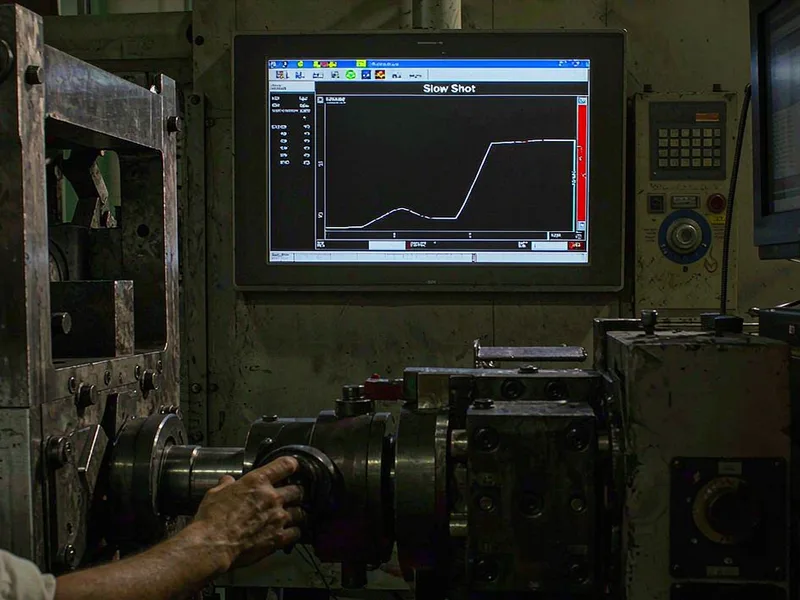
Here is the practical rule: watch the shot curve. The intensification step should be a sharp, clean step. A rounded or creeping ramp means the hydraulic system is slow.
How to Tell It Is Working

The pressure gauge is a starting point, not proof. You need to see inside the part. We use three checks on every program.
First, machine trace review. Every shot is logged, and the intensification step is monitored for drift. A pressure spike or a missing step tells you the hydraulic valve or accumulator needs attention. This is the cheapest and fastest check.
Second, X-ray or CT on sample parts. These show shrink porosity and gas porosity directly. Shrink voids usually appear in thick sections and hot spots. If intensification is working, those voids get smaller and rounder, or disappear.
Third, destructive sectioning. Cut the part at the thickest section and at the last-to-fill area. Polish and inspect under magnification. This validates the X-ray result and gives you a physical record for the customer.
A useful field test is to run a short trial at low and high intensification and compare the sectioned parts. The difference is often visible by eye. That comparison convinces a skeptical customer faster than any report.
Common Problems and Their Fixes

Flash is the most common side effect. High intensification pressure can force metal into die parting-line gaps. If flash appears on a well-built die, check die locking force first, then the pressure setpoint. Do not simply drop the pressure — that costs you the packing you need.
Another issue is over-packing near the gate. Too much pressure can actually cause ”jetting” related defects or localized stress. The fix is to tune the pressure and gate design together, not to raise pressure blindly.
Cold shuts are a filling problem, not a packing problem. Increasing die casting intensification pressure rarely fixes a cold shut. That defect needs faster fill, better venting, or a hotter die. Confusing the two wastes time.
Finally, watch for machine capability. Pushing a small machine to the top of its intensification range adds wear and heat. Match the tonnage and intensification capability to the part, not the other way around. If you are also sizing the machine, our guide on die casting machine tonnage covers the paired decision.
External Links
- North American Die Casting Association (NADCA) — industry resources and standards on HPDC process control, including shot monitoring and porosity reduction.
- International Organization for Standardization (ISO) — source of quality and process standards used across global casting supply chains.
- ASM International — materials reference material on aluminum solidification, shrinkage, and alloy behavior in die casting.
FAQ
What is die casting intensification pressure?
It is the hydraulic squeeze applied during the third phase of an HPDC shot, after the cavity fills. The intensifier drives the plunger forward a few millimeters to pack the shrinking metal through the gate. This pressure controls shrink porosity and pressure tightness.
What intensification pressure should I use?
Most aluminum parts run 500 to 1,100 bar of metal pressure at the gate. Thin-wall and structural castings sit at the high end. Start in the middle of the band, then tune based on X-ray and sectioning results rather than a fixed number.
Why does late intensification cause porosity?
If the gate freezes before the squeeze arrives, no metal can reach the cavity. The casting then shrinks freely and forms voids in the last areas to freeze. Starting intensification within 0.02 to 0.10 seconds after fill keeps the gate open long enough.
Does higher intensification pressure always help?
No. Past a point it causes flash, increases die stress, and wastes energy without closing more porosity. The goal is the lowest pressure that produces a sound part, verified by inspection. More is not automatically better.
How do I verify intensification pressure on the shop floor?
Log every shot curve and watch for drift in the intensification step. Then confirm with X-ray or sectioning on sample parts. Running a low-versus-high trial on the same die is the fastest way to see the effect for yourself.