The cold chamber vs hot chamber die casting question is settled by alloy chemistry before tonnage, price or supplier preference enter the conversation. Hot chamber machines hold a gooseneck submerged in a molten pot and inject zinc, magnesium or lead at 20-45 second cycles. Cold chamber machines ladle metal into a separate shot sleeve and press aluminum at 660-700 °C. If the part is aluminum, cold chamber is the only route that survives a full year of running.
Key Takeaways
- Hot chamber machines inject straight from a molten pot through a gooseneck, so there is no ladle, no biscuit and a 20-45 second cycle.
- Cold chamber machines use a separate shot sleeve filled by ladle or robot, keeping aluminum away from the injection mechanism.
- Molten aluminum dissolves the iron in a gooseneck within hours, which is why no foundry casts aluminum hot chamber.
- Zinc, magnesium and lead alloys run hot chamber because their melting points stay below roughly 650 °C.
- Zinc dies often survive several hundred thousand shots, since the die sees 400-430 °C metal instead of 680 °C.
- Cold chamber parts carry more gas porosity, so a pressure-tight or T6 structural part usually needs vacuum assistance.
- Any cold chamber vs hot chamber die casting shortlist collapses to one option once the drawing says aluminum.
Two Architectures, One Decisive Difference
Both machine types clamp a two-part steel die, inject liquid metal and eject a casting. The difference sits in where the injection plunger lives. In a hot chamber machine the plunger, sleeve and nozzle stay immersed in the molten alloy. In a cold chamber machine the plunger sits outside the furnace and picks up one measured dose of metal per cycle.
Inside a hot chamber machine
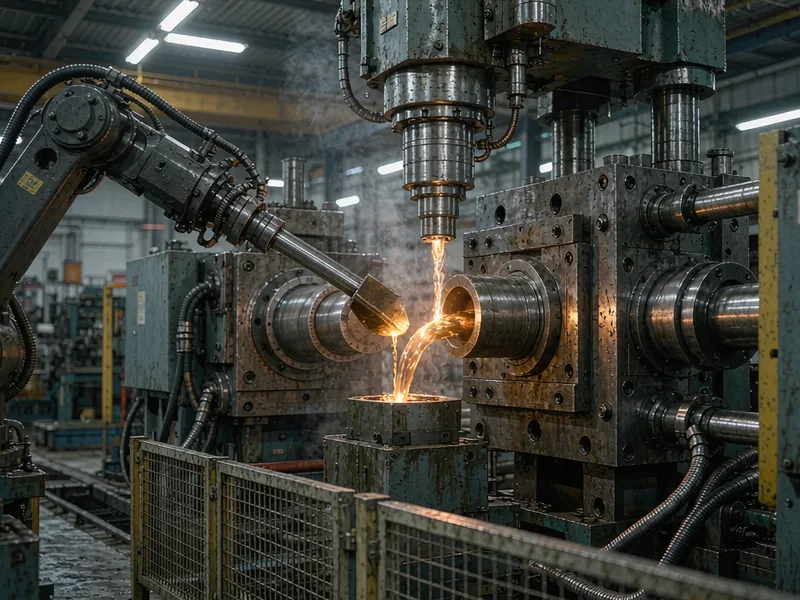
A heated pot holds the alloy at casting temperature. A hydraulic cylinder drives a plunger down inside a gooseneck, and metal travels up a channel and out of a nozzle pressed against the die sprue. Injection pressure runs 10-35 MPa, low because the metal travels only a short distance. There is no ladle and no open pour, so oxide generation is minimal. The shot takes 20-45 seconds and the cell runs unattended once the pot is stable.
That architecture has a hard limit: the gooseneck is iron, and it sits in liquid metal all shift.
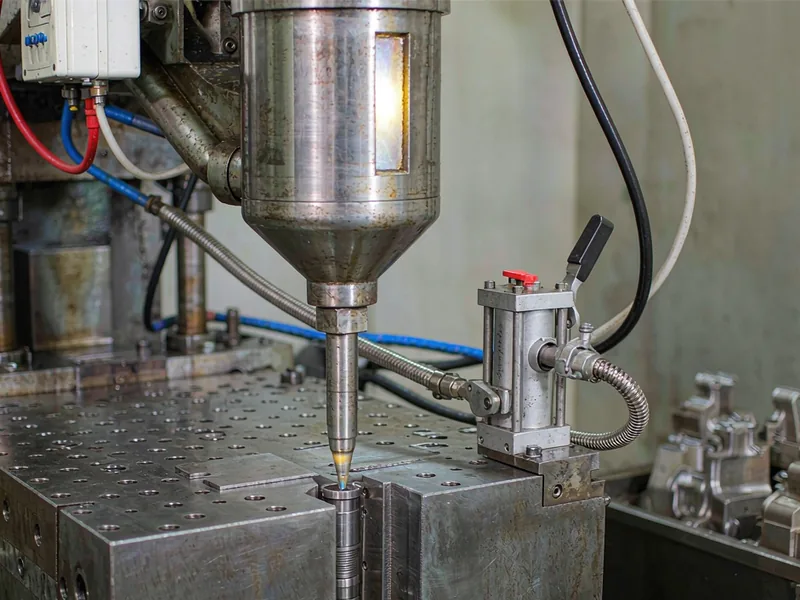
Inside a cold chamber machine
The shot sleeve is a horizontal bore in the fixed platen, filled through a pour hole on top. A ladle, dosing furnace or robot delivers one shot, the plunger advances, and metal is driven through the runner at 30-80 m/s gate speed. Intensification then rises to 500-1,200 bar while the casting solidifies. The biscuit ejects with it.
Cold chamber is a slower, dirtier cycle: 60-120 seconds, a biscuit to recycle, a fresh oxide skin every shot. It is also the only way to pressurize aluminum at 680 °C. That single metallurgical fact explains most of the machine population in any aluminum foundry.
Why Aluminum Never Runs in a Hot Chamber
Aluminum at 680 °C is chemically aggressive toward the iron and steel it touches. The melt dissolves iron from the gooseneck wall, saturating the alloy with a phase that forms brittle needles in the casting. A gooseneck exposed to aluminum typically fails within a shift or two, and the metal it delivers is already out of specification before the die fills. ASM International treats this dissolution as the main reason submerged injection systems cannot handle aluminum.
There is a second problem. Aluminum oxidizes instantly in air, and a hot chamber system stirs the same pot all day, folding oxide film into every shot. Dross volume climbs, metal yield falls, and castings carry oxide inclusions that no amount of venting removes. Hot chamber machines are also built for small shots, so a 4 kg housing has no machine in that architecture.
The magnesium exception
Magnesium melts near 650 °C and behaves better in contact with steel, so hot chamber magnesium machines exist and are common for small electronic housings. The pot is blanketed with SF6 or SO2 to suppress burning, which adds gas handling, monitoring and environmental controls. Most structural magnesium parts still run cold chamber, because larger shot weights matter more than cycle time.
What this means for a buyer
A zinc or magnesium part quoted on a hot chamber machine is normal and usually the cheapest route. An aluminum part quoted on a hot chamber machine is a misunderstanding of the process or a translation error. Ask for the machine list with tonnage and type, and check it against the alloy on the drawing.
Alloy grade drives more than the machine. The choice between ADC12 and A380 changes fluidity, die life and machining behavior, and it is worth settling before the die is designed. The ADC12 vs A380 comparison covers those trade-offs.
The Comparison Table Buyers Actually Need
Published cold chamber vs hot chamber die casting tables usually stop at cycle time. The rows below move a landed cost or a quality clause, and every one is verifiable on a supplier audit. Alloy designations follow ASTM B85/B85M for aluminum and the equivalent zinc standards.
| Criterion | Hot chamber | Cold chamber |
|---|---|---|
| Production alloys | Zamak 3, Zamak 5, magnesium AZ91D, lead, tin | ADC12, A380, A360, ADC10, AlSi9Cu3, A356 |
| Metal temperature at the die | 390-430 °C (zinc), 640-670 °C (magnesium) | 660-700 °C (aluminum) |
| Injection pressure | 10-35 MPa | 500-1,200 bar intensification |
| Gate velocity | 10-25 m/s | 30-80 m/s |
| Typical dry cycle | 20-45 s | 60-120 s |
| Maximum shot weight, practical | 2-5 kg zinc, 3-8 kg magnesium | 0.2-20 kg aluminum |
| Metal yield (part / shot) | 75-90% | 45-70% |
| Die life | 300,000-1,000,000 shots on zinc | 80,000-150,000 shots on H13 |
| Minimum wall | 0.6-1.0 mm on zinc | 1.5 mm short flow, 2.0 mm production |
| As-cast porosity | Low, calm fill from below | Higher, vacuum needed for structural work |
| T6 heat treatment | Not applicable to zinc | Only with vacuum or pore-free variants |
| Machine range in service | 25-400 t | 160-2,500 t at HKX, larger elsewhere |
Read the yield row with the die life row. A hot chamber zinc part converts 80% of its metal into saleable castings, and the die survives a million shots. A cold chamber aluminum part returns nearly half its metal as biscuit and overflow, and the die is replaced far sooner. Those two numbers explain most of the price gap between a zinc bracket and an aluminum one of the same size.
Cycle Time, Yield and the Real Cost per Part
A 30-second hot chamber cycle sounds three times more productive than a 90-second cold chamber cycle. It is not, once shot weight is included. A zinc shot weighs 300 g and yields a 210 g part. An aluminum shot weighs 3.5 kg and yields a 1.6 kg housing. Output per hour is closer than the cycle numbers suggest, and cost per kilogram of metal handled is the honest comparison.
Three cost lines matter:
- Metal loss. Sealed hot chamber pots generate little dross. Cold chamber ladling exposes a fresh surface every cycle, so dross plus spillage costs 2-5% of metal input.
- Internal scrap. Biscuit, runner and overflow return to the furnace in both processes, but the cold chamber return stream is larger and needs more remelt energy per kilogram shipped.
- Die amortization. Aluminum die steel erodes and heat checks faster at 680 °C, so one die cost spreads over a tenth as many parts.
Above roughly 5 kg of shot weight, hot chamber runs out of pressure and pot capacity. Zinc also loses its cost edge as parts grow, since it costs more per kilogram than aluminum and weighs 2.6 times more for the same volume. A large zinc enclosure becomes heavy and expensive for no gain. That is where zinc vs aluminum die casting stops being a machine question and becomes a material question.
A pot at 420 °C costs less to hold than a furnace at 700 °C, so hot chamber cells run cheaper per hour. On a 20,000 part program, tooling dominates anyway.
Porosity, Density and What Shows Up After Machining
In any cold chamber vs hot chamber die casting review, porosity is where the routes separate most sharply. Hot chamber filling is calm and bottom-fed, so the metal front stays intact and little air enters the cavity. Zinc castings are machined, polished and electroplated without blistering, which is why decorative hardware, locks and plumbing fittings still run hot chamber.
Cold chamber filling is violent by design. Metal must reach the far end of the cavity before it freezes, so gate speed is high and flow is turbulent. Air that cannot escape through vents becomes gas porosity, concentrated near last-filled regions and behind cores. Machine the surface and the pores open as pits; run the part through a paint cure oven and the gas expands into blisters. According to the North American Die Casting Association, gas entrapment during fill remains the dominant defect source in high-pressure aluminum castings.
Three routes to a denser aluminum part
The first is vacuum assistance, which evacuates the cavity and cuts gas content by an order of magnitude. The second is squeeze pins, which push metal into hot spots as they shrink. The third is a different process family, such as low pressure or squeeze casting, where filling is calm and pressure is applied through a large gate. Each adds cost, and each needs a written acceptance criterion.
For structural parts that must also take T6, vacuum plus heat treatment is the standard answer. The vacuum die casting and T6 combination explains how the two requirements constrain each other. A general overview of the process families is also on the Wikipedia die casting page.
Sizing the Machine Before You Approve the Die
Tonnage is not a prestige number. It is set by projected area, cavity pressure and the safety factor the foundry applies. Aluminum solidifies under 500-1,200 bar of intensification pressure, so a part with 400 cm² of projected area needs roughly 400 t of clamping force at 800 bar plus margin. Undersized machines flash at the parting line and wear the die. Oversized machines waste cycle time heating metal that is not needed.
| Machine size | Typical projected area | Shot weight | Parts that fit |
|---|---|---|---|
| 160-250 t | 150-400 cm² | 0.2-1.2 kg | Small brackets, sensor housings, connector bodies |
| 400-630 t | 400-1,100 cm² | 0.8-3.0 kg | Motor end covers, throttle bodies, LED housings |
| 800-1,250 t | 1,100-2,400 cm² | 2.5-7.0 kg | Clutch covers, oil pump housings, larger enclosures |
| 1,600-2,500 t | 2,400-5,000 cm² | 6.0-14 kg | Transmission covers, structural nodes, large housings |
Tie-bar clearance is the second constraint. A die that fits the platen but not between the tie bars cannot be mounted, and a deep housing may need a larger machine purely for opening stroke.
The table assumes one cavity and a balanced runner. Multi-cavity tools add projected area without adding part size, which is why a two-cavity LED housing can need a 1,000 t machine for parts weighing 300 g each. Buyers reviewing a quotation should ask for the machine model, cavity count and calculated projected area. A quote without those three numbers cannot be compared with a competing quote. The die casting machine tonnage guide works through the same calculation with a full example.
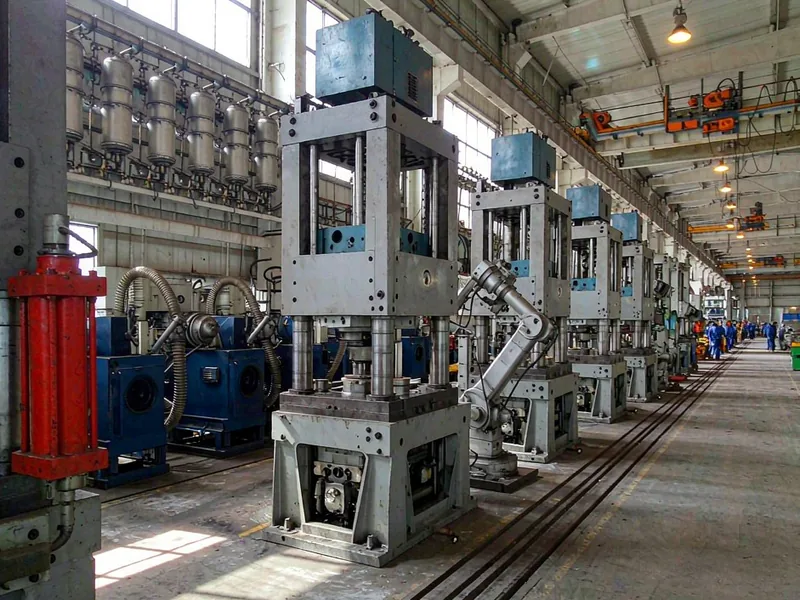
Inside the HKX Machine Floor
HKX runs cold chamber machines from 160 t to 2,500 t in Ningbo, and every aluminum program starts with alloy verification rather than a machine booking. Furnace samples go to a direct-reading spectrometer before the melt is released, and the ADC12 window is held at 10.5-11.5% silicon with copper between 1.5% and 3.0%. Iron stays in a narrow band because it controls die soldering, and an out-of-window reading sends the melt back for correction.
Die temperature is managed in three zones, with oil units holding the fixed half at 200-240 °C and the moving half slightly cooler so the part shrinks onto the ejector side. On vacuum-assisted structural work the valve opens at a set ram position and the cavity reaches 80-120 mbar before the shot, with the vacuum curve recorded every shot. Release agent is sprayed on a fixed cycle, since a short spray raises soldering. First-off parts go to CMM with drawing datums, one part in twenty goes through X-ray to ASTM E505, and pressure-tight housings run a written 1.5 bar, 30-second decay test. Lot records tie heat number, machine, shift and X-ray images to the shipment, the discipline behind the cold chamber vs hot chamber die casting choice at HKX and the reason aluminum motor end covers ship into automotive programs in more than 20 countries.
A Five-Question Decision Sequence
The cold chamber vs hot chamber die casting decision is a filter, not a debate. Most buyers do not need to compare machine catalogs; they need to know which architecture can produce their part, then confirm the supplier owns it.
- What alloy is on the drawing? Aluminum means cold chamber. Zinc or magnesium under 650 °C opens the hot chamber route.
- How heavy is the part? Above 5 kg, hot chamber is out on shot weight alone, whatever the alloy.
- Does it need plating or a Class A face? Zinc plates cleanly; aluminum needs painting or a controlled anodizing grade.
- Is there a leak or T6 requirement? Cold chamber with vacuum, or a switch to low pressure or squeeze casting.
- What annual volume justifies the die? Below 10,000 parts, revisit the process before committing to a die, and check the year-two forecast.
Two checks remain. Ask whether the die is quoted in H13 or a premium steel, since die life and repair cost follow that decision. Ask who owns the tooling, because a die that cannot be moved is not an asset. The high pressure die casting process page shows the full cell layout if the answer needs a visual reference.
Ask for the PPAP level in the same conversation. A production part number usually needs a dimensional report, material certificates and a process flow, and those documents cost time rather than money. A supplier who cannot produce them at T1 will not produce them at launch.
Frequently Asked Questions
Can a hot chamber machine cast aluminum if the pot is lined?
No. The failure is chemical, not thermal. Aluminum dissolves iron from the gooseneck and nozzle, contaminating the melt and destroying the injection system within hours. No lining survives a production shift at 680 °C in contact with flowing aluminum, and the melt is contaminated within minutes.
Which machine type gives the tighter tolerance?
Both hold similar linear tolerances when the die is rigid and the process is stable, typically CT5-CT6 for small features. Zinc parts hold tolerance more easily because they shrink less and run cooler, so a 0.05 mm feature is more realistic in Zamak than in ADC12.
Why is cold chamber metal yield so much lower?
Every shot carries a biscuit, a runner and overflow runners that never become part of the casting. On small aluminum parts those features can weigh more than the part itself, which is why multi-cavity tools and short runners are used to recover yield.
Is a hot chamber machine cheaper to buy?
For the same clamping force, yes, because it needs no ladle, dosing furnace or shot monitoring. That saving is irrelevant if the alloy is aluminum, since the machine cannot run the job at all. Compare total program cost, not machine price.
Does a cold chamber part need vacuum?
Only if the drawing carries a leak test, a T6 temper or a fatigue requirement. A cosmetic cover with no sealing function runs fine on a standard cell with well-designed vents and overflows. Vacuum is a cost, not a default.
How can a buyer verify which machine a supplier will use?
Ask for the machine list with tonnage, type and age, then ask which specific machine is booked for your part. A foundry that cannot name the machine before quoting has not finished its process planning. Ask for a photo of the machine and its asset number.
Author: HKX Engineering Team
HKX — Ningbo Hexin Mould Co., Ltd., an aluminum die casting manufacturer in Ningbo, China, with 30+ years of tooling experience, in-house machining and finishing, ISO 9001 and IATF 16949 certification, and customers in more than 20 countries.
Talk to the HKX Engineering Team
If the alloy is aluminum, the machine question is already answered, and the useful conversation is about tonnage, gating, porosity acceptance and machining stock. Send a drawing with the alloy, annual volume and any leak or heat treatment requirement, and HKX will return a process sheet naming the machine, the cavity count, the projected area and the inspection plan before any price is discussed. Buyers also receive DFM feedback on walls and draft, a T1 sample plan and a first article report with X-ray images. To start, contact our engineering team with the drawing and annual volume.