Permanent Mold vs Die Casting for Medium-Volume Parts
Choosing between permanent mold vs die casting is really a question about volume. Gravity permanent mold casting and high pressure die casting both pour molten aluminum into a steel tool. What splits them is how the metal gets in, how fast the die wears, and where the tooling money lands. Get this call right and your unit price drops for the life of the program. Get it wrong and you pay for a die you cannot fill. This guide gives you the crossover numbers we use when we quote medium-volume aluminum work.
Key Takeaways
- Die casting wins above roughly 10,000 to 20,000 parts per year; permanent mold wins below it.
- Die tooling costs 3 to 5 times more than a permanent mold, but cycle time runs 5 to 10 times faster.
- Permanent mold castings generally have lower porosity and better pressure tightness.
- Die casting holds tighter as-cast tolerances and thinner walls.
- The real crossover is total cost at your annual volume, not the headline tooling quote.
How the Two Processes Actually Differ
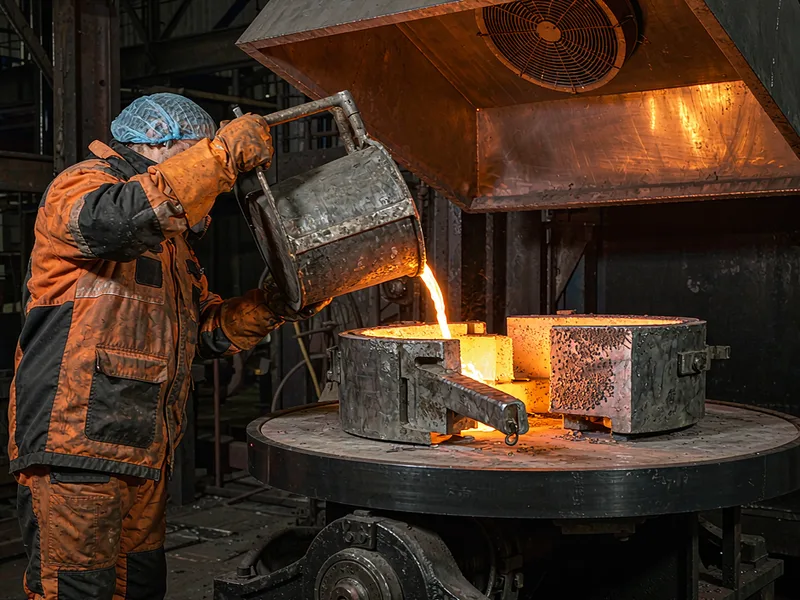
In permanent mold casting, you ladle molten aluminum into a steel or iron mold by hand or robot. Gravity does the filling. The mold opens in two halves, may have sand or steel cores, and often runs coated with a refractory wash that slows heat loss and helps release. Low pressure permanent mold is the upgrade: gas pressure pushes metal up a riser tube so fill is calmer. Fill takes seconds, not milliseconds.
In high pressure die casting, a hydraulic plunger drives metal into a hardened steel die at 70 to 140 MPa. The cavity fills in 20 to 80 milliseconds. That speed makes thin walls practical, and it is why the tooling bill is so much larger.
The metal behaves differently in each case. Gravity filling is laminar, so gas escapes before the metal locks. Pressure filling is turbulent, and any air caught in the flow ends up as porosity unless you vent well or pull a vacuum. That physical difference explains most of the quality trade-offs on your quotes.
Low pressure permanent mold sits between the two, and some shops run squeeze casting or vacuum-assisted die casting to close the porosity gap. When you ask about permanent mold vs die casting, the honest answer starts with how tight the porosity spec really needs to be.
Cost and Tooling Comparison
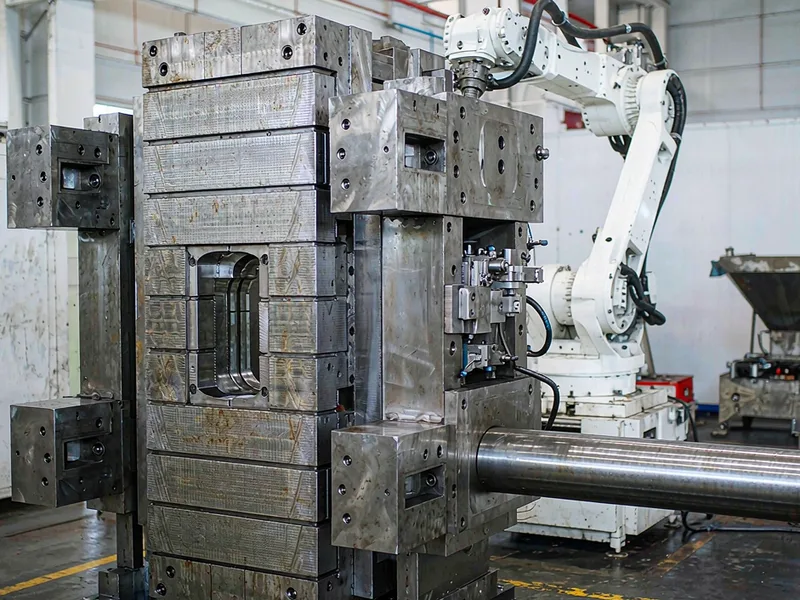
Tooling is where the two paths diverge hardest. A permanent mold for a medium part might run $8,000 to $25,000. A die casting die for the same part runs $35,000 to $120,000. That gap is why low-volume programs almost always start in permanent mold.
Cycle time flips the math at higher volume. A permanent mold cell might produce 20 to 60 parts per hour depending on cavitation. A die casting cell can run 150 to 400 shots per hour. Multiply that against labor, machine rate, and energy, and the faster process pays back its tooling in a predictable number of parts.
The table below guides the first pass on the two processes. These are working ranges for aluminum parts in the 0.2 to 3 kg class, not absolute limits.
| Factor | Permanent mold (gravity / low pressure) | High pressure die casting |
|---|---|---|
| Typical tooling cost | $8,000–$25,000 | $35,000–$120,000 |
| Parts per hour | 20–60 | 150–400 |
| Tool life | 50,000–150,000 shots | 100,000–500,000 shots |
| Minimum wall | 3–4 mm | 1.0–2.5 mm |
| As-cast tolerance | ±0.5 mm typical | ±0.1–0.25 mm typical |
| Draft angle | 2–5 degrees | 1–3 degrees |
| Typical porosity | Low | Higher unless vacuum assisted |
| Surface finish | Rough, more machining | Fine, near net shape |
Where Permanent Mold Earns Its Place
Permanent mold shines on parts that need pressure tightness, soundness, or heat treatment. Because gravity fill is calm, gas content stays low and the casting can usually be T6 heat treated without blistering. Die castings commonly trap gas, and those pockets expand into surface blisters at solution temperature. That rules out full T6 on standard die casting.
Structural and safety parts lean this way for that reason. Wheels, suspension arms, intake manifolds, and pump housings are classically permanent mold work. So is anything that must hold hydraulic pressure or pass a leak test.
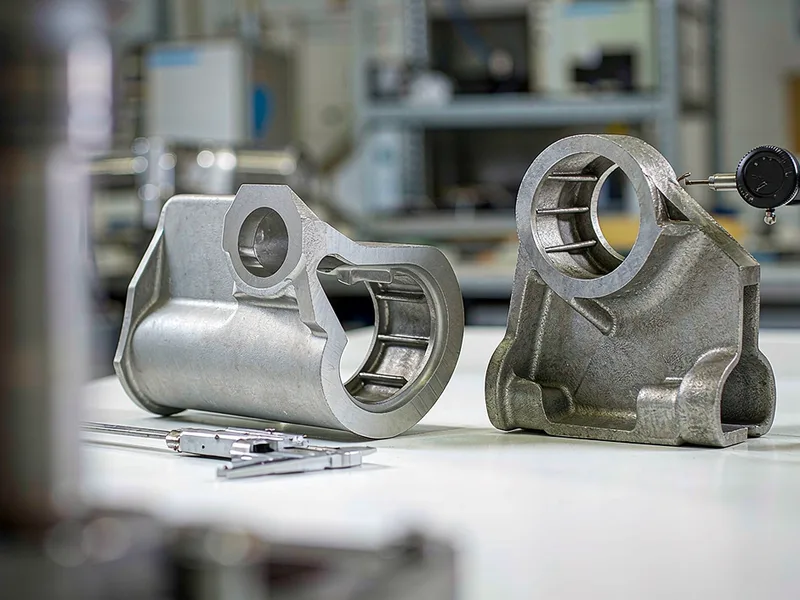
Low pressure casting widens the window further. It combines gravity-level soundness with better fill control, so thinner sections and taller parts become possible. When volume sits at 5,000 to 30,000 parts a year and quality is non-negotiable, this is often the sweet spot. The catch is speed and labor. Permanent mold cells run slower, need more operator attention, and wear out molds faster in thermal fatigue.
Where Die Casting Takes Over
Once annual volume passes roughly 10,000 to 20,000 pieces, the tooling gap stops mattering. A $90,000 die spread across 60,000 parts adds $1.50 per unit. Spread across 200,000 parts it adds $0.45. Meanwhile the cycle time advantage compounds every shot, and the near-net shape cuts machining passes.
Feature complexity also favors die casting. You can cast bosses, ribs, threads, lettering, and fine detail straight from the die. Undercuts need slides, but the process handles them. Permanent mold struggles with fine detail and usually leaves it to the machining department.
Tolerance and finish are the other reasons buyers move. As-cast flatness and hole position hold tighter in a die, so downstream CNC work drops. For high-volume housings, brackets, and electronics enclosures, that alone can justify the tool.
Making the Call for Your Program
Start with annual volume and expected program life. Multiply them, then add a realistic forecast band. If the total lands under about 20,000 parts, permanent mold usually returns the better total cost. Above 50,000, die casting almost always wins. Between those numbers, run both quotes.
Then weigh the quality spec. Ask whether the part needs heat treatment, pressure tightness, or a leak test at 2 bar or more. If it does, gravity or low pressure permanent mold is the safer path. If the part is a cosmetic housing with a tight tolerance stack, die casting is the natural fit.
Do not forget changeover risk. Permanent mold tools cost less to modify if the design moves. Die casting dies are expensive to cut and harder to rework. On a new design with unstable demand, that flexibility has value you cannot put in a spreadsheet.
Finally, compare total landed cost, not just casting price. Add machining, scrap, inspection, and freight for each route. The comparison between permanent mold vs die casting is only honest when both columns carry the same scope of work.
How We Quote Both Routes
We run both processes in house, so we can quote the same drawing through each path without bias. Send us the part, the annual volume, and the quality spec. We will price tooling, cycle time, machining, and finished cost side by side.
Most of the time the numbers point clearly one way. When they do not, we say so and explain which assumption on the boundary is doing the work. Medium volume is where the decision costs the most, so it deserves a real comparison.
External Links
- North American Die Casting Association (NADCA) — industry body with design guides covering high pressure die casting practice and alloy selection.
- ASTM B85 — standard specification for aluminum-alloy die castings, listing chemistry and mechanical property requirements.
- ASM International — materials engineering society with reference data on aluminum casting alloys and solidification behavior.
FAQ
At what volume should I switch from permanent mold to die casting?
Most programs cross over between 10,000 and 20,000 parts per year. Below that, permanent mold usually gives a lower total cost. Above roughly 50,000 parts, die casting almost always wins on cycle time and piece price.
Is permanent mold casting stronger than die casting?
It is usually sounder, not automatically stronger. Gravity fill traps less gas, so the casting heat treats without blistering and holds pressure better. Die castings are strong in the as-cast condition but lose strength if gas porosity is present.
Can die castings be heat treated?
Standard die castings cannot take full T6 treatment. Trapped gas expands at solution temperature and blisters the surface. Vacuum-assisted die casting lowers gas content and opens the door to some heat treat cycles, but permanent mold remains the safer choice.
Which process holds tighter tolerances?
Die casting does. A hardened steel die filled under pressure holds as-cast tolerances near ±0.1 to 0.25 mm. Permanent mold is closer to ±0.5 mm and often needs machining to reach critical dimensions.
How much does tooling cost for each process?
A permanent mold for a medium part typically runs $8,000 to $25,000. A comparable die casting die runs $35,000 to $120,000. The die costs more up front but amortizes fast once annual volume passes the crossover point.