A die cast ADC12 housing leaves the anodizing tank dark grey, mottled, and nowhere near the bright sample that was approved. The cause is chemistry, not operator error. ADC12 carries 10.5-12% silicon and 1.5-3.5% copper: silicon forms no oxide at all, so the coating grows around inert dark particles, and copper dissolves out and leaves voids behind. Anyone planning an anodizing die cast aluminum program has to design around those two elements before choosing a color, a rack, or a supplier.
Key Takeaways
- ADC12 holds 10.5-12% silicon, which anodizes to nothing, so the coating reads grey to charcoal no matter how the bath is run.
- Copper at 1.5-3.5% dissolves during anodizing and leaves voids, smut and edge burning; A380 with 3-4% copper is worse, not better.
- A large share of grey-part complaints trace to silicon smut from a weak desmut step rather than to the alloy.
- Type II coatings on ADC12 top out near 8-12 µm before edges burn; Type III hard anodize reaches 25-40 µm but stays charcoal.
- Bright or clear anodize is not achievable on ADC12 at any price. Powder coat, e-coat or an A360/A356 casting are the honest alternatives.
- Write ΔE00 ≤ 1.5 against a signed master, 8-12 µm film and 240-336 h of ASTM B117 on the drawing instead of the word grey.
Why Silicon and Copper Decide the Anodic Color
Anodizing die cast aluminum converts metal into aluminum oxide at the surface, and that reaction only works on aluminum. Every other element either sits inert inside the growing film or dissolves and leaves a hole. ADC12 is built for casting, not finishing, and its two main alloying elements both work against the coating. Compositions below follow ASTM B85/B85M.
Silicon does not anodize
ADC12 solidifies as aluminum dendrites surrounded by a fine Al-Si eutectic that carries silicon particles of 2-10 µm through the whole wall, not just at the skin. The film grows outward from aluminum only, so those particles are simply engulfed. At a 10 µm film, a 5 µm particle occupies half the film height: the coating is interrupted and light scatters off exposed silicon. The eye reads that as grey, then as dark grey as the film thickens. Polishing does not help, because the silicon is in the metal.
Copper dissolves and leaves voids
Copper sits in the Al2Cu phase and in copper-rich grain boundaries. In sulfuric electrolyte it dissolves while the surrounding aluminum oxides, so each particle leaves a pore with uncoated walls. Copper also builds up in the bath, raising conductivity and pushing current density up at edges. The result is dark blotches, a powdery grey film that wipes off, and burned edges. A380, at 3.0-4.0% copper, shows all of it more strongly.
Iron adds streaks
Iron up to 1.3% forms beta-Al5FeSi platelets larger than the silicon particles. Where one reaches the surface the coating cracks along it, and the crack reads as a dark line after dyeing.
| Alloy | Si (%) | Cu (%) | Anodized appearance | Practical verdict |
|---|---|---|---|---|
| ADC12 (AlSi11Cu3) | 10.5-12.0 | 1.5-3.5 | Dark grey to charcoal, mottled, visible speckle | Black dye or matte dark grey only; no bright work |
| A380 | 7.5-9.5 | 3.0-4.0 | Dark grey with blotches and smut; heavy edge burning | Worst of the common die casting alloys for anodizing |
| A360 | 9.0-10.0 | ≤0.6 | Medium grey, more uniform, fewer blotches | Best HPDC compromise when a grey look is accepted |
| A413 (AlSi12) | 11.0-13.0 | ≤1.0 | Dark grey, hard to dye evenly, low film build | Functional coating only; dye results are inconsistent |
| A356-T6 (LPDC or gravity) | 6.5-7.5 | ≤0.25 | Light to medium grey, uniform, dyes cleanly | Closest cast route to a decorative finish |
| AlMg5Mn (HPDC) | ≤0.5 | ≤0.1 | Bright silver, near-wrought appearance | Decorative anodizing only; lower fluidity, different design rules |
| 6061-T6 (wrought, reference) | ≤0.8 | ≤0.4 | Clear, bright, uniform | The benchmark buyers picture when they say anodized |
Read the table as a purchasing tool. If the drawing says clear anodize and the part is ADC12, no anodizing die cast aluminum supplier can meet it, and the two cheapest outcomes are a rejected lot or a quiet substitution. If the drawing says matte black anodize, ADC12 is a sound and economical choice, because black dye hides the mottling that clear anodize exposes.
Two Different Greys: Smut and Alloy Color
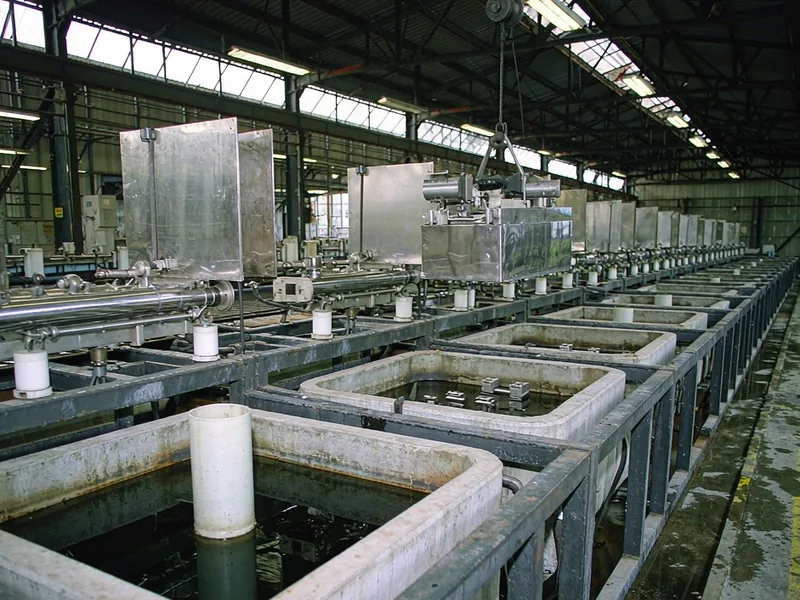
Not every grey part that leaves an anodizing die cast aluminum line is a metallurgical failure. Two mechanisms produce grey, and they are fixed in completely different ways. Telling them apart takes one minute at the receiving bench, and it decides whether the corrective action lands on the anodizer or on the drawing.
Silicon smut is a process defect
Most lines start with an alkaline etch, typically 40-60 g/L sodium hydroxide at 50-60 °C for one to three minutes. The etch dissolves aluminum and leaves silicon behind as a loose black film called silicon smut. A nitric acid desmut, usually with ammonium bifluoride addition, removes it. Skip the desmut, run it too cold, or let it exhaust, and the smut stays on the part and gets sealed under a thin coating. The part comes out uniformly dark grey and feels slightly chalky.
The field test is a white cloth and a drop of water. Rub a hidden area: if black transfers to the cloth, the grey is smut and the desmut step is at fault. If the cloth stays clean, the color comes from the alloy. Photograph the cloth and file it with the inspection record.
Alloy grey is a specification defect
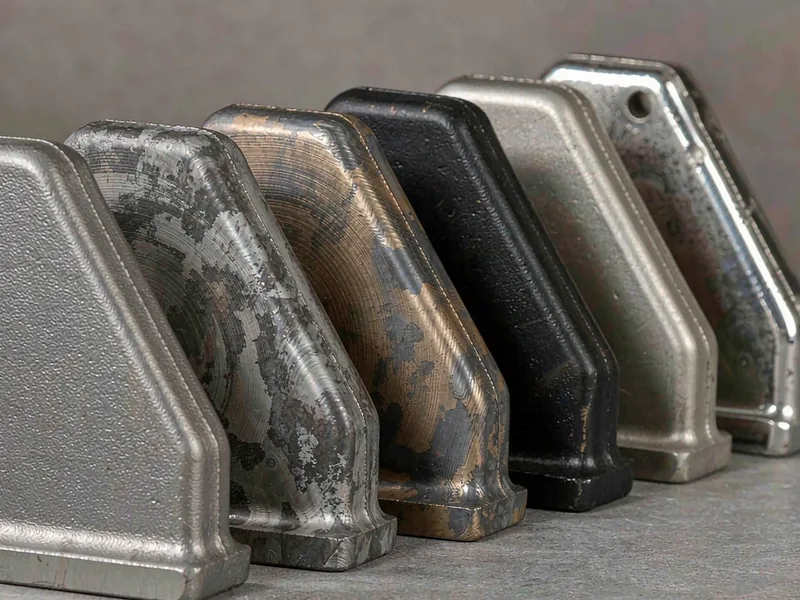
Alloy grey is uniform across the part, follows the geometry rather than the rack position, and survives a wipe. It is the expected result of anodizing any alloy above about 8% silicon, and no parameter change removes it. According to the reference literature on anodizing, the coating nucleates only on aluminum, which is precisely why a multi-phase casting alloy cannot produce a continuous, water-clear film. The corrective action is a drawing change: accept the color and control it with a master sample, move to a lower-silicon alloy, or move to a coating that covers the surface instead of growing out of it.
The Process Window That Works on ADC12
ADC12 can be anodized commercially, and thousands of tons of it are anodized every year. The window is simply narrower than the window for 6061, and three parameters carry most of the risk.
Current density and temperature
Type II sulfuric anodizing on die cast aluminum runs best at 1.2-1.5 A/dm² and 20-22 °C. Above 1.8 A/dm² the high-silicon regions cannot carry current evenly; edges take the load, heat locally and burn. Burned coating is powdery, dark and non-adherent, and it cannot be repaired, only stripped. Film build should be held to 8-12 µm. Thicker films sound better and behave worse: stress rises, the interrupted coating cracks, and corrosion resistance falls even though the gauge reads higher.
Racking and contact marks
Aluminum racks and titanium jigs carry current into the part through contact points. On a die casting, contact should land on a machined pad or a non-cosmetic face, because the contact point always leaves a small uncoated ring. Clips with too much tension crack thin walls; too little arcing burns the spot. A practical rule is one contact per 1.5-2.0 dm² of surface, doubled for parts with deep pockets, plus a 0.5 mm minimum edge break on every cosmetic edge.
Sealing and dyeing
Hot nickel acetate or boiling deionized water both seal the film on ADC12, but the pores around silicon particles never close completely, which is why anodized die castings underperform wrought parts in salt spray. Dyeing works well only in dark colors. Black, charcoal and dark bronze absorb light and mask speckle; light colors and bright reds show every particle. Type III hard anodize is the exception: 25-40 µm at 0-5 °C gives a near-black, very hard skin that is excellent on sliding surfaces and useless for appearance.
When to Change Alloy and When to Change Finish
Most anodizing die cast aluminum problems are solved before the die is cut, by deciding which of three routes the program should take. The choice depends on what the surface is for: appearance, corrosion, wear or electrical grounding.
Appearance-driven parts
A visible bezel, lamp body or instrument housing that must look bright and metallic will not be made from ADC12. At high volume the options are a coated die casting, a lower-silicon casting such as A360 for a medium grey, or an A356 part from low-pressure or gravity for a near-decorative finish. Where the visible piece is a thin trim strip, a 6061 extrusion often costs less than any casting.
Corrosion-driven parts
Anodizing on ADC12 gives modest protection because the film is discontinuous at every silicon particle. A conversion coating plus powder coat usually beats 10 µm of anodize on the same part, at lower cost. The corrosion behavior of cast aluminum alloys explains why. According to NADCA, corrosion performance depends on surface condition and alloy chemistry together, which is why routes that seal the whole surface beat thin grown films on high-silicon parts. The surface finishes overview compares the routes, and anodizable die casting alloys covers which grades respond to which chemistry.
Wear and grounding parts
Wear surfaces benefit from Type III hard anodize at 300-500 HV, with no separate insert needed. Grounding and EMI parts need the opposite: a thin conductive conversion coating, not an insulating oxide. A part that must both wear and ground is a design conflict, and the usual answer is a masked hard anodize with bare pads.
| Finish route on ADC12 | Look | Corrosion (ASTM B117) | Cost index | Best use |
|---|---|---|---|---|
| Clear Type II anodize, 10 µm | Dark grey, speckled | 168-240 h to white corrosion | 1.0 | Hidden functional surfaces |
| Black dyed Type II, 10 µm | Uniform matte black | 168-240 h | 1.2 | Cosmetic dark housings |
| Type III hard anodize, 30 µm | Charcoal, matte | 336-500 h | 2.2 | Wear surfaces, sliding fits |
| Trivalent chromate conversion | Pale blue-grey iridescent | 96-168 h | 0.4 | Paint base, grounding |
| Powder coat, 70 µm polyester | Any RAL color | 500-1,000 h | 1.1 | Outdoor cosmetic parts |
| E-coat plus powder, two layer | Any color, smooth | 720-1,000 h | 1.8 | Outdoor parts with edges and threads |
The cost index is relative, not absolute, and it moves with lot size and rack density. What matters for a sourcing decision is the shape of the table: anodize is a mid-priced route that buys wear resistance and a dark look, while coating routes buy corrosion resistance and color freedom. Choosing anodize for a corrosion requirement, or powder coat for a wear requirement, is the most common mismatch in die cast finishing specifications.
Acceptance Metrics to Write Into the Drawing
A note on anodizing die cast aluminum that says “anodized, dark grey” cannot be inspected and cannot be enforced. The six characteristics below turn an appearance argument into a measurement, and every one can be checked on a first article report before production begins.
| Characteristic | Test method | Typical requirement on ADC12 | Why it matters |
|---|---|---|---|
| Coating thickness | Eddy current, ASTM B244 | 8-12 µm, minimum 8 µm on 90% of readings | Below 6 µm corrosion drops sharply; above 15 µm the film cracks |
| Color | Spectrophotometer, 45/0, D65, ΔE00 | ≤ 1.5 against a signed master, ≤ 2.0 lot to lot | Separates a real color shift from a lighting argument |
| Gloss | 60° gloss meter | 2-6 GU for matte black, ±1.5 GU | Catches over-polished or under-etched surfaces |
| Seal quality | Mass loss after acid immersion, ISO 3210 | ≤ 30 mg/dm² | Poor sealing is the main cause of early staining |
| Corrosion | Neutral salt spray, ASTM B117 | 240 h with no base metal corrosion, D1654 rating ≥ 7 | Links the finish to the warranty the customer actually offers |
| Edge condition | Visual, 3× magnification | No burning or bloom, edge break ≥ 0.5 mm | Burned edges are the first failure in the field |
Two rows in that table do the heavy lifting. A signed master, kept in a light-tight box and replaced yearly, ends most color disputes because both sides measure the same object. A salt spray number ties the cosmetic finish to a functional promise. Write the coating designation to ISO 7599 so supplier, inspector and customer read the same definitions for grade, sealing and appearance.
How HKX Qualifies an Anodized Die Casting
At HKX, anodizing die cast aluminum starts in the melting department, not in the finishing shop. The silicon and copper that decide the final color are set before the first shot, and they cannot be corrected afterwards.
HKX confirms chemistry on every heat with a direct-reading spectrometer, holding ADC12 inside the Si 10.5-12.0% and Cu 1.5-3.5% windows and reporting the actual values on the certificate. When a customer asks for the lightest possible grey, the melt is adjusted toward the low end of the silicon window and the low end of the copper window, and the change is recorded as a deviation so the next heat does not drift back. Die thermal balance is set with zone-controlled oil heaters held at 180-220 °C, arranged so cosmetic faces fill last-but-one and stay free of cold shuts, since a cold shut under an anodic film reads as a black stain that no polishing removes. Each cavity has a stored shot profile, so a drift in fill time shows up in the record before it reaches a visible surface. Cosmetic surfaces are X-rayed to ASTM E505 severity level 2, and gas porosity above that level is routed to non-cosmetic parts rather than patched.
Before the first production lot, HKX runs witness coupons cut from the same castings through the anodizing line with the production load, then measures film thickness by eddy current, color by spectrophotometer against the approved master, and seal quality by the acid mass-loss method. Those results, plus the salt spray log, go into the first article inspection report and the PPAP package. Coupons are retained for 12 months with the lot number, so a field question about a specific shipment can be answered with the actual test data from that shipment rather than a general statement about process control.
Frequently Asked Questions
Can ADC12 be anodized to a bright silver finish?
No. Bright silver requires a low-silicon, low-copper alloy, and ADC12 contains 10.5-12% silicon plus up to 3.5% copper. The film grows only on aluminum, so silicon stays visible as dark speckle and copper leaves pores. Silver anodize is a common specification error in anodizing die cast aluminum projects, not a supplier capability gap.
Why did my parts come out patchy instead of uniformly grey?
Patchiness usually points to racking and current distribution rather than alloy. Contacts too far apart, a rack that shields part of the load, or an overloaded rack all create current shadows. Ask for the rack layout and the current density record for that lot, then check whether the patches line up with contact positions.
How thick should the anodic film be on a die casting?
Specify 8-12 µm for Type II cosmetic work and 25-40 µm for Type III hard anodize. Thicker Type II films raise internal stress and crack around silicon particles, so 20 µm on ADC12 is not twice as protective as 10 µm; it is usually less protective and prone to crazing.
Does black dye hide the silicon speckle?
Yes, largely. Black and charcoal dyes absorb most light that would scatter off exposed silicon, so the part reads as a uniform matte black. Light colors do the opposite, which is why matte black is the standard cosmetic anodize for these parts.
Is anodizing better than powder coating for outdoor parts?
On ADC12, powder coat usually wins. A 70 µm polyester coat reaches 500-1,000 h of neutral salt spray; a 10 µm anodic film on the same casting reaches 168-240 h. Anodize wins only where wear resistance or a metallic look outranks corrosion life.
What should the drawing say if the color is critical?
Give a physical master, a measurement geometry and a tolerance: ΔE00 ≤ 1.5 at 45/0 geometry under D65, film 8-12 µm, gloss within 1.5 GU, and a salt spray hour target. That converts an argument about shade into a pass or fail result both buyer and finisher can reproduce.
Author: HKX Engineering Team
HKX — Ningbo Hexin Mould Co., Ltd., an aluminum die casting manufacturer in Ningbo, China, with 30+ years of tooling experience, in-house machining and finishing, ISO 9001 and IATF 16949 certification, and customers in more than 20 countries.
Talk to the HKX Engineering Team
Send the drawing with the finish callout, the alloy and the annual volume, and HKX will return a written assessment of what that surface can deliver: the achievable color range, the film thickness and salt spray hours to expect, and whether a coating route serves the part better. Deliverables include DFM feedback on cosmetic faces, witness coupons from the trial lot, and a first article report with thickness, color and corrosion data. Where an anodized look is essential, the same review covers aluminum LED lamp housings. To start, contact our engineering team with the master sample or target color reference.