Density of Metals: g/cm3 Tables for Casting Design
Density of metals turns a drawing into a price. Once you know a part’s volume and its alloy density, you can predict weight, metal cost, shipping, and even how the part behaves in service. Get the number wrong and your quote drifts. Get it right and design decisions get simple. This guide gives you working density tables in g/cm³ for the metals we cast and machine every week. It also shows how density differs from specific gravity, why alloying shifts the value, and where density changes a design. We use these figures on live die casting programs for automotive, electronics, and industrial parts. Read the tables, then the rules that turn density into cost and performance.
Key Takeaways
- Aluminum alloys sit near 2.7 g/cm³, which makes them the default choice for light, strong castings.
- Magnesium is the lightest structural option at about 1.8 g/cm³, but it costs more per kilogram.
- Zinc alloys run near 6.6 g/cm³, so zinc parts feel heavy for their size.
- Copper and brass exceed 8.4 g/cm³ and suit thermal and electrical parts, not weight saving.
- Multiply volume by density of metals to get mass. That product drives metal cost and cycle planning.
Why Density Drives Casting Design
Density is mass per unit volume. It answers a simple question: how heavy is this shape in this alloy? For a casting, that number sets the metal you buy, the machine that carries the shot, and the price on the invoice.
Light metals change what a design can do. A bracket in aluminum can weigh a third of the same bracket in steel at the same stiffness. That is why the density of metals sits near the top of every material review.
Density also affects the process. A heavy zinc shot puts more load on the machine and the die. A light magnesium shot needs different handling, because the metal burns and floats. Weight shows up in the tooling plan, not just the spec sheet.
Weight and strength are not the same thing, and density forces you to separate them. A dense alloy feels solid, but that bulk adds no stiffness by itself. Engineers look at strength-to-weight ratio instead. Aluminum wins on that score for most cast parts, which is why it dominates.
Density Table for Common Casting Metals
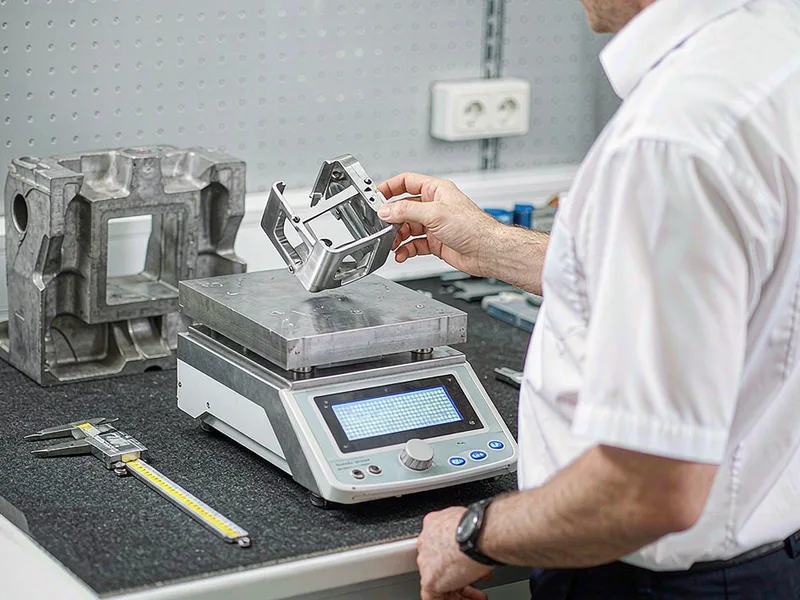
The table below lists solid density at room temperature for the alloys we see most often. Values are typical for commercial grades. Small shifts come from chemistry and from porosity, which lower the measured density slightly.
| Metal or alloy | Density (g/cm³) | Specific gravity | Typical casting use |
|---|---|---|---|
| Magnesium AZ91D | 1.81 | 1.81 | Lightweight housings |
| Aluminum A380 | 2.71 | 2.71 | General die castings |
| Aluminum A356 | 2.68 | 2.68 | Structural, wheels |
| Titanium Ti-6Al-4V | 4.43 | 4.43 | Aerospace only |
| Zinc Zamak 3 | 6.60 | 6.60 | Small precision parts |
| Gray cast iron | 7.20 | 7.20 | Engine blocks |
| Carbon steel | 7.85 | 7.85 | Machined inserts |
| Brass (Cu-Zn) | 8.50 | 8.50 | Fittings, valves |
| Pure copper | 8.96 | 8.96 | Thermal, electrical |
Notice that the numbers span five times from top to bottom. That range is the whole story of metal selection. Pick the light end and you save weight. Pick the heavy end and you gain stiffness, wear resistance, or conductivity.
Density vs Specific Gravity
People mix these two up, so here is the clean version. Specific gravity is a ratio. It compares a metal’s density to the density of water at 4 °C, which is 1.000 g/cm³.
Because water is the reference, specific gravity and density in g/cm³ share the same number for almost every engineering metal. Aluminum has a specific gravity of 2.71 and a density of 2.71 g/cm³. They are not two facts. They are one fact in two units.
Where this matters is sourcing. Buyers sometimes quote a weight based on specific gravity and gravity-cast values. Die castings trap a little porosity, so an as-cast part often weighs about 1 to 2 percent less than the solid density figure predicts. Always confirm with a real part on a scale.
Density, Weight, and Cost
Metal cost follows mass, not volume. Since mass equals volume times density, a heavier alloy costs more for the same shape. A zinc part carries about 2.4 times the mass of the same part in aluminum. That ratio shows up directly in the alloy bill.
Shipping and handling follow the same math. Light aluminum parts ship more per kilogram of freight. Heavy parts raise handling costs and machine loads. Designers who ignore density get a nasty surprise at the logistics stage.
The density of metals also guides stiffness decisions. Steel is three times denser than aluminum, but not three times stiffer per unit weight in every case. That is why engineers compare specific stiffness, not just density, before they pick an alloy.
Use this simple rule during concept work. Estimate volume in CAD, multiply by the alloy density, and you have the mass in grams. From there, a price per kilogram gives a first-pass cost before any tooling is cut.

Using Density Data on Real Projects
We pull density into three places on every job. First, quoting: mass times price per kilogram sets the metal line. Second, process planning: shot weight and machine tonnage follow from mass. Third, quality: a part that weighs too little for its predicted mass may hold internal porosity.
That third point earns its keep. If a casting comes off the scale well under the CAD prediction, we know to look for voids. The same logic helps when a customer switches alloy from A380 to a lighter grade and expects the same shot weight.
Density also settles finish choices. Anodizing and plating add little mass. Plastics and composites can cut it sharply, but they give up strength and thermal performance. Density is the quick filter that keeps a material list honest before deeper testing starts.
Keep one caution in mind. Density from a handbook is a solid value. Real castings hold voids, so measured weight often runs slightly low. That gap is a signal, not noise. Track it over a production run and you learn how well the die fills and how stable the process stays.
External Links
- North American Die Casting Association (NADCA) — design references and alloy data used across the die casting industry.
- ASTM B85 — the standard specification for aluminum-alloy die castings, covering chemistry, properties, and test methods.
- ASM International — publishes the reference handbooks that list density and physical properties for engineering metals.
FAQ
What is the density of metals in die casting?
Aluminum alloys sit near 2.7 g/cm³, magnesium near 1.8, and zinc near 6.6. Ferrous and copper alloys run from 7.2 up to about 9.0 g/cm³.
Is density the same as specific gravity?
For engineering metals, the numbers match because water is the reference at 1.000 g/cm³. So a density of 2.71 g/cm³ equals a specific gravity of 2.71.
Which casting metal has the highest density?
Among common casting metals, copper leads at about 9.0 g/cm³, with brass close behind. That weight is why copper parts suit conductivity roles, not weight saving.
How does porosity affect measured density?
Gas and shrink voids remove metal without adding volume. An as-cast part can weigh 1 to 2 percent less than the solid value. Weigh the part to catch this early.
How do I estimate casting weight from a drawing?
Take the part volume from CAD in cubic centimeters. Multiply by the alloy density. The result is the mass in grams, which feeds straight into metal cost and machine selection.