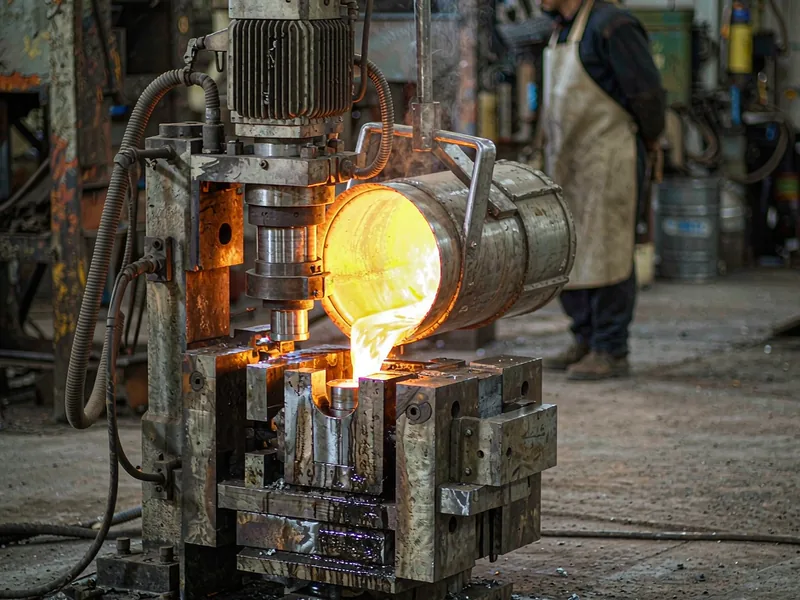
Squeeze casting pours liquid aluminum into a die that is already almost closed, then applies 50-150 MPa while the metal solidifies. Slow, non-turbulent filling means almost no air enters the cavity, and the sustained pressure feeds shrinkage as the part freezes. The result is a casting with forging-like density, 8-12% elongation and full T6 capability, produced at a cycle time closer to casting than to forging.
Key Takeaways
- Squeeze casting fills at 0.1-0.5 m/s with no air entrapment, then holds 50-150 MPa through solidification.
- Porosity drops to near forging levels, so elongation reaches 8-12% in A356-T6 instead of 1-3% in HPDC.
- T6 treatment works without blistering, because there is no trapped gas to expand at 500 °C.
- Wall thickness stays practical at 3-5 mm; this is not a thin-wall process and does not replace HPDC for a 1.5 mm cover.
- Cycles run 90-180 seconds, so the route wins at 5,000-100,000 parts a year, not at a million.
- It beats forging on shape freedom and machining stock, and beats low pressure casting on strength and pressure tightness.
How the Process Works, Step by Step
The melt is held at 700-720 °C for A356 and treated for hydrogen before the pour, . Even a low-porosity process inherits the gas the metal already carries. A measured dose goes into the lower die, which is coated and held at 250-350 °C. The press then closes the die and the punch enters the cavity. It pushes metal through a large gate and applies pressure before a solid skin can form.
The process sits between casting and forging, and buyers meet it under two names: squeeze casting or liquid metal forging. Pressure is the defining variable. A conventional die casting intensifies for a fraction of a second at the end of fill. This process holds pressure for 20-60 seconds, until the last liquid has fed the last hot spot. That pressure collapses shrinkage voids and keeps the casting against the die for fast heat transfer. It also produces a fine structure with small dendrite arm spacing.
The direct version
In the direct version, the punch is also the upper die half. Metal is poured into a shallow lower cavity and the punch descends, pressurizing the whole part at once. Shape freedom is limited to simple, thick, rotationally symmetric or plate-like parts, but the pressure path is short and the density is excellent. Brake calipers and piston-type components suit this version.
The indirect version
The indirect version separates filling from pressurization. Metal enters through a sprue and runner at low velocity, fills a closed cavity from the bottom, and is then intensified through the same gate. It handles more complex geometry, including ribs, bosses and mounting lugs, and it is the version most automotive structural parts use. Gate design matters because the gate must freeze after the pressure has done its work, not before.
Benefits That Change a Part Design
The commercial case for squeeze casting is not a single property. It is the combination of strength, ductility, pressure tightness and weldability in one part, without the shape limits of forging.
Ductility and fatigue
Gas porosity and shrinkage porosity both act as crack initiators. Remove them and elongation rises by a factor of four to six. A356-T6 parts from this route typically reach 300-340 MPa tensile strength, 240-280 MPa yield strength and 8-12% elongation. Those values come from coupons cut from production parts, not from separately cast test bars. Fatigue life follows the same trend, because a pore-free surface layer resists crack initiation.
Heat treatment without blisters
Solution treatment at 530-545 °C expands any gas trapped near the surface, which is why conventional HPDC parts blister. A part with 1 ml/100 g of gas or less can be fully treated, quenched and aged. That unlocks the T6 temper as a design option instead of a process compromise. The T6 cycle and property gains are worth reviewing before fixing a temper on the drawing.
Pressure tightness and weldability
A part with no connected porosity holds gas or coolant without impregnation, which is why e-drive housings and battery components migrate toward this route. The same density makes the alloy weldable: a low-porosity A356 or AlSi10Mg casting can take a structural MIG weld without the porosity blowouts that plague HPDC. For a battery tray frame with welded flanges, that is often the deciding factor.
Machining stock
These castings hold CT6-CT7 tolerance under ISO 8062-3 and a fine as-cast skin. Stock allowances of 1.0-1.5 mm are common, against 2.5-3.0 mm on a gravity casting. Less stock means fewer passes, shorter cycle time at the CNC and less chance of opening a pore at the finished surface.
How It Compares With HPDC, Low Pressure and Forging
Buyers rarely choose a process in isolation. The realistic shortlist for a structural aluminum part is this route, high-pressure die casting, low pressure casting and forging, and each wins on a different axis.
| Criterion | Squeeze cast | HPDC | Low pressure | Forging |
|---|---|---|---|---|
| Fill velocity | 0.1-0.5 m/s | 30-80 m/s at the gate | 0.05-0.3 m/s | Solid billet, no fill |
| Pressure during solidification | 50-150 MPa | 500-1,200 bar, briefly | 0.2-0.6 bar | 100-250 MPa |
| Typical wall | 3-5 mm | 1.5-2.5 mm | 3-4 mm | 4 mm minimum, uniform |
| Elongation, T6 | 8-12% | Not treatable in standard form | 5-8% | 10-14% |
| Porosity level | Near zero | Level 2-5, ASTM E505 | Low | None |
| Cycle time | 90-180 s | 60-120 s | 4-10 min | 30-90 s plus billet heating |
| Shape freedom | Good, ribs and bosses | Excellent | Moderate | Poor, needs machining |
| Machining stock | 1.0-1.5 mm | 0.3-0.5 mm | 1.0-2.0 mm | 2-5 mm |
| Tooling life | 50,000-100,000 shots | 80,000-150,000 shots | 100,000+ pours | 100,000+ strokes |
| Economic volume | 5,000-100,000/yr | 10,000+ /yr | 2,000-50,000/yr | 20,000+ /yr |
Read the wall row against the elongation row. The process cannot match HPDC on thin walls, and HPDC cannot match it on ductility. A part that needs both a 1.8 mm cosmetic wall and 8% elongation is not a candidate for this route. It is a vacuum-assisted HPDC candidate with a managed acceptance level. A part with 3.5 mm walls, a fatigue load and a weld seam is the opposite case.
Forging still wins where a uniform grain flow and the highest fatigue strength justify the machining cost. It wins when the shape has ribs, bosses and cored holes that would otherwise be machined from a billet. According to the North American Die Casting Association, these processes exist to close the gap between casting shape freedom and wrought properties.
Where the Process Stops Working
A supplier who offers squeeze casting for every part is not screening the work. The process has firm boundaries, and a buyer should test a proposal against them before a die is quoted.
Wall thickness
Below about 2.5 mm, the metal freezes before pressure can act on it, and the advantage disappears. Thick sections are equally awkward: a 15 mm mass needs a long hold and a large gate, and the cycle stretches. The comfortable window is 3-5 mm, which fits most suspension and housing geometry but excludes thin cosmetic covers.
Part size and press capacity
Press capacity limits projected area and shot weight. A 2,000 t squeeze press will handle a control arm or a knuckle, not a full body-side casting. Large parts stay with HPDC or with low pressure, where a bigger platen is available at lower clamping force.
Die life and maintenance
Slow filling keeps the die cooler at the gate. The long pressure hold and the thermal cycle from 700 °C metal to a 300 °C die face still produce heat checking. Die life of 50,000-100,000 shots is realistic, below what a good HPDC die achieves. Inserts need replacement planning from the start, and the quotation should state the assumed shot life.
Cost structure
Piece cost runs above HPDC because cycle time is longer and automation is harder. Tooling cost is comparable to a low pressure die, sometimes 10-25% higher because of the punch and the gate design. The route pays back when the alternative is a forging plus heavy machining, or when a T6 requirement rules out HPDC altogether.
Applications Where It Wins
Automotive chassis and powertrain parts dominate the installed base, because they combine a fatigue load with a shape that forging cannot produce economically. The parts that justify squeeze casting share three traits: a 3-5 mm wall, a load path that needs ductility, a shape with ribs or cored bores.
| Part | Alloy and temper | Why this route | Usual alternative |
|---|---|---|---|
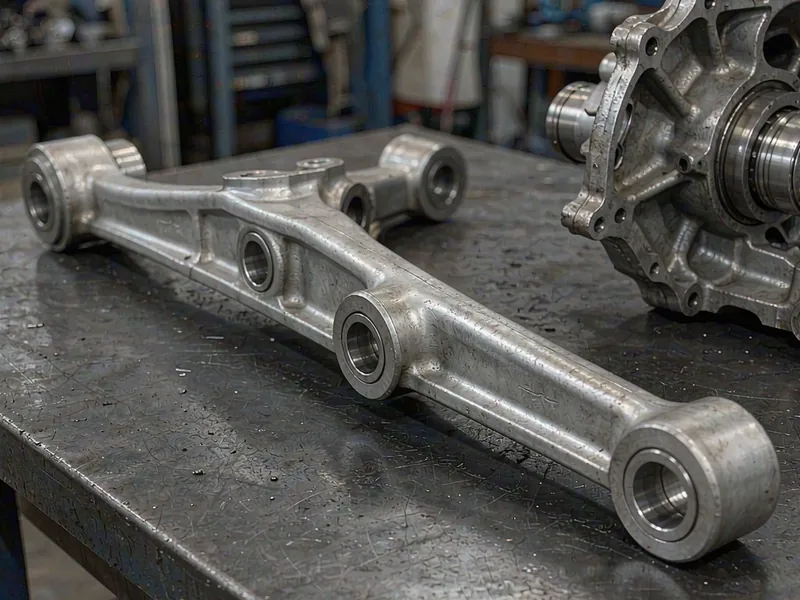
| Suspension control arm | A356-T6 | Fatigue life plus cored bushing bores | Forged arm with machined ends |
| Steering knuckle | A356-T6 or AlSi7Mg | Ductility in a safety part, complex lug geometry | Forging or ductile iron |
| Brake caliper body | A356-T6 | Pressure tight under 150 bar brake fluid | Gravity cast then impregnated |
| E-drive motor housing | AlSi10Mg-T6 | Leak tight, weldable, thin enough at 3.5 mm | HPDC plus impregnation |
| Battery tray node | AlSi10Mg-T6 | Weldable flanges, crash load path | Extrusion plus welding |
| Robotic arm joint housing | A356-T6 | Stiffness with cored ribs, low porosity at bearing seats | Sand cast plus machining |
Outside automotive, the route suits pump and valve bodies, hydraulic manifolds, compressor housings and any part that must hold pressure and still be welded. It also suits low-volume structural parts where a forging die cannot be justified. The limitation is rarely technical. It is finding a supplier with a press, die design capability and a heat treatment line in one control loop. Most suppliers hold two of those three, and the missing one is usually the heat treatment discipline.
Proving the Properties: Metallography and Testing
Property claims are only as good as the sampling behind them. A program for this route should be verified on three levels, and each one answers a different question.
The first is chemical and gas content, measured before the pour. Hydrogen below 0.12-0.15 ml/100 g is the practical target for a T6 part, and it is checked per melt rather than per shift. The second is radiographic or tomographic inspection, which shows whether pressure actually reached the hot spots. The third is destructive: a section cut from a production casting, polished and etched, shows secondary dendrite arm spacing, eutectic morphology and any remaining shrinkage. ASM International publishes the metallographic practice that makes those readings comparable between laboratories.
Coupons cut from the gate or from a sacrificial extension are the honest tensile sample, because separately cast test bars flatter the process. A program that reports 12% elongation from a test bar and 6% from the part has a gate or a thermal problem, not an alloy problem.
Sampling frequency should match the risk. A safety part gets a section from the first casting of every shift during ramp, then one per lot. A non-structural part can move to one section per tool service interval. Photographs of each section belong in the first article report, not only in the lab notebook. A buyer cannot audit a claim that stays on a bench.

How HKX Reviews a Squeeze Cast Requirement
HKX does not sell squeeze casting as a high-volume substitute for HPDC, and the engineering team says so early. The Ningbo plant runs cold chamber machines from 160 t to 2,500 t, low pressure cells and gravity lines, with in-house CNC machining. When a drawing arrives with a T6 temper, a fatigue note and 3.5 mm walls, the review compares three answers before recommending one.
The first is low pressure casting in A356-T6, which reaches 5-8% elongation at lower tooling cost. The second is this route through a partner press, with HKX owning tooling design, machining and inspection. The third is vacuum-assisted HPDC in AlSi10Mg, which is the only route that also delivers thin walls and high volume.
The deciding data are usually the wall map and the load case. A control arm with 4 mm walls and a fatigue requirement goes to this route. A housing with 2.0 mm walls and 200,000 parts a year goes to vacuum HPDC, with T6 dropped or the design changed. HKX then holds the downstream chain together: CMM with drawing datums, X-ray to ASTM E505, metallographic sections on the first article, and a 100% leak test on sealing parts.
Bearing bores are held to 0.02 mm. A ductile casting still fails if the bore is machined off-center. Programs get lot traceability from heat number to shipment, the first thing an automotive audit asks for. HKX machines and finishes robotic arm support castings on the same basis.
A Decision Sequence for Structural Parts
Five questions separate a genuine squeeze casting candidate from a part that should stay on a pressure die casting route.
- What elongation does the load case require? Above 6% in the part, HPDC is out unless the design changes.
- What is the thinnest functional wall? Below 2.5 mm, stay with vacuum-assisted HPDC.
- Does the part hold fluid or gas? If yes, and if impregnation is unacceptable, this route or low pressure wins.
- Will the part be welded? Low porosity is a prerequisite; HPDC generally is not weldable at structural seams.
- What annual volume and program life apply? Between 5,000 and 100,000 parts a year is the economic band.
Two further checks protect the program. Ask for the die life assumption in writing, because a 60,000-shot die changes the amortization at year three. Ask how the supplier validates pressure during solidification, since a squeeze press without a recorded pressure curve is a gravity casting with a longer cycle. The five answers rarely conflict with each other. When they do, the wall map wins, because no process can cast a geometry it cannot fill. Write the conclusion into the purchase order, not just the meeting minutes, so the assumption survives staff changes.
The comparison also depends on the alloy. AlSi10Mg and A356 respond differently to T6, and the choice affects both ductility and casting behavior. The AlSi10Mg structural casting guide covers that trade-off, and the low pressure die casting process page shows the route most often compared with this one.
Frequently Asked Questions
Is squeeze casting the same as forging?
No. Forging starts from a solid billet and shapes it under pressure, so grain flow follows the die but shape freedom is limited. Squeeze casting starts from liquid metal, fills a closed die slowly and pressurizes during solidification, which keeps casting shape freedom while approaching forged density.
What elongation is realistic in A356-T6?
Typically 8-12% on coupons cut from production castings, with tensile strength around 300-340 MPa. Values at the low end usually indicate a gate that froze early, a hot spot that was not fed or a melt with too much hydrogen.
Why is the cycle time so much longer than HPDC?
Filling is deliberately slow to avoid turbulence, and pressure is held for 20-60 seconds while the part solidifies. That hold is the mechanism that eliminates shrinkage, so shortening it removes the reason to use the process at all and leaves a slow HPDC casting.
Can these castings be welded?
Yes, and that is one of the main reasons the route is chosen for battery and e-drive housings. Low porosity allows a sound structural weld, while a conventional HPDC part tends to show blowouts along the seam and needs a redesign of the joint.
How thick can the walls be?
Section size is limited by feeding and cycle time rather than by the press. Sections up to 15-20 mm are possible with a suitable gate and hold profile, though the economics weaken as thickness grows, the cycle stretches and die life shortens.
What should an RFQ specify?
State the alloy and temper, the wall map, the load case, the leak test, the weld requirement, the sampling plan and the expected die life. Ask for a recorded pressure curve and a metallographic section on the first article, so the process can be audited rather than assumed.
Author: HKX Engineering Team
HKX — Ningbo Hexin Mould Co., Ltd., an aluminum die casting manufacturer in Ningbo, China, with 30+ years of tooling experience, in-house machining and finishing, ISO 9001 and IATF 16949 certification, and customers in more than 20 countries.
Talk to the HKX Engineering Team
Send a drawing with the wall map, the load case and the temper, and HKX will return a written route recommendation that compares squeeze casting with low pressure and vacuum-assisted HPDC on ductility, wall, volume and tooling. The package includes DFM feedback on gate and rib layout, a T1 sample plan, a first article report with radiographs and metallographic sections, and a die life assumption you can put into a business case. Buyers who compare routes before cutting steel avoid the most expensive mistake in structural casting: a die that produces parts the validation lab will not accept. To start that review, contact our engineering team with the annual volume and the test standard the part must meet.