A die casting cycle time of 45-90 seconds for a 0.5-1.5 kg aluminum housing is normal, and less than 2 seconds of that is actual injection. Dwell, spray and part handling take the rest. Buyers who read a quotation as one number cannot tell a realistic cycle from an optimistic one, so ask for the phase breakdown before you accept the piece price built on it.
Key Takeaways
- Injection accounts for under 2 seconds of a 45-90 second cycle; solidification dwell holds 35-50% of the clock.
- Wall thickness sets the dwell floor: a 2 mm wall needs 8-12 s of cooling, an 8 mm boss 30-40 s.
- Die thermal balance, not machine tonnage, is the usual reason two foundries quote 20-30% apart.
- Vacuum assistance adds 1-4 s per shot and buys porosity margin that removes a sorting operation later.
- A cycle trimmed by 6 seconds that lifts scrap by 2 points costs more than it saves at any alloy price.
- Ask for phase-by-phase seconds and an OEE assumption; an average cycle time hides both.
What the Number on the Quote Actually Means
Three different clocks get quoted as die casting cycle time, and they differ by 20-40%. Shot-to-shot time measures die close to die close with no interruption. Gate-to-gate time adds the spray and extraction that keep the cell running. Good-part cycle divides the shift by parts that passed inspection, which folds in scrap and downtime.
The distinction is commercial. A 55 second shot-to-shot figure on a 2 kg housing is credible. The same part at 55 seconds gate-to-gate is either a very well cooled die or a number that assumes no release agent.
For capacity planning, only the good-part clock works. A cell at 75% OEE with 3% scrap turns a 60 second cycle into roughly 43 good parts an hour, not 60.
| Phase | 0.8 kg housing (s) | 4.5 kg housing (s) | What sets the duration | Buyer leverage |
|---|---|---|---|---|
| Ladle and pour | 4-6 | 6-9 | Shot sleeve fill ratio, metal temperature | Alloy choice, allowed pour temperature |
| Fill at the gate | 0.03-0.08 | 0.08-0.2 | Gate velocity 30-60 m/s, wall thickness | DFM only, before steel is cut |
| Intensification | 0.3-0.8 | 0.5-1.2 | Biscuit thickness, 500-1,200 bar pressure | Specify the pressure on the process sheet |
| Dwell and solidification | 9-16 | 18-32 | Thickest section, die cooling, alloy latent heat | Wall and boss design, cooling layout |
| Die open and eject | 4-6 | 6-9 | Stroke length, ejector pattern, draft angle | Draft angles, ejector placement |
| Spray and blow-off | 10-18 | 14-24 | Surface area, release agent, die temperature | Cosmetic class, coating plan |
| Extraction and die close | 4-7 | 5-9 | Robot reach, trim station, conveyor layout | Automation level you are willing to fund |
| Gate-to-gate total | 45-65 | 70-115 | All of the above plus transfer losses | Fix in tooling review, not in the PO |
Read the total row as a range, not a commitment. A die with conformal cooling in the boss area can sit at the bottom of its range while an identical part on a conventionally drilled die sits at the top. That gap, repeated over 6,000 shots a day, is where piece price differences come from.
Phase by Phase: Where the Seconds Disappear
Walking a cell with a stopwatch changes how a buyer reads a quotation, because the biggest block on the clock is not the one most people expect. Shot monitoring records the injection curve in milliseconds, yet the machine sits idle for a minute between shots. That idle minute is the die casting cycle time that bills.
Fill and intensification
Fill takes 30-200 milliseconds. The plunger accelerates to 3-6 m/s, metal passes the gate at 30-60 m/s, and the cavity fills before any section freezes. Intensification follows within 0.3-1.2 seconds, compacting the biscuit at 500-1,200 bar. Together these two phases are so short that they barely register in a capacity model, but they decide whether the part is sound.
This is the phase where buyers ask the wrong question. A faster shot does not shorten the cycle in any meaningful way. It changes fill patterns, gas entrapment and die erosion. According to NADCA, fill time and gate velocity are set by wall thickness and flow length, and pushing them for speed is how cold shuts enter a process.
Dwell: the largest single block
Dwell is the wait before the die opens. The part must be rigid enough to eject without bending, so the thickest section has to reach safe ejection strength. A 2 mm wall on ADC12 typically needs 8-12 seconds once the die is at 180-220 °C. A 6 mm boss in the same part may need 25 seconds, and the whole cycle inherits the slowest section.
Two levers shorten dwell honestly. Thinner walls cool faster, since cooling time scales roughly with the square of section thickness. Better cooling pulls heat out of hot spots instead of waiting for the whole die to equalize.
Spray, extraction and close
Spray is the phase buyers most often forget. Release agent goes on in 10-24 seconds depending on surface area, and the die surface temperature has to stay inside a window: too cool and the coating runs, too hot and it burns off before the next shot. Robot extraction and die close add 4-9 seconds.

Wall Thickness Sets the Floor Under the Clock
Nothing on the process sheet buys back die casting cycle time faster than a thinner section, and nothing is harder to change after the die is cut. Cooling time in a steel die follows a square law: doubling a wall from 3 mm to 6 mm roughly quadruples the time needed to reach ejection strength. A part designed at 2.2 mm nominal with one 5 mm boss cycles like a 5 mm part.
Practical numbers for ADC12 and A380 in a water-cooled die sit in a narrow band. A 1.5 mm wall ejects in 5-8 seconds, 2.5 mm in 10-14 seconds, 4 mm in 18-24 seconds, and 8 mm in 30-40 seconds. Those figures assume good cooling on both halves and a die at operating temperature. A cold die on Monday morning runs 20-30% slower until thermal balance returns.
The buying consequence is direct. A 6 mm pad where a 3.5 mm pad would carry the load costs money on every shot for the life of the program, and a DFM review that removes it is worth more than any negotiation on piece price. The same limits are set out in the guide to minimum wall thickness in aluminum die casting and govern aluminum motor end covers, where a 2 mm wall around a bearing bore sets the dwell.
There is a limit to thinning. Below 1.5 mm the metal may freeze before the cavity fills. The right target is the thinnest wall that still fills at an acceptable scrap rate.
Die Thermal Balance and the Hidden 20 Percent
Two foundries quoting the same drawing, alloy and 800 t machine can still land 20-30% apart on die casting cycle time. The difference is usually thermal, not mechanical. A die that runs hot in the center and cold at the edges forces a longer dwell to protect the hot spot, and a longer spray to protect the cold one.
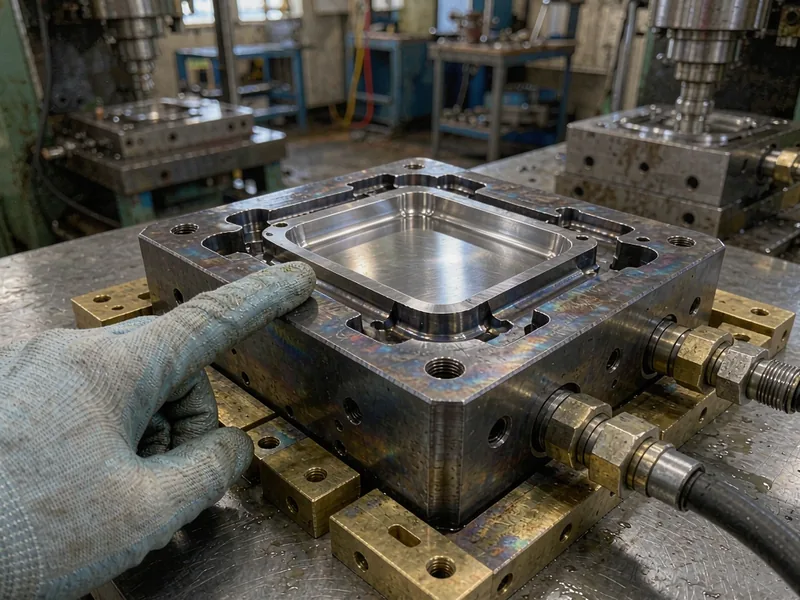
Thermal balance means the die reaches a steady state where every zone sits inside its working window. HKX runs die temperature controllers on separate circuits for the fixed half, the moving half and each slider, and the setpoints are tuned per part rather than copied from a similar job. A thermal image taken after 30 shots shows whether the hot spot landed where the simulation predicted.
This is where conformal cooling channels earn their tooling premium. A drilled line can only run straight; a printed insert can follow the boss contour and pull heat from the section that sets dwell. On a housing with a deep bearing boss, the saving is often 8-15 seconds per shot, which pays back the insert within a normal program life.
Buyers should treat die thermal design as a quotation item, not a black box. Ask how many cooling circuits the die has, whether the sliders are cooled, and what die temperature the cycle assumes. A supplier who answers in zones runs a controlled process; one who answers with a single number is guessing.
Machine Size, Cavity Count and Automation
Tonnage does not set die casting cycle time directly, but it constrains everything that does. A die sized for a 1,600 t machine cannot run on an 800 t press, and a machine near its rated locking force cannot use the full injection profile without flash. Sizing is covered in the guide to die casting machine tonnage, and the cycle consequence is simple: an undersized machine forces a slower shot and a longer dwell per shot.
Cavity count is the other multiplier. A two-cavity die doubles output per shot while adding 15-40% to the cycle, because the projected area doubles. At high volume the arithmetic favors two cavities. At 15,000 parts a year it does not, because the second cavity adds tooling cost and a scrap risk that runs in parallel.
Automation changes the shape of the cycle rather than its length. A robot that extracts and places the part on a trim press removes 3-5 seconds of manual handling, and it also removes the variability that makes a manual cell run 10% slower on the night shift. Inline trimming, conveyor cooling and automatic die spray together turn a 70 second manual cycle into a 62 second repeatable one.
Die change time belongs in the comparison. A cell that swaps a die in 25 minutes can hold a smaller batch economically than one that needs three hours.
How HKX Rebuilds a Cycle Without Shipping Scrap
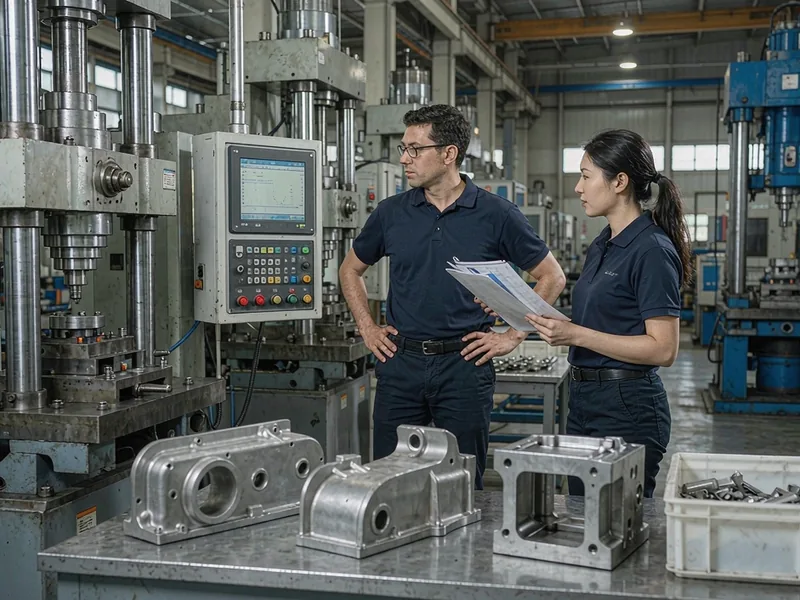
At HKX, work on die casting cycle time starts on a production cell rather than a spreadsheet. The engineering team at the Ningbo plant takes a part that has run for several months, logs 200 consecutive shots with the machine recorder, and splits the data into the phases above. Only then does anyone touch a setpoint.
The sequence is fixed. First, die temperature: each zone is checked against the process sheet with a contact probe at the start of shift, and the temperature controller setpoints are trimmed until the thermal image is even. Second, spray: the release agent dilution and the spray stroke are adjusted so the coating flashes off in 4-6 seconds instead of pooling in the ejector pockets. Third, dwell: the timer is stepped down in 0.5 second increments until ejection marks or distortion appear, then raised one step for margin.
Vacuum timing is reviewed at the same time. The valve must open before the metal reaches it and close before intensification, and a 20 millisecond error costs either porosity or a blocked valve. HKX sets the open and close points against the shot curve, then verifies with X-ray sampling under ASTM E505 at a documented frequency per shift.
The result is recorded on a one-page process sheet: gate velocity, intensification pressure, dwell, spray time, die temperature by zone, and the cycle time the cell is expected to hold. Buyers receive that sheet with the first article report, so the quoted cycle can be audited against the running process instead of trusted.
What HKX does not do is trade dwell for speed on a part that has not been validated. A cycle cut that opens porosity in a bearing bore shows up at the customer’s leak test, and that discovery costs more than the seconds saved.
Accept the Quoted Cycle or Challenge It
A buyer does not need to run a stopwatch to sanity-check a die casting cycle time. Four questions expose most optimistic numbers, and each has a documented answer the supplier should already have.
Ask for the phase split in seconds, the OEE assumption, the die temperature the cycle assumes, and the scrap rate it was validated at. A supplier with a real process answers all four from a process sheet; one quoting from experience estimates the rest.
| Quoted claim | What it usually means | How to test it | Disposition |
|---|---|---|---|
| 40 s cycle on a 2.5 kg housing | Shot-to-shot only, spray excluded | Request 20 consecutive gate-to-gate timings | Challenge the number |
| Cycle holds at 55 s | Measured at nominal 2.0 mm wall, drawing has 1.2 mm ribs | Compare drawing wall to the validated part | Clarify before tooling |
| Vacuum adds 30 s per shot | Valve maintenance folded into the cycle; actuation is 1-4 s | Ask for shot profile and valve service interval | Renegotiate the allowance |
| Two cavities cut piece price 25% | Cycle rises 15-40%, tonnage may jump a frame size | Model piece price at your actual annual volume | Accept above 40,000 parts a year |
| Cycle includes deburring | Inline trim press, robot transfer | Confirm trim die ownership and maintenance | Accept with written scope |
| Cycle improves 10% in year two | Learning curve, no process change committed | Ask which parameter changes and when | Decline as a price basis |
The pattern in the table is consistent: claims that shrink the clock without naming a process change are commercial, not technical. A supplier who can point to a cooling circuit, a spray adjustment or a dwell reduction has done the work. One who cannot is passing you risk in a piece price that will not hold.
What to write into the RFQ
An RFQ that produces a comparable cycle time states the alloy, the wall range, the annual volume and the inspection standard, then asks for the cycle broken down by phase. It also asks for the OEE and scrap assumptions used to convert cycle into capacity. Those five data points make two quotations comparable even when the suppliers run different machine sizes.
Add the non-negotiables: die temperature by zone, intensification pressure, vacuum level if applicable, and the porosity acceptance level referenced to a radiographic standard. HKX works to ISO 8062-3 for casting tolerances and quotes stock allowance against it, so a buyer can see how much machining the casting will need.
Finally, ask for the process sheet with the first article report. A cycle time that cannot be reproduced on the shop floor is a planning assumption, not a manufacturing capability. The manufacturing process overview shows what HKX documents at each stage, from die trials to PPAP submission.
Frequently Asked Questions
What is a normal cycle time for an aluminum die casting?
Most cold chamber HPDC parts run 45-120 seconds gate-to-gate, and that die casting cycle time band holds across alloy families. A 0.5-1 kg housing with 2-3 mm walls lands near 45-65 seconds, a 3-5 kg housing near 70-115 seconds. Parts with 8 mm sections or heavy bosses exceed 120 seconds because dwell sets the clock.
How much of the cycle is actual injection?
Fill takes 0.03-0.2 seconds and intensification under 1.2 seconds, so the shot is under 2% of a 60 second cycle. Do not buy a cycle reduction that claims to come from faster injection. Buy it from cooling, spray discipline and handling.
Does a thicker wall always lengthen the cycle?
Yes, and disproportionately. Cooling time rises roughly with the square of section thickness, so moving from 3 mm to 6 mm can add 15-20 seconds of dwell. A local boss is enough to set the whole cycle, which is why DFM review of thick sections returns more value than most price negotiations.
Can a supplier shorten the cycle on an existing die?
Usually by 5-15%, through die temperature tuning, spray reduction and dwell trimming verified by X-ray and dimensional checks. Gains beyond that need cooling changes inside the die, such as baffles, bubblers or conformal inserts, which means tooling work and a fresh validation run.
How does vacuum die casting change the cycle?
It adds 1-4 seconds for valve actuation, evacuation and valve maintenance, and it can add dwell because a vacuum die is often run hotter to improve fill. The trade is worth it when the part must pass a leak test or carry structural loads, because the porosity margin removes a sorting operation downstream.
Why does cycle time drift upward after six months?
Cooling circuits scale, spray nozzles wear, ejector pins gall and die temperature setpoints get adjusted informally. A drift of 8-12% over six months is common without a documented process sheet and monthly re-validation. Ask for the shot log and the cooling circuit cleaning interval.
Author: HKX Engineering Team
HKX — Ningbo Hexin Mould Co., Ltd., an aluminum die casting manufacturer in Ningbo, China, with 30+ years of tooling experience, in-house machining and finishing, ISO 9001 and IATF 16949 certification, and customers in more than 20 countries.
Talk to the HKX Engineering Team
Send the drawing with the wall range, the annual volume and any leak or porosity requirement, and the HKX team will return a phase-by-phase die casting cycle time estimate before quotation. The package includes DFM feedback on thick sections, a recommended machine and cavity count, first article and X-ray sampling plans, and the process sheet the cell will run to. To start, contact our engineering team with the 3D model and the tolerance block.