Trivalent and hexavalent chromate do the same job by different chemistry, and the choice is now a compliance decision more than a performance one. Hexavalent Cr(VI) baths still give the longest unpainted salt spray life and the widest process tolerance, but RoHS, ELV and REACH restrict them. Trivalent Cr(III) baths meet those rules and reach 168-240 h of salt spray with correct pretreatment. Any trivalent vs hexavalent chromate decision comes down to three questions: what the drawing requires, how long the part must last unpainted, and whether a topcoat follows.
Key Takeaways
- RoHS restricts hexavalent chromium to 0.1% by weight in a homogeneous material, which removes Cr(VI) coatings from most consumer and automotive parts.
- Hexavalent chromate self-heals at scratches because soluble Cr(VI) migrates to damaged areas; trivalent films cannot, and depend on pretreatment instead.
- Expect 168-336 h of neutral salt spray from a hexavalent film and 96-240 h from a trivalent film on the same aluminum, unpainted.
- Under paint the gap nearly closes, and trivalent is the better base because it survives a 180-200 °C powder cure.
- Class 3 trivalent coatings hold contact resistance under 1 mΩ, covering chassis grounding and EMI parts.
- Specify coating weight, salt spray hours, contact resistance and a Cr(VI) test method, or you are buying a color rather than a coating.
What Each Chemistry Actually Is
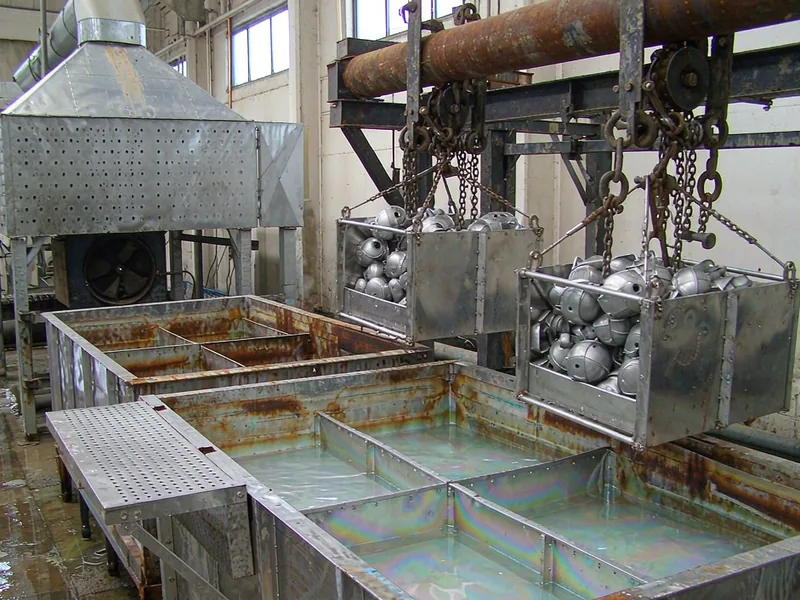
Any trivalent vs hexavalent chromate comparison starts with the chemistry, because the two films look similar and behave differently. Both coatings are conversion films: the bath reacts with the aluminum surface and builds a thin mixed oxide layer containing chromium, aluminum and fluoride species. Neither is a plating, and neither adds meaningful thickness. The difference sits in the oxidation state of the chromium and in what that chromium can still do once it is in the film.
The hexavalent route
A traditional chromate bath is built on chromic acid with fluoride accelerators, run near pH 1.5-2.5 and 20-35 °C. Immersion for 30 seconds to five minutes produces 0.2-1.0 µm of film at 20-100 mg/ft², colored from clear to iridescent yellow or brown. Part of the chromium remains as soluble Cr(VI) trapped in the film. That soluble fraction is the source of the performance advantage and of the regulatory problem.
The trivalent route
Trivalent baths use chromium(III) sulfate or chloride with zirconium, titanium or cobalt salts and an oxidizing agent. They run at pH 3.5-4.5 and 20-40 °C for 30-120 seconds and build 10-40 mg/ft² of clear to pale blue film. With no Cr(VI) present there is no soluble reservoir to migrate later. Coverage is harder to see, so most lines add a dye. According to the technical literature on chromate conversion coating, losing that reservoir is exactly why trivalent films behave differently at damage.
The designations buyers still quote
Most RFQs cite MIL-DTL-5541, where Type I is hexavalent and Type II is trivalent. Class 1A denotes a thicker coating for maximum corrosion protection, Class 3 a thin coating for low resistance. A drawing that says “chem film per MIL-DTL-5541, Class 3” without a type lets the supplier choose either chemistry, which is how a compliant and a non-compliant part end up under one part number.
| Property | Hexavalent chromate (Type I) | Trivalent chromate (Type II) |
|---|---|---|
| Chromium oxidation state | Cr(VI), carcinogen 1A | Cr(III), not classified as a carcinogen |
| Bath pH and temperature | 1.5-2.5, 20-35 °C | 3.5-4.5, 20-40 °C |
| Typical coating weight | 20-100 mg/ft² | 10-40 mg/ft² |
| Appearance | Clear to iridescent yellow or brown | Clear to pale blue, usually dyed |
| Self-healing at scratches | Yes, soluble Cr(VI) re-passivates | No |
| Neutral salt spray, unpainted | 168-336 h | 96-240 h |
| Contact resistance, Class 3 | < 1 mΩ | < 1 mΩ |
| After a 200 °C bake | Protection largely lost | Retains most protection |
| RoHS and ELV status | Restricted, exemptions narrowing | Compliant |
| Waste treatment | Cr(VI) reduced to Cr(III) before discharge | Precipitation only |
| Relative process cost index | 1.0 | 0.9-1.2 |
The table explains why the transition happened in the order it did. Consumer electronics moved first because RoHS enforcement is simple on a homogeneous material. Automotive followed as ELV reporting tightened. Aerospace and defense are last, because qualifying a process change on a flight-critical part costs more than the compliance risk.
The Compliance Picture in Plain Terms
The compliance half of a trivalent vs hexavalent chromate decision is where most buyers get a partial answer and stop. Three regimes matter, and they do not all apply to the same product, which is why a supplier can be truthful and still not answer your question.
RoHS
RoHS restricts hexavalent chromium to 0.1% by weight in any homogeneous material. A conversion coating is assessed as its own homogeneous material, not as a fraction of the finished part, so a film containing Cr(VI) at percent level fails even though the whole part contains almost none. Screening is normally done by XRF, with a confirmatory wet test where XRF finds chromium, following the IEC 62321 series. That is why most electronic enclosures moved to trivalent years ago, and the same pressure drives the lead and cadmium limits covered in RoHS-compliant casting alloys.
ELV and REACH
The EU End-of-Life Vehicles Directive limits hexavalent chromium to 2 g per vehicle, averaged across the whole vehicle. REACH adds a second layer: chromium trioxide and several chromate salts sit on the authorisation list, so continued use needs a granted authorisation, and the family is also identified as substances of very high concern. A supplier that has not checked its own authorisation position may run a legal process today and an illegal one next year. Ask for the RoHS and REACH statement in writing, for the specific chemistry, on the specific part number.
The worker-safety layer
Hexavalent chromium is a respiratory carcinogen, so compliance is also a plant question. A Cr(VI) line needs local exhaust ventilation, mist control, air monitoring and medical surveillance in most jurisdictions, plus a reduction step in waste treatment before discharge. A trivalent line needs ventilation and pH control but not carcinogen controls. When a finisher quotes trivalent at close to hexavalent pricing, this overhead is part of the reason: the Cr(VI) compliance cost rose, and the trivalent bath did not get cheaper.
Material declarations follow the same logic. An automotive part usually needs an IMDS entry, and the coating appears there as a separate material with its own declaration. A trivalent film can be declared without a Cr(VI) exemption note; a hexavalent film cannot, and that entry is visible to every downstream customer in the chain.
Where the Performance Gap Is Real
The performance half of a trivalent vs hexavalent chromate decision is usually argued with numbers quoted out of context, which is why they sound contradictory. The gap is real, but it is narrow in some situations and wide in others.
Unpainted outdoor exposure
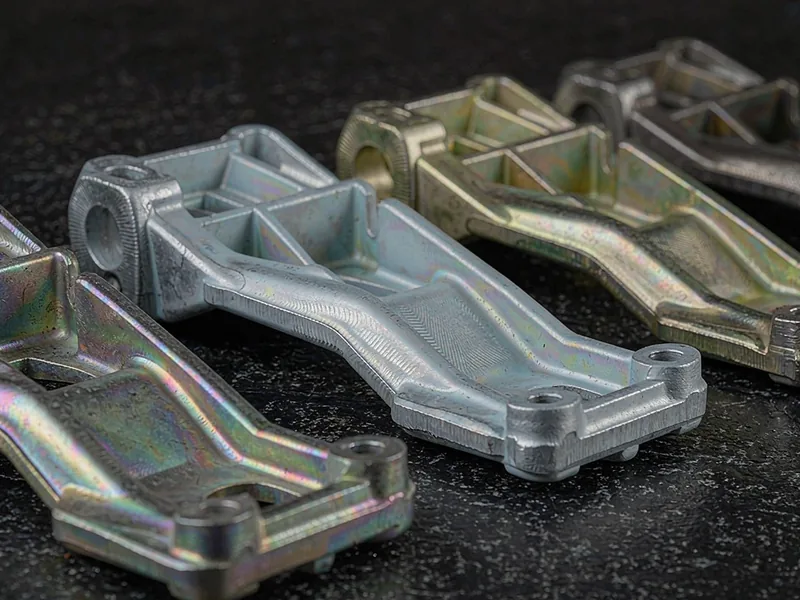
On bare aluminum with no topcoat, hexavalent chromate wins clearly. The soluble Cr(VI) migrates to a scratch and re-passivates the exposed metal, so damage stays local. Trivalent coatings have no such reservoir: a scratch exposes bare aluminum and corrosion starts there and creeps under the film. For an unpainted part that sits outdoors for years, that difference is the whole argument, and bath tuning does not replace it. The mechanism is the same one described in corrosion behavior of cast aluminum alloys.
Under paint
Once a part is painted, the topcoat becomes the corrosion barrier and the conversion coating becomes an adhesion promoter plus a fallback at defects. Under those conditions the two chemistries land within a few hundred hours of each other, and heat becomes the deciding factor. A powder coat cures at 180-200 °C for 10-15 minutes. A hexavalent film heated to that range loses most of its protection; a trivalent film retains most of it. According to ASM International, coating selection for painted aluminum should follow the full thermal history of the part, not just the conversion step.
Electrical resistance and rework
Both chemistries can meet Class 3 contact resistance, under 1 mΩ at typical probe pressure, because both films are thin enough to conduct through their asperities. Hexavalent films stored in humid air can build surface oxide and drift upward in resistance; trivalent films are more stable in storage but more sensitive to rinse residue. Rework differs too: a damaged hexavalent film can be touched up with a chromate pen, which aerospace depots rely on, while a trivalent film is normally stripped and recoated. Budget that rework rate into the comparison instead of assuming both routes scrap the same percentage.
Picking a Route by Application
A trivalent vs hexavalent chromate decision collapses quickly once the application is named. Below is the pattern HKX sees across automotive, lighting and enclosure programs.
| Application | Recommended chemistry | Why | Watch-out |
|---|---|---|---|
| Automotive underhood housing, painted | Trivalent, Class 1A | ELV compliance plus a heat-stable paint base | Pretreatment decides salt spray, not the bath brand |
| EV battery tray, controller enclosure | Trivalent, Class 3 on ground pads | RoHS and contact resistance on one part | Mask pads before coating, not after machining |
| Electronic chassis with EMI gaskets | Trivalent, Class 3 | Low resistance, no Cr(VI) declaration issue | Gasket contact area must stay coating-thin |
| Outdoor lighting housing, unpainted | Trivalent plus powder coat, or hexavalent where still permitted | Bare aluminum needs the self-healing film | Check the destination market before quoting |
| Aerospace or defense legacy part | Type I per drawing, or an approved Type II substitution | Drawing and qualification control the choice | Substitution needs customer approval |
| Casting with machined bores | Trivalent, coated before final machining where possible | Avoids masking and touch-up | Machining after coating strips the bore |
Two rows carry most of the volume. Automotive housings, aluminum motor end covers and EV enclosures have already converted to trivalent in most programs, so the remaining work is documentation rather than chemistry. Outdoor unpainted parts are where hexavalent still earns its place, and those are also the parts most exposed to the next restriction. Specifying a compliant chemistry now avoids a requalification later. For a part that ships to several markets, the practical rule is to specify the strictest chemistry any destination allows and keep one part number across all of them, so a shipment cannot be diverted against a drawing it no longer meets.
Acceptance Criteria and How to Audit Them
In a trivalent vs hexavalent chromate audit, a conversion coating is thin enough that a visual check tells you almost nothing, and the spray booth paints over whatever the conversion step produced. The surface finishes page lists the full sequence from deburring to packing. The five requirements below can all be measured, and all of them can be verified from a certificate without visiting the plant.
| Requirement | Method | Typical value | What it catches |
|---|---|---|---|
| Coating weight | Gravimetric strip, ASTM B137 | 20-40 mg/ft² trivalent, 40-100 hexavalent | Weak bath, short dwell, poor activation |
| Salt spray, unpainted | ASTM B117 or ISO 9227 NSS, 5% NaCl, 35 °C | 168 h minimum, 240 h target | Pretreatment failure a visual check misses |
| Paint adhesion | Cross-hatch, ASTM D3359 | 4B or better after cure | Over-thick film or inadequate rinse |
| Contact resistance | 4-wire, 200 g probe load | < 1 mΩ on Class 3 areas | Film too thick on grounding pads |
| Hexavalent chromium | XRF screening plus spot test, IEC 62321 | Not detected | A Type I film shipped against a Type II drawing |
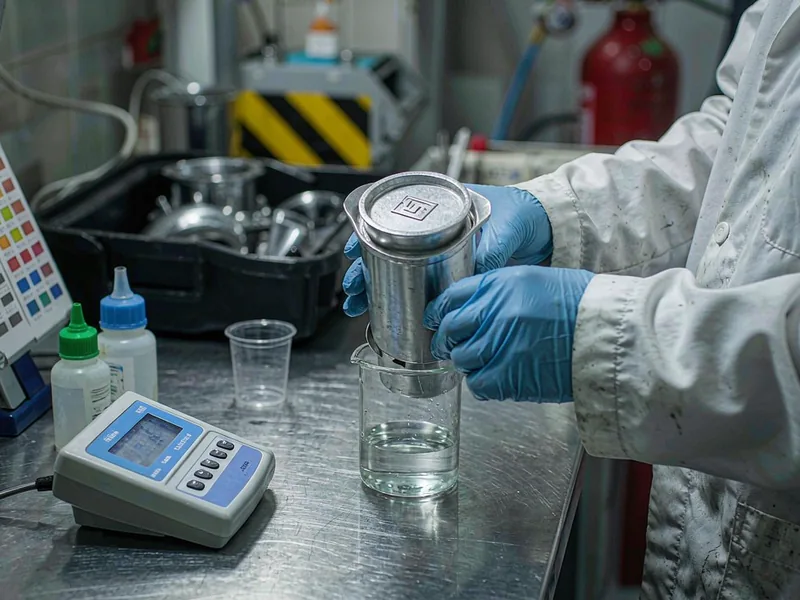
The salt spray row should name the standard, not just the hours: ASTM B117 and ISO 9227 NSS use the same fog but differ in acceptance rating, so a 240 h claim means different things under each. The last row is the one to insist on. A diphenylcarbazide spot test turns pink or violet in the presence of Cr(VI), takes two minutes, and runs on a production part rather than a coupon. Ask for the bath analysis record as well: pH, chromium concentration and fluoride level, measured daily, say more about the process than any appearance standard.
How HKX Runs Conversion Coating on Die Castings
At HKX, the trivalent vs hexavalent chromate question is answered with measurements rather than a bath label, because the film is too thin to inspect visually and too important to guess at. Castings arrive after deburring and an alkaline clean, and the first control point is rinse quality: final deionized rinse conductivity is held below 10 µS/cm, since residue at that stage appears later as adhesion loss under powder coat. The trivalent bath runs at pH 3.8-4.2 and 30-35 °C with a 60-90 second dwell, and coating weight is held at 20-40 mg/ft², verified gravimetrically on a stripped panel each shift. A blue dye lets operators see coverage, but dye intensity is never the acceptance criterion. Bath chemistry is titrated daily for chromium and fluoride, and pH is logged every two hours; a drifting pH is the most common cause of a coating that looks right and fails salt spray at 96 h.
Each lot carries three witness castings from the same shot, coated with the production load. One goes to salt spray, one is retained for 12 months with the lot number, and one is sectioned for coating weight. A diphenylcarbazide spot test runs on five parts per lot to confirm no Cr(VI) is present, and XRF screens three parts for the RoHS file. Those results plus the bath log form the coating report that ships with the inspection documents and feed the IMDS declaration for automotive customers. When a customer moves from Type I to Type II on an existing part, HKX runs a side-by-side salt spray comparison on the same casting lot before the drawing revision is released, so the performance change is documented rather than assumed.
Frequently Asked Questions
Is trivalent chromate as good as hexavalent?
Unpainted and outdoors, no: hexavalent reaches 168-336 h of neutral salt spray against 96-240 h, because only Cr(VI) self-heals at scratches. Painted, or where a 200 °C cure follows, trivalent is equal or better. Most trivalent vs hexavalent chromate decisions turn on whether a topcoat is included.
Does MIL-DTL-5541 allow trivalent chemistry?
Yes. Type II covers the trivalent process and Type I covers hexavalent, while Class 1A and Class 3 define coating thickness and resistance rather than chemistry. A drawing that names Class 3 without a Type leaves the choice open, so add the Type when compliance depends on it.
Can a trivalent coating be used on ADC12 castings?
Yes, and it is the common choice. High-silicon castings take conversion coatings less evenly than wrought aluminum because silicon does not react, so the film forms mainly on the aluminum matrix. That makes pretreatment and rinse quality more important than the chemistry choice.
How do I prove a coating contains no hexavalent chromium?
Use two methods together. XRF screening gives a fast pass or fail on chromium content, and a diphenylcarbazide spot test confirms the oxidation state by color. Ask for both on the production lot plus the bath log, because a certificate that only claims RoHS compliance does not prove which chemistry ran that day.
Why did my coating fail salt spray when it passed last year?
Conversion coatings fail from process drift far more often than from a chemistry change. Rinse conductivity, pH, fluoride level and dwell all move slowly, and a film 30% under weight looks identical to the eye. Compare coating weight and bath logs from the failing lot against the last good one before changing the specification.
Is a dyed trivalent coating acceptable on cosmetic parts?
Only if the color is specified as a coating indicator rather than a finish. The dye exists so operators can see coverage, and it fades under UV. Parts seen by an end user normally receive a powder coat or paint over the conversion layer.
Author: HKX Engineering Team
HKX — Ningbo Hexin Mould Co., Ltd., an aluminum die casting manufacturer in Ningbo, China, with 30+ years of tooling experience, in-house machining and finishing, ISO 9001 and IATF 16949 certification, and customers in more than 20 countries.
Talk to the HKX Engineering Team
Send the drawing with the coating callout, the destination market and the annual volume, and HKX will confirm which chemistry the specification actually requires, what salt spray hours that chemistry reaches on your alloy, and what documentation ships with the parts. Deliverables include a coating report with coating weight and spot test results, the bath log for the lot, salt spray data on witness castings, and RoHS and IMDS declarations that name the chemistry. Where a legacy drawing still calls for Type I, HKX will quote the compliant alternative and the test evidence needed to support a drawing change. To start, contact our engineering team with the part number and the market the product ships to.