HKXCAST One-Stop Aluminum Alloy Product Solutions Provider Email :hkxcast@163.com
 09/01/2025
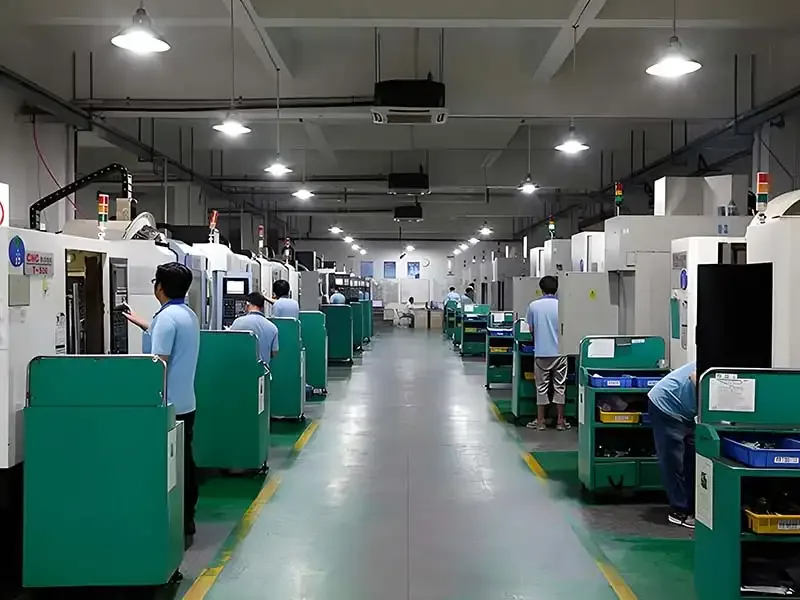
Understanding the real cost of CNC machining is critical for manufacturers, product designers, and procurement professionals. Whether you work in an engine machine shop or are evaluating automotive machine shops for a production run, this guide will help you grasp the cost drivers and practical strategies to reduce expenses while maintaining quality. What is CNC Machining? (A Quick Refresher) CNC (Computer Numerical Control) machining uses computer-controlled tools to remove material from a workpiece to create custom parts. It’s a staple process across industries—used in aerospace, electronics, and automotive machine shops. The process includes milling, turning, drilling, and grinding, all programmed via CAM software. Modern CNC machine shops, including machine workshop operations and metal machining shops, rely on precision programming to deliver parts with tight tolerances and high repeatability. Why CNC Machining Costs Vary: The Core Challenge No two machining jobs are the same, which is why CNC machining cost varies widely. Design complexity, material type, volume, and even the geographic location of your provider (e.g., machine shops in South Carolina vs. California) all contribute. As more businesses search for “auto machine shops near me,” understanding these cost drivers helps ensure accurate quotes and budget forecasting. Key Factors Influencing CNC Machining Costs (Deep Dive) 4.1 Material Selection & Cost Material costs can make up a significant portion of a machining quote. Basic aluminium is generally cheaper, especially when sourced in bulk, while specialty metals like titanium or stainless steel anodizing raise costs. Anodizing (or annodize/anotizing/anodyzed/anodisé) further adds value and durability but increases machining cost. Services like ace anodizing offer various finishes, often required in high-end consumer and aerospace applications. 4.2 Part Design & Complexity The more complex your part, the higher the machining cost. Tight tolerances, intricate geometries, undercuts, and deep cavities require longer machine time, specialized tooling, and more manual…
 08/29/2025
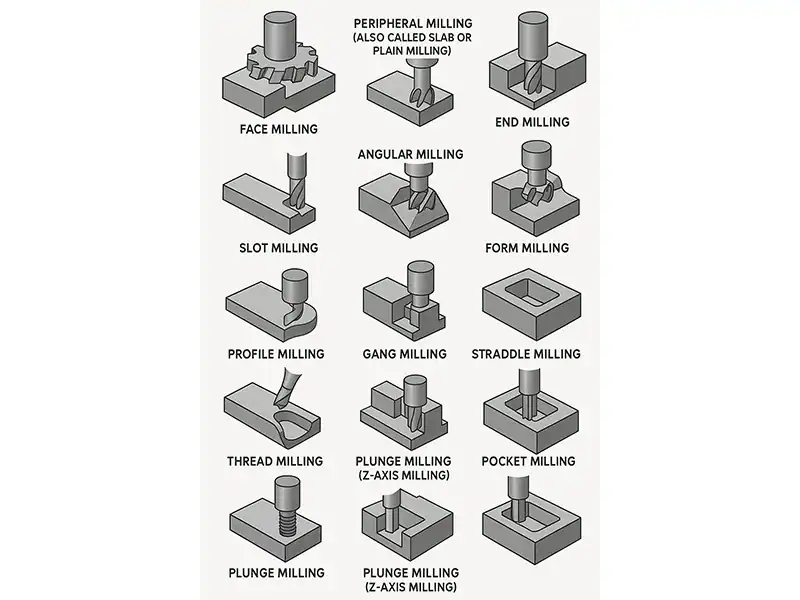
Milling is a critical machining process that uses rotary cutters to remove material from a workpiece. Known for its versatility and precision, it plays a vital role in manufacturing across industries like automotive, aerospace, mold-making, and general engineering. This guide explores the 12 essential types of milling operations, offering practical insights into how each technique works, where it applies, and how CNC enhances their effectiveness. How Milling Works Milling machines operate through coordinated movements along the X, Y, and Z axes. A workpiece is fixed in place while a rotating cutter moves across or into it, removing material to achieve the desired shape. These machines can be operated manually or controlled by CNC systems for high accuracy and repeatability. 1. Face Milling Face milling is a machining process that creates flat surfaces by cutting with the tool’s face—the bottom of a rotating cutter. The axis of the cutter is perpendicular to the workpiece surface, and the cutter typically has multiple replaceable carbide inserts arranged in a circular pattern. This operation is used primarily to smooth or level the top surface of a part. It allows for efficient material removal over large areas and produces a high-quality surface finish. Face milling is commonly used in the initial phases of part production to prepare the surface for more detailed machining. 2. Peripheral Milling (Also Called Slab or Plain Milling) Peripheral milling removes material using the cutter’s edge (periphery), with the tool axis parallel to the work surface. Unlike face milling, which targets flat faces, peripheral milling is ideal for machining long vertical surfaces such as shoulders, ledges, and side walls. The operation typically uses a plain milling cutter with straight or helical teeth. It’s efficient for removing bulk material and is often used to prepare parts for fitting, assembly, or further machining…
 08/26/2025
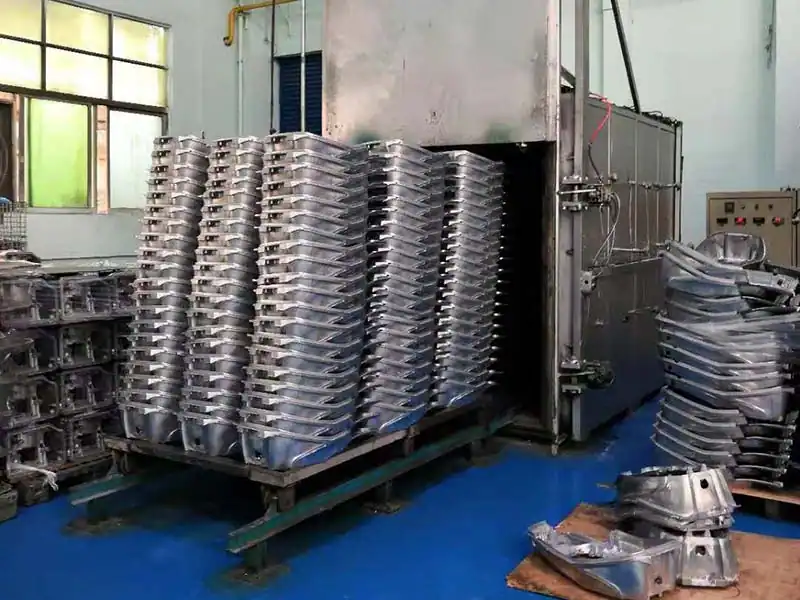
Start here. This page is the overview of heat treatment for cast aluminum alloys: what each process does, how the T4 / T5 / T6 states are built, and which defects show up on the shop floor. The individual processes have their own pages, and the table below says which one to read next. Process What it does to the casting Where to read more Annealing Relieves stress, softens the part, spheroidises silicon. No strength gain. What is annealing? Solution treatment (quench) Dissolves the alloying elements, then quenches fast enough to hold them in supersaturated solution. This is the T4 step. Section 2, below Artificial aging Precipitates fine particles and raises yield strength. Turns T4 into T6. Section 3, below Stabilising Low-temperature hold that locks dimensions in a part which will see service heat. Section 3, below Diffusion / homogenisation annealing Removes dendrite segregation from the as-cast structure before machining. Types of annealing The order matters, and the direction is not reversible. Annealing is a dead end for strength: you anneal when the part has to be soft or dimensionally stable, not when it has to be strong. Strength comes from solution treatment plus aging, and those two steps only work on alloys whose chemistry responds to them — ZL101A, ZL104, ZL105 and ZL107 among the gravity grades. The high-silicon die casting grades generally do not respond, and quenching a porous HPDC part blisters it. Which grade responds is decided by chemistry, not by the furnace. 1. Characteristics and Objectives of Cast Aluminum Alloy Heat Treatment As mentioned earlier, the metallurgical structure of cast aluminum alloys is coarser than that of wrought aluminum alloys, leading to differences in their heat treatment. The former requires longer holding times, generally exceeding 2 hours, while the latter requires shorter holding times, sometimes only…
 08/24/2025
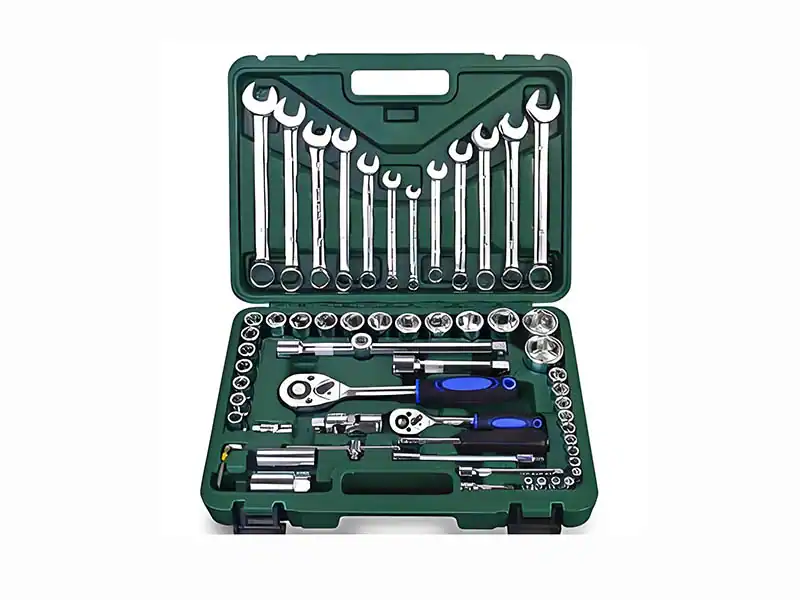
That satisfying whirr of a well-tuned lathe, the clean shaving of steel peeling away under a sharp cutter, the final part sliding perfectly into place with micron-level precision – this is the magic of machining. But behind every perfect cut and flawless fit lies a foundation of essential machinist tools. Whether you’re a weekend hobbyist building a model engine, a maker crafting custom motorcycle parts, or a seasoned pro setting up a new shop, having the right tools isn’t just convenient – it’s the difference between frustration and triumph, between wasted material and masterpiece, between safety and hazard. Feeling overwhelmed? Wondering where to start or if your workshop is truly complete? Stop guessing. This definitive 2025 checklist breaks down the must-have machinist tools into logical categories, covering everything from the absolute basics to precision-enhancing upgrades. We’ll prioritize based on need and budget, offering practical pro-tips along the way. Bookmark this guide – it’s your roadmap to a workshop built for precision and success. I. The Bedrock of Accuracy: Measurement & Layout Tools (Measure Twice, Cut Once!) Precision machining starts with precise measurement. Without accurate data, even the best cuts are just guesses. This category is non-negotiable for any level of machining work. II. Shaping Metal: Cutting, Forming & Finishing Tools (Making the Cut) These are the tools that directly remove metal, create shapes, add threads, and clean up edges. They turn measurement into reality. III. Holding It All Together: Workholding & Fastening Tools (Secure Your Work!) Precision and safety demand rock-solid workholding and the right tools for assembly. Your workpiece must be immovable. IV. Powering Up: Core Workshop Machinery (Level Up Your Capability) These machines dramatically expand your capabilities, efficiency, and the types of projects you can tackle. Investment increases significantly here. V. Precision & Protection: The Supporting Cast (The Finishing Touches & Non-Negotiables) These tools elevate your precision on machines…
 08/21/2025
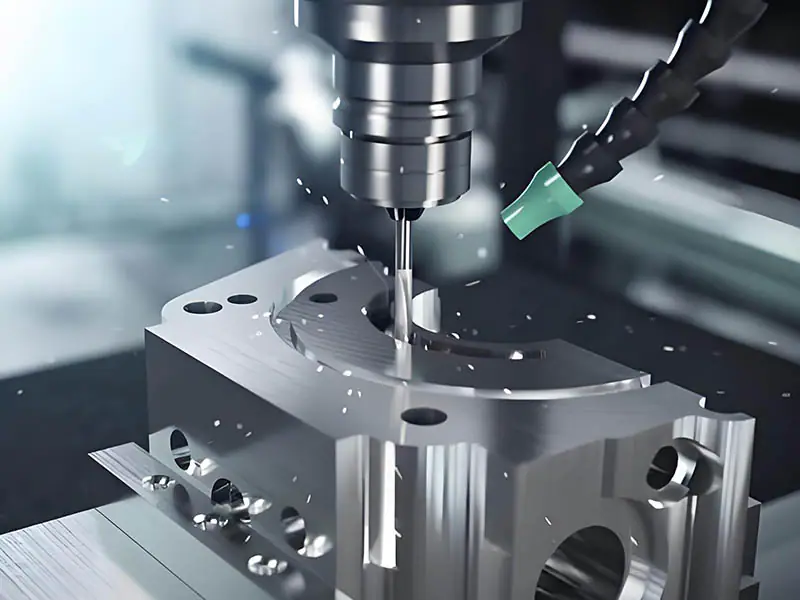
In manufacturing industries such as machinery equipment production and casting, we often encounter the term “CNC machining.” So, is CNC machining important in manufacturing? Yes, it is crucial. CNC (Computer Numerical Control) is a manufacturing technology that automates machine tools using pre-programmed software and code, enabling precise control over operations like cutting, shaping, drilling, or milling to produce parts. This article will delve into how CNC machines operate and explain why they are so indispensable in manufacturing components for automotive parts, general machinery, and beyond. What is CNC Machining? Computer Numerical Control Machine (CNC) is a processing tool that converts pre-designed graphics or 3D graphics of the parts to be processed into complex CNC mechanical movements using 3D programming software, including lathes, grinders, milling machines, drilling machines, etc. CNC machines can process materials or die-cast blanks by using the cutting paths generated by the programming software. Core Principle: CAD models → CAM-generated G-code → Machine execution. The History of CNC Machining The history of CNC processing began in the late 1940s, when John Parsons proposed the concept and collaborated with MIT to develop it. Initially, it was designed to solve the problems of manufacturing complex aviation components. The machine tools were controlled using punched paper tapes (referred to as NC). With the development of computer technology, in the late 1960s to the 1970s, small computers were integrated into the control unit, giving birth to the true CNC (Computer Numerical Control), which enabled program storage, editing, and more complex functions. Subsequently, the maturity of microprocessors, CAD/CAM software, the improvement of multi-axis processing capabilities, and the promotion of networked intelligence (Industry 4.0) transformed CNC from an expensive and complex specialized equipment into the core cornerstone of modern manufacturing for achieving high precision, high efficiency, and high flexibility automated production, completely changing the way of…
 08/18/2025
The manufacturing landscape employs diverse techniques to shape metals, balancing precision, strength, and efficiency. Casting methods like die casting (high-pressure injection into reusable molds) and sand casting (low-cost, expendable sand molds) cater to volume and size needs. Investment casting achieves intricate designs via wax patterns, while lost foam and centrifugal casting enhance efficiency and material integrity. Forging (die/drop) strengthens metals via compression, refining microstructure. Rolling (hot/cold) forms sheets/bars via rollers. Modern additive methods (SLM/SLS) enable complex geometries via laser-fused powders. Metal injection molding merges powder metallurgy with injection principles for small, precise parts. Stamping, drawing, and squeeze casting optimize sheet/semi-solid forming. Processes like continuous casting and roll forming streamline mass production, while grinding and machining (turning/milling) ensure precision. Innovations like metal deposition and die-cutting expand repair and shaping capabilities. Each technique addresses unique demands, driving advancements in aerospace, automotive, and industrial sectors.
 08/16/2025
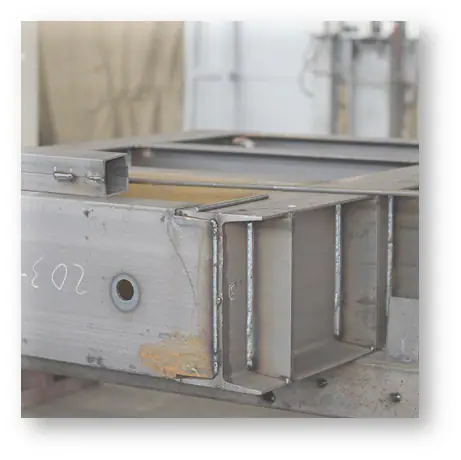
When it comes to welding, two of the most popular methods are MIG (Metal Inert Gas) and TIG (Tungsten Inert Gas). Both techniques have their own strengths and are widely used in various industries. However, choosing between them can be a bit overwhelming, especially for beginners or those new to welding. In this article, we’ll break down the key differences between MIG and TIG welding, helping you decide which method is best suited for your needs. 🔍 Understanding MIG Welding What is MIG Welding? MIG welding, also known as Gas Metal Arc Welding (GMAW), uses a continuous solid wire electrode that is fed through a welding gun. The process involves an electric arc between the wire and the base material, melting both to create a strong bond. A shielding gas, typically argon or a mix of argon and carbon dioxide, protects the weld from atmospheric contamination. Key Features of MIG Welding Ideal Applications 🔍 Understanding TIG Welding What is TIG Welding? TIG welding, or Gas Tungsten Arc Welding (GTAW), uses a non-consumable tungsten electrode to produce the weld. Unlike MIG welding, TIG welding requires the welder to manually feed a separate filler rod into the weld pool. A shielding gas, usually pure argon, protects the weld area from oxidation. Key Features of TIG Welding Ideal Applications 🤔 How to Choose Between MIG and TIG Welding? Choosing between MIG and TIG welding depends on several factors, including your project requirements, skill level, and available resources. Here’s a breakdown to help you decide: 1. Project Complexity 2. Skill Level 3. Cost Considerations 4. Aesthetics 💡 Final Thoughts Both MIG and TIG welding have their place in the world of metalworking. MIG welding is versatile, fast, and beginner-friendly, making it suitable for a wide range of applications. On the other hand, TIG welding…
 08/13/2025
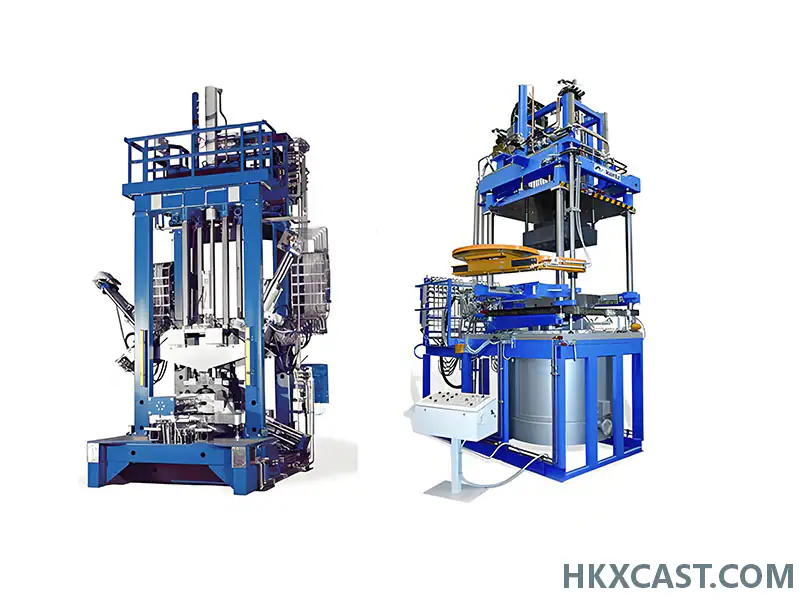
Introduction Low pressure die casting is a highly advanced metal forming process that has become indispensable in modern manufacturing. Unlike traditional gravity or high-pressure casting methods, low pressure die casting involves injecting molten metal into a mold under controlled, low-pressure conditions. This technique offers significant advantages in terms of product quality, efficiency, and versatility. In this article, we will delve into the detailed process of low pressure die casting, its key technologies, and its wide-ranging applications across various industries. Additionally, we will explore the benefits, challenges, and future trends shaping this dynamic field. Low-pressure casting machine The Basic Principle of Low Pressure Die Casting The core principle of low pressure die casting lies in its ability to inject molten metal into a mold at pressures typically ranging from 0.5 to 1.5 bar. This low-pressure environment minimizes gas entrapment, reduces porosity, and enhances the density and surface finish of the castings. Compared to gravity casting, where metal flows under the force of gravity, low pressure die casting ensures a more controlled and uniform filling of the mold cavity. Key Advantages of Low Pressure Die Casting: Low-pressure-casting-production-process The Detailed Process of Low Pressure Die Casting The low pressure die casting process consists of several critical steps: Step 1: Preparation Step 2: Low Pressure Injection Step 3: Cooling and Solidification Step 4: Demolding and Post-Processing Key Equipment and Technologies in Low Pressure Die Casting Effective implementation of low pressure die casting relies heavily on advanced equipment and cutting-edge technologies. Primary Equipment Critical Technologies Applications of Low Pressure Die Casting Low pressure die casting finds extensive use across multiple industries due to its ability to produce high-quality, complex parts with precision. Automotive Industry Aerospace Industry Electronics and Appliances Industry Building and Hardware Industry Advantages and Challenges of Low Pressure Die Casting Advantages Challenges Future…
 08/05/2025
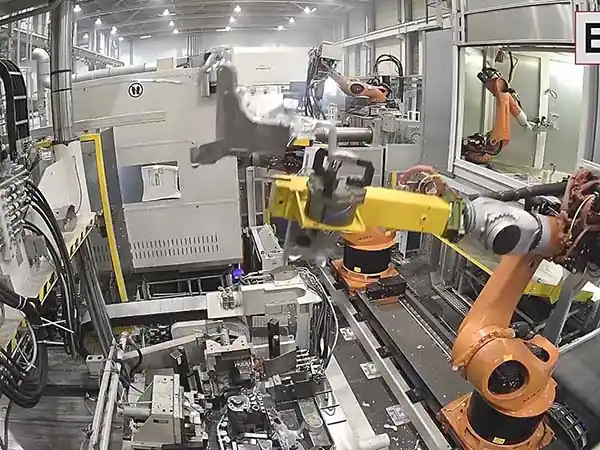
With fast economic growth, industries like cars, communication equipment, trains, and machinery are growing quickly. This has made die casting develop fast too. Now, die cast products are more varied and complex, and the need for automation is higher. For the die casting industry, the quality of castings decides its success. Moving toward high-end die cast products is the future, so stable quality is more important than ever. In this guide, we will explain: What is Automotive Die Casting? How die casting automation works? Why it matters for manufacturing (like cars). How to pick the right factory for your needs. What is Automotive Die Casting? Auto die casting is a manufacturing method where melted metal is poured into a mold under high pressure to create car parts. It’s widely used because it makes parts that are lightweight, strong, and cheap to produce. For example, engine blocks, gearboxes, and even electric vehicle (EV) battery cases are often made this way. Die-casting automation involves related processes such as spray, part removal, deburring, deburring, and cleaning How Does Automotive Die Casting Work? The auto die casting process has four simple steps: Step 1: Melt the MetalMetals like aluminum, zinc, or magnesium are heated until they turn into liquid. Step 2: Inject Liquid into a MoldThe liquid metal is pushed into a steel mold at high pressure. This ensures the metal fills every part of the mold. Step 3: Cool and Remove the PartAfter a few seconds, the metal cools down and hardens. The mold opens, and the part is taken out. Step 4: Trim and FinishExtra metal (like flash or sprues) is cut off, and the part is polished or coated if needed. Why Use Die Casting for Cars? Here are four reasons why car makers love die casting: 3.1 Saves Money 3.2 Strong &…
 08/02/2025
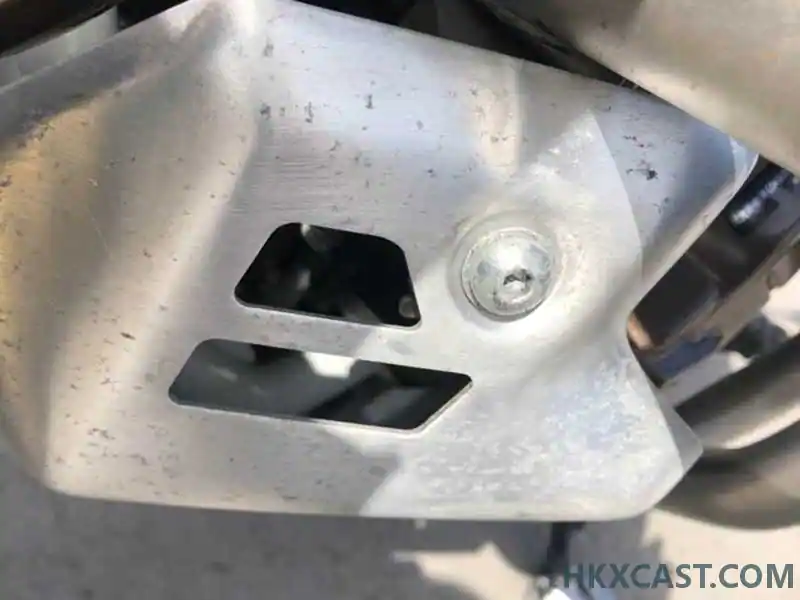
Our engineers often get asked: “Will aluminum parts rust like old iron tools?” Simply put, no—aluminum doesn’t “rust” in the same way as iron. But that doesn’t mean it can’t corrode. In fact, aluminum corrodes even more easily than iron! However, when aluminum corrodes, it still looks clean and shiny, unlike iron, which becomes covered in ugly red flakes. Let’s take a closer look at the science behind aluminum corrosion and why it’s a top choice for durable industrial parts. Does aluminum rust? Aluminum (symbol: Al, atomic number: 13) is a lightweight, silver-white metal. On the periodic table, aluminum is a very reactive metal, so in theory, it should corrode easily. So why do people often say aluminum doesn’t rust? Here’s why: When exposed to air, aluminum quickly reacts with oxygen to form a thin layer of aluminum oxide (Al₂O₃)—only about 2-10 nanometers thick. This layer: Because of this, aluminum usually does not corrode under normal conditions. When Can Aluminum Corrode? Even though aluminum resists rust well, it can still corrode in these situations: Proven Ways to Protect Aluminum Components How to Protect Aluminum?Usually, aluminum parts undergo Surface treatments. Here are the common surface treatment processes used to protect aluminum alloys, along with their key characteristics and applications: 1. Anodizing 2. Chemical Conversion Coating 3. Electroplating 4. Spray Coating 5. Passivation 6. PVD/CVD (Physical/Chemical Vapor Deposition) 7. Sealing (Post-Anodizing) 8. Laser Cladding Selection Guide These processes can be used alone or combined (e.g., anodizing + painting) based on performance needs and cost considerations. Conclusion: Engineering Confidence with Aluminum Aluminum’s self-protecting oxide layer makes it the MVP of corrosion-resistant metals. By understanding its limits and applying smart protections, you can design components that outlast competitors’ products. Need a corrosion-resistant die-casting solution? [Contact our engineering team] We will provide you with the most suitable solution. FAQs:…
 07/31/2025
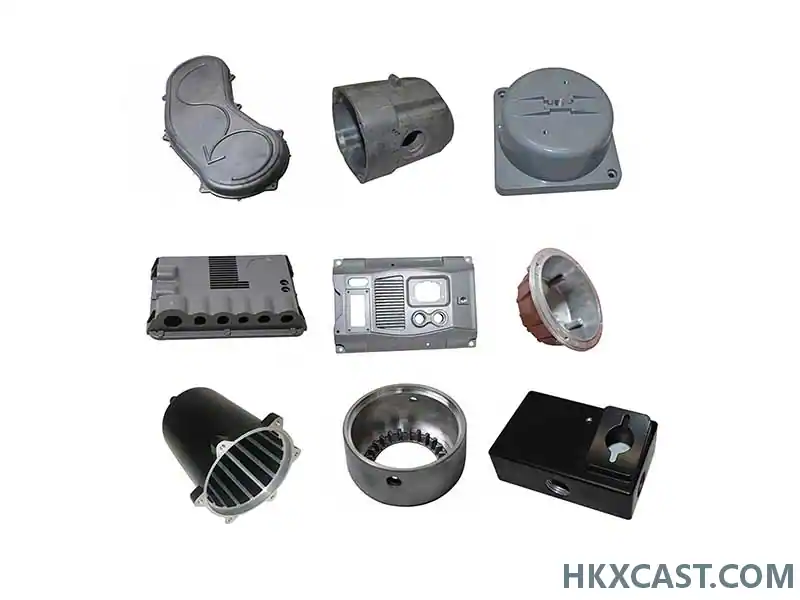
What is Aluminum Die Casting? Aluminum die casting is a metal manufacturing process where molten aluminum is injected under high pressure into a mold to form precise shapes—similar to plastic injection molding. However, it involves more complex systems, such as cores (for internal features), cooling channels, and ejection mechanisms. In simple terms, the process works by forcing liquid metal through a central injection port into a pre-designed cavity, where it solidifies into the desired part. It’s a high-efficiency method for producing strong, lightweight metal components.This article explores the fundamentals of aluminum die casting, including material selection, key technologies, and diverse applications across industries. Aluminum die-castings 1. Aluminum Die Casting Alloys and Material Composition The performance of die-cast aluminum products heavily depends on the alloy composition. Common aluminum die casting alloys like ADC12 and A380 are formulated with elements such as silicon, copper, and magnesium. These elements enhance properties like fluidity during casting, mechanical strength, and corrosion resistance. For instance, higher silicon content improves casting performance, while magnesium boosts structural integrity. Aluminum die-casting alloys can be divided into four main types based on their composition: These alloys are chosen based on required properties like strength, corrosion resistance, heat resistance, and castability. Selecting the right aluminum die cast material is critical. Factors like part complexity, intended use (e.g., structural components or heat-resistant cookware), and post-processing requirements influence the choice of die cast aluminum alloys. 2. The Aluminum Die Casting Process Explained The aluminum die casting process involves injecting molten alloy into a steel mold under high pressure. This method, known as high-pressure aluminum die casting, ensures precise filling of intricate molds, resulting in components with tight tolerances and smooth surfaces. Aluminum Die Casting Production Process Key equipment includes aluminum die casting machines, which control injection speed and pressure, and durable aluminum casting dies designed to withstand repeated thermal cycles. Advanced cooling systems within the…
 07/25/2025
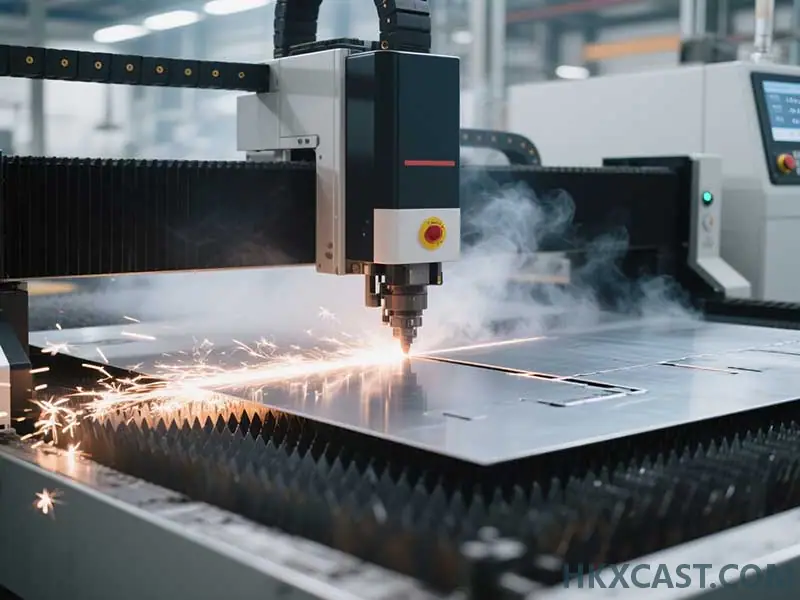
Metal fabrication is the backbone of modern manufacturing, and choosing the right cutting method can make or break a project. Two of the most common techniques are laser cutting and metal stamping. Whether you’re working with a steel sheet, producing intricate laser cutting metal parts, or managing high-volume production using a sheet metal stamping machine, selecting the right process is critical. This article offers a technical comparison to help engineers and manufacturers decide between laser cutting and stamping based on quality, cost, flexibility, and lead time. Understanding the Basics of Laser Cutting and Stamping What Is Laser Cutting? Laser cutting uses a high-powered laser for cutting steel and other metals with precision. It’s a non-contact process ideal for thin to medium materials, offering exceptional accuracy with minimal heat-affected zones. Modern sheetmetal laser cutting systems are programmable via CAD/CAM software, making them perfect for prototyping or producing custom laser cut sheet metal. In some cases, pliers for cutting metal may be used post-process to trim or adjust fine features manually. What Is Metal Stamping? Metal stamping uses dies and a metal stamp press machine to form or punch metal sheets into shape. It is widely used in steel sheet stamping applications, particularly in the automotive and appliance industries. For high-strength or specialized applications, high-temperature metal stamping enables shaping of heat-resistant alloys. This process is optimal for mass production, especially when tooling is done via a sheet metal stamping machine for consistency and throughput. Head-to-Head Comparison: Laser Cutting vs. Stamping Quality Comparison Table Feature Laser Cutting Stamping/Punching Remarks Workpiece Deformation No Yes Non-contact laser process applies no physical force Tool Wear No Yes Stamping tools degrade over time Tool Replacement Needed No Yes Dies require periodic replacement Material Hardness Cuts all hardness levels Requires calculations Stamping harder metals needs stronger tooling Post-Cut…