A useful aluminum finish cost comparison starts with surface area and substrate, not with the finish name. On a normalized index where Type II anodize equals 1.00, powder coating lands near 0.80 for large flat parts, e-coat sits at 0.90 to 1.20, and hard anodize reaches 2.50 to 4.00. For die cast aluminum the deciding variable is silicon content, because ADC12 anodizes unevenly while powder and e-coat hide the cast skin.
Key Takeaways
- Pretreatment and masking usually carry 40-60% of finish cost, so the cheapest chemistry on paper rarely produces the cheapest part.
- Powder coating indexes around 0.80 on large flat panels but climbs past 1.20 on small, pocketed castings where rack density drops.
- E-coat wins on geometry: dip coverage reaches recesses that powder cannot, at 15-25 µm film and a 0.90-1.20 index.
- Type II anodize holds 10-25 µm and passes 200-400 hours of salt spray when sealed; hard anodize triples wear life at 2.5-4x the cost.
- ADC12 with 10-12% silicon anodizes to a dark, patchy gray; specify powder or e-coat when color match matters.
- Cost per square meter hides the real number. Ask for cost per finished part at your annual volume, including expected rework.
Why Finish Cost Behaves Differently on Aluminum Castings
A machined aluminum block and a die cast housing enter the same paint line and leave with very different economics. The casting arrives with a skin that is not pure aluminum. It carries silicon particles, iron-rich intermetallics, a mold-release residue and a thin oxide layer that formed in the die.
Pretreatment has to deal with all of it. Anodizing dissolves the surface and rebuilds it as an oxide, so anything alloying the metal shows up in the coating. Powder coating and e-coat sit on top, which makes them forgiving of chemistry and less forgiving of cleanliness.
The silicon problem
ADC12 and A380 carry roughly 9-12% silicon. In an anodizing tank the aluminum matrix converts to oxide while the silicon particles do not, so the coating grows around inert islands. The result reads dark, uneven and often chalky after dyeing. A buyer who specifies black anodize on an ADC12 housing will receive a part that matches the drawing and fails the appearance standard.
A360 behaves better because silicon sits near 9-10% with more magnesium and less copper, and A356 gravity castings anodize cleanly enough for decorative work. The practical rule: if the substrate is a high-silicon die casting alloy, budget for powder or e-coat, or accept a dark anodic finish as a design intent rather than a defect.
Porosity meets oven heat
Powder curing runs 180-200 °C for 10-20 minutes. Gas trapped near the surface of a die casting expands in that window and blows pinholes through the film. The fix is a pre-heat outgassing step of 10-15 minutes before coating, which costs an extra pass through the oven and adds roughly 15-25% to the coating line time. E-coat cures lower, near 160-180 °C, and the film is thin enough that outgassing defects are rarer.
Anodize involves no elevated cure, so blistering is not the risk. Instead, porosity shows as dark speckles because each pore traps electrolyte and dyes heavily. That is one reason a aluminum finish cost comparison cannot use a single price per square meter across three processes.
The Three Processes Priced Side by Side
Indexes below use Type II sulfuric anodize at 1.00 as the anchor for a mid-size die cast housing with 0.25 m² of coated area, quoted at 5,000 pieces a year. They are ratios, not prices, and they move with geometry and volume. A sensible aluminum finish cost comparison always states its anchor, because an index quoted against a different baseline cannot be compared with yours.
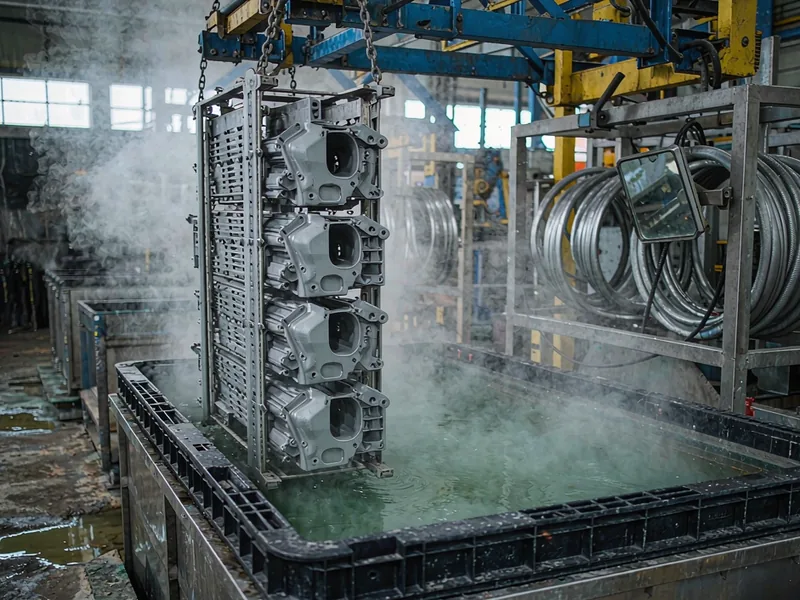
Comparison table
| Criterion | Type II anodize | Powder coat | E-coat (cathodic epoxy) |
|---|---|---|---|
| Film thickness | 10-25 µm | 60-90 µm | 15-25 µm |
| Dimension change | 50% inward, 50% outward | Full build on surface | Full build, uniform |
| Process time per batch | 60-90 min tank plus 20-30 min seal | 10-20 min cure at 180-200 °C | 2-3 min dip plus 20-30 min bake |
| Salt spray, sealed or cured | 200-400 h | 500-1,000 h polyester | 400-700 h |
| Color range | Wide through dye, batch sensitive | Widest, any RAL | Narrow, mostly black and gray |
| Coverage in deep pockets | Good, line-of-sight not required | Poor, Faraday shadowing | Excellent throw power |
| Masking demand | High, contact marks and threads | Medium, hanging points | Low to medium |
| Relative cost index | 1.00 | 0.75-0.95 flat, 1.20+ complex | 0.90-1.20 |
| Hard anodize variant | 2.50-4.00 index, 25-50 µm | Not applicable | Not applicable |
Read the last two rows together. A flat LED housing cover with two bends is a powder part on cost. The same cover with a 40 mm deep driver pocket and six mounting bosses is an e-coat part, because powder will not reach the pocket floor without a manual touch-up pass that erases the index advantage.
Where the Money Actually Goes
Buyers tend to compare chemistry and ignore everything around it. In a aluminum finish cost comparison built from real line data, pretreatment, handling and yield usually outweigh the coating material itself. Five drivers explain most of the spread between two quotes on the same drawing.
Surface area and rack density
Every process charges for area, but anodize also charges for contact points. Each part needs a titanium rack contact that carries current and leaves a small uncoated mark. Small parts with awkward shapes hold few pieces per rack, so labor per part rises while tank time stays fixed. Doubling rack density can cut anodize cost per part by 30% without touching chemistry.
Masking and threads
Threads, bearing bores and electrical contact pads must stay conductive or within tolerance. Masking a die casting with eight threaded inserts can consume more labor than the coating step. Powder masking uses silicone plugs and high-temperature tape; e-coat masking uses the same plus a post-cure removal step. On a part with heavy masking, anodize can index above 1.40 even though its chemistry is mid-priced.
Color changes and batch size
Powder lines lose time on color change, and small lots pay for it. Anodize dye baths are batch-sensitive: two lots of the same dye recipe can land a Delta E of 1.5 apart, which matters when a housing sits beside a painted cover on the same assembly. E-coat avoids the color problem by offering fewer colors.
Yield and rework
Rework is where the cheap option stops being cheap. Anodize strips and re-runs, but stripping removes 3-5 µm of base metal each cycle and can ruin a tolerance. Powder burns off and re-coats, usually with a blast pass first. E-coat is the hardest to strip cleanly. A process with a 4% rework rate at double the rework cost beats a 2% rate at nominal price only if the difference survives the arithmetic.
Freight and packaging
Coated parts need separation. Powder films chip at edges; anodized films scratch but do not chip; e-coat films are thin and mar easily before full cure. Packaging cost per part often differs by 10-20% between processes, and it does not appear in a per-square-meter quote.
How HKX Controls Finish Cost on the Line
At HKX, finishing is planned at the DFM stage, before the die is cut, because most finish cost is locked in by geometry. The Ningbo plant runs anodizing, powder coating and e-coat alongside CNC machining, so the engineering team compares all three routes on the same part rather than quoting whichever line happens to be free.
The first control is rack design. HKX engineers review the casting for hanging points and current paths, then confirm that the rack can carry enough parts to hit the quoted labor rate. A part with a single flat face and no undercuts may hang 24 pieces per rack; the same part with a deep fin stack may hang eight. That difference is quoted, not discovered later.
The second control is pretreatment discipline. Castings are degreased, etched and desmutted on a defined timetable, and the team tracks bath chemistry daily rather than by batch. Anodize dye lots are recorded against the part number so that a repeat order can be matched to the original shade. Powder parts pass a pre-heat outgassing cycle before coating when the casting has thick sections, which is the single most effective step against pinholes on a 6 mm boss.
The third control is masking templates. HKX builds reusable plugs and caps for each part number instead of taping threads by hand, which cuts masking labor by roughly half on high-runner parts. Every quote issued by the plant carries a line for this labor, so the aluminum finish cost comparison a buyer receives reflects the actual rack and masking plan rather than an average.
Fourth, coated parts are inspected against a master sample under defined lighting, and salt spray coupons from each batch go into the cabinet on a fixed schedule. Fifth, the finish route is written into the control plan with the film thickness, adhesion test method and color tolerance, so a repeat order reproduces the first one rather than approximating it.
That planning is why HKX can quote a coated part as a single landed number covering casting, machining, masking and finish. Buyers comparing that number against a bare casting quote plus a separate coater invoice are comparing two different scopes.
Matching the Finish to the Part
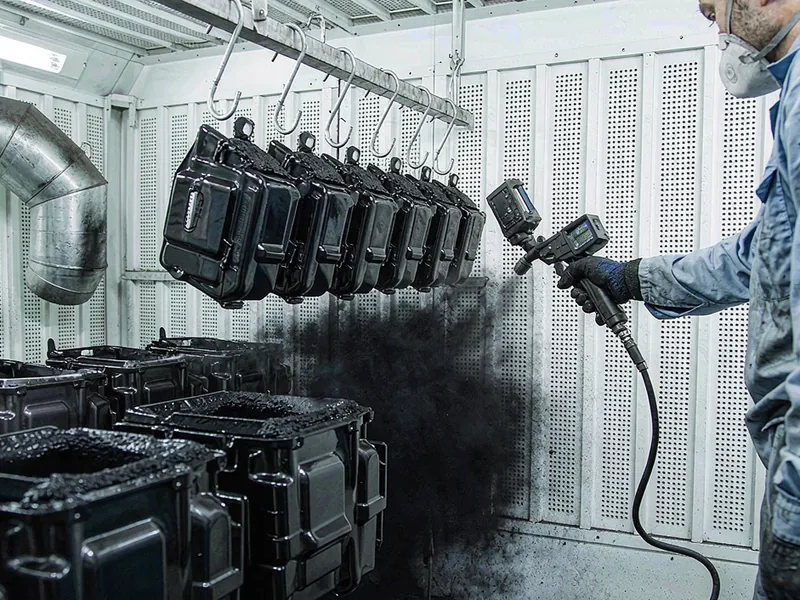
The fastest way to finish a aluminum finish cost comparison is to start from the part, not the process. Castings fall into recognizable groups, and each group has a finish that is both technically defensible and commercially sane.
| Part and substrate | Recommended finish | Why it wins | Cost watch-out |
|---|---|---|---|
| LED housing, ADC12, visible black | E-coat or powder | Hides silicon, covers fins evenly | Fins need outgassing; powder may bridge fin roots |
| Street lamp head, A360, coastal site | Powder polyester | 600+ h salt spray, wide color choice | Edge coverage needs a 60 µm minimum |
| Structural bracket, A356-T6 | Type II or hard anodize | Wear resistance plus dielectric standoff | Masking of mating faces adds labor |
| Explosion-proof housing, ADC12 | E-coat plus powder topcoat | Dip primer seals porosity, topcoat adds UV and chemical resistance | Two cure passes, index 1.4-1.6 |
| Electronic enclosure, deep pocket | E-coat | Throw power coats the pocket floor | Color limited to dark tones |
| Decorative cover, color match to paint | Powder with matched RAL | Single coat, tight color control | Delta E still needs a master sample |
Two rules resolve most of these cases. First, if the part needs electrical isolation inside a cavity, choose the dip process. Second, if the part is a high-silicon die casting and the customer expects a metallic look, reset the expectation before quoting, because no anodize recipe will make ADC12 look like extruded 6063.
Writing a Finish Spec That Produces Comparable Quotes
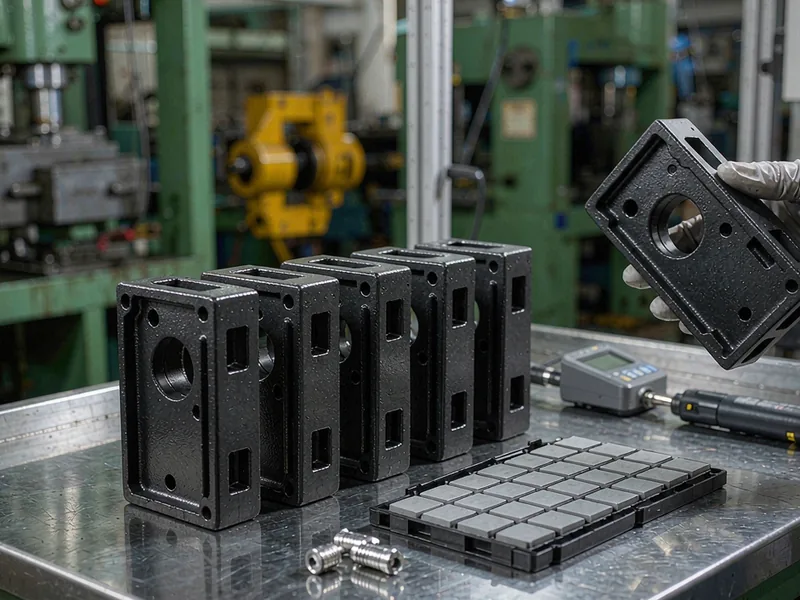
Most finish quotes arrive incomparable because the request leaves three things open: film thickness, masked areas and acceptance criteria. A supplier fills those gaps with its own defaults, and the buyer compares numbers built on different scopes. Closing those gaps turns a aluminum finish cost comparison into a decision instead of a negotiation.
Specify film thickness as a range with a minimum at the high-stress area, not a nominal. Specify which surfaces must remain conductive, and mark them on the drawing rather than describing them in prose. Name the corrosion test and its duration, for example 480 hours of neutral salt spray per ASTM B117, and state whether red rust or white corrosion is the failure criterion. Add an adhesion method, a color tolerance in Delta E, and a gloss range.
Then ask for cost per finished part in three columns: coating, masking and packaging. That split tells you which line item to attack. If masking is 30% of the finish cost, a design change that moves threads out of the coated zone is worth more than negotiating the coating rate. If packaging is high, a nest design pays back in one shipment.
The substrate decision deserves the same rigor. Standard alloy designations and their chemical limits are defined in ASTM B85/B85M, and the anodizing response of each grade differs enough that alloy choice can decide whether an anodic finish is even possible. The mechanism is described in the reference entry on anodizing, including why silicon-bearing alloys produce uneven coatings.
For a full view of what the plant can run in-house, see the surface finishes page. Buyers working on outdoor lighting often pair this decision with the corrosion behavior covered in does aluminum rust, and with alloy-level guidance in weldable and anodizable die casting alloys. For a housing that will be coated and then assembled, the LED lamp housings range shows how finish and thermal geometry are specified together.
Frequently Asked Questions
Is anodizing always more expensive than powder coating?
On large flat parts, no. Powder usually indexes 0.75-0.95 against anodize at 1.00, so powder is cheaper there. Reverse the geometry and the answer flips: small castings with heavy masking push anodize to 1.40 while powder climbs past 1.20 on rack density. Any aluminum finish cost comparison that ignores part geometry is quoting an average, not your part.
Can ADC12 be anodized to a cosmetic standard?
Rarely. Silicon of 10-12% does not convert to oxide, so the coating forms around inert particles and reads dark and patchy. It can work as a functional finish where appearance is secondary. For visible parts, powder or e-coat gives a consistent result at a lower total cost.
Why does powder coating sometimes show pinholes on castings?
Gas trapped in surface porosity expands during the 180-200 °C cure and pushes through the film while it is still fluid. A pre-heat outgassing step of 10-15 minutes before coating removes most of it. The step adds oven time, so expect a 15-25% line-time increase on parts that need it.
Which finish survives salt spray longest?
A polyester powder at 60-90 µm typically holds 500-1,000 hours, sealed Type II anodize 200-400 hours, and e-coat 400-700 hours. Thickness and pretreatment matter more than brand. For coastal lighting, specify the hours and the failure mode, then let the finisher choose the system.
Does coating change my dimensions?
Yes, and the direction differs. Anodize grows about half its thickness outward and consumes the other half inward, so a 20 µm coating adds roughly 10 µm per surface. Powder and e-coat add their full thickness. Bores with a 0.05 mm tolerance should be masked or finished before the final machining pass.
How do I compare quotes from three different finishers?
Normalize three variables: coated area, masked area and acceptance criteria. Then ask each supplier for cost per finished part at your annual volume, including expected rework. A supplier quoting a lower rate with a 6% rework allowance is often the more expensive partner once scrap and freight are counted.
Author: HKX Engineering Team
HKX — Ningbo Hexin Mould Co., Ltd., an aluminum die casting manufacturer in Ningbo, China, with 30+ years of tooling experience, in-house machining and finishing, ISO 9001 and IATF 16949 certification, and customers in more than 20 countries.
Talk to the HKX Engineering Team
Send the drawing with the coated area, the masked zones and the corrosion requirement, and HKX will return a finish recommendation with a cost index for each route rather than a single price. The package includes DFM feedback on rack and masking design, sample castings finished on the production line, and a film thickness and salt spray report from the first batch. Buyers who settle the finish before the die is cut avoid the most common surprise in this category: a cosmetic requirement that the chosen alloy cannot meet. To start the review, contact our engineering team and state the annual volume and the salt spray hours the part must pass.