The salt spray test aluminum buyers request usually arrives as “500 hours”, and that number only carries weight when the standard, the finish and the acceptance criterion are named together. ASTM B117 runs a continuous 5% sodium chloride fog at 35 °C, and a bare ADC12 die casting shows white corrosion within 24-72 h while a powder-coated part can pass 1,000 h. The hours below are realistic ranges for production parts, not best-case laboratory results.
Key Takeaways
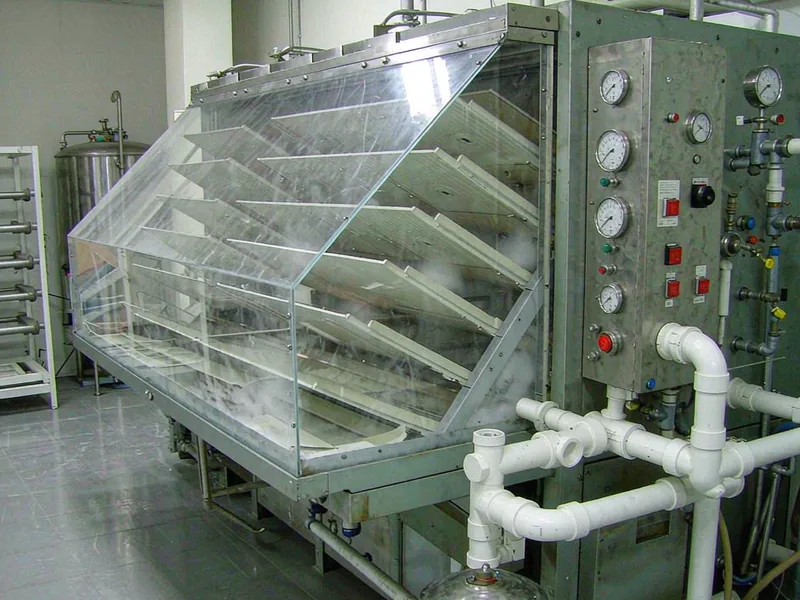
- ASTM B117 specifies 5% NaCl fog at 35 °C, pH 6.5-7.2, collected at 1-2 mL/h per 80 cm², with no pass or fail criterion of its own.
- Bare die cast aluminum shows white corrosion in 24-72 h; trivalent chromate pushes that to 96-240 h and powder coat to 500-1,000 h.
- Hours scale with total coating thickness only up to a point; adhesion and pretreatment decide the failure mode after that.
- A scribed panel is the honest test for painted parts, because it measures creep from a defect rather than from an intact film.
- B117 is a comparative screen, not a service-life prediction; coastal exposure involves wet-dry cycling and chloride load that a constant fog cannot copy.
- Write the standard, the hours, the scribe condition and the rating scale on the drawing, or two labs will report different verdicts on the same part.
What ASTM B117 Actually Specifies
B117 is a method, not a specification. According to the reference description of the salt spray test, B117 tells a laboratory how to create and hold a corrosive fog and deliberately says nothing about how long a part must survive. That distinction explains most of the arguments between buyers and finishers: the standard defines equipment and conditions, the purchase order defines the acceptance limit.
The controlled variables
The salt solution is 5% sodium chloride by weight in water, with total impurities held under about 0.3% and iodide kept low, because trace iodide accelerates attack on aluminum in a way that does not happen outdoors. The collected fog must sit at pH 6.5-7.2 at 25 °C; dissolved carbon dioxide pushes pH down over a run, so most labs check it daily. Chamber temperature is 35 °C with a tolerance of about ±1.1 °C, and the air saturator runs near 47 °C to humidify the air before atomization.
Fog collection rate is the variable most often out of control. Two collectors placed in the chamber must gather 1-2 mL/h per 80 cm² of horizontal area, and a chamber that collects 3 mL/h is not running a B117 test even if the display says 35 °C. Specimens sit at 15-30° from vertical so that condensate runs off instead of pooling, and they must not shield each other. According to ASTM B117, the test is continuous except for brief inspections, and the duration is whatever the specification calls out, usually in 24 h increments.
What B117 does not cover
Four things lie outside the salt spray test aluminum suppliers actually run, and all four belong in the drawing. First, surface preparation: a coupon cut from a casting and tested without the production pretreatment is testing a different part. Second, the scribe: depth, tool and shape change the result, so the drawing should cite a scribe method. Third, the acceptance rating: hours to first white corrosion, area percentage, or creep from a scribe are three different measures. Fourth, the post-test cleaning method, because how much corrosion product is removed before rating changes the number.
| Test | Standard | Electrolyte and cycle | Typical use |
|---|---|---|---|
| Neutral salt spray | ASTM B117 | 5% NaCl, 35 °C, continuous | General screening, drawing callout |
| Neutral salt spray | ISO 9227 NSS | 5% NaCl, 35 °C, continuous | Same fog, European acceptance ratings |
| Acetic acid salt spray | ISO 9227 AASS | pH 3.1-3.3, 35 °C | Decorative coatings, faster attack |
| Copper accelerated | ISO 9227 CASS | Copper chloride, pH 3.1-3.3 | Anodized and plated appearance parts |
| Cyclic acidified | ASTM G85 A5 | Salt fog plus wet-dry cycling | Industrial coatings, better field correlation |
| Cyclic corrosion | ISO 11997-1 | Salt, humidity, dry-off cycles | Automotive OEM validation |
The table is the first thing to check in a quotation. A supplier quoting “500 hours” against CASS and a buyer expecting B117 are describing different tests, and the CASS result will look far worse on the same coating. For die cast aluminum parts the usual callout is B117 or ISO 9227 NSS, with AASS and CASS reserved for decorative anodized or plated surfaces.
Hours by Finish Type
The ranges below come from production parts on ADC12 and A380 substrates, tested unscribed unless noted, with the finish applied on a properly pretreated surface. They are what each finish delivers in the salt spray test aluminum buyers write into a purchase order, not the best result a laboratory can produce on a polished coupon.
| Finish | Typical thickness | Hours to first white corrosion | With a scribe | Best use |
|---|---|---|---|---|
| Bare as-cast aluminum | None | 24-72 h | Not applicable | Machined or painted downstream only |
| Bare, tumbled and dried | None | 48-96 h | Not applicable | Indoor parts with no visible surface |
| Trivalent chromate, thin (Class 3) | 0.05-0.3 µm | 96-168 h | 72-120 h | Grounding pads, paint base |
| Trivalent chromate, thick (Class 1A) | 0.3-0.8 µm | 168-240 h | 120-168 h | Painted housings, indoor corrosion |
| Hexavalent chromate | 0.3-1.0 µm | 240-336 h | 168-240 h | Unpainted parts where still permitted |
| Type II anodize, clear, sealed | 8-12 µm | 168-240 h | 120-192 h | Cosmetic indoor parts |
| Type II anodize, black dyed | 8-12 µm | 240-336 h | 168-240 h | Cosmetic dark housings |
| Type III hard anodize | 25-50 µm | 500-1,000 h | 336-720 h | Wear surfaces, outdoor hardware |
| E-coat, single layer | 20-25 µm | 240-480 h | 240-336 h | Complex geometry, edges and threads |
| Powder coat, polyester | 60-80 µm | 500-1,000 h | 500-720 h | Outdoor cosmetic housings |
| E-coat plus powder, two layer | 80-110 µm | 720-1,000 h | 720-1,000 h | Coastal and industrial outdoor parts |
| PVDF coating | 25-30 µm | 1,000 h and beyond | 1,000 h | Architectural and lamp posts |
Two patterns in that table drive most sourcing decisions. Conversion coatings sit in the 96-336 h band and anodizing sits just above them, so none of the thin-film routes will satisfy a 720 h requirement no matter how the bath is tuned. Organic coatings start at 500 h because the film is 60-100 µm thick, and thickness is doing the work rather than chemistry.
Why the same finish varies by 100 hours
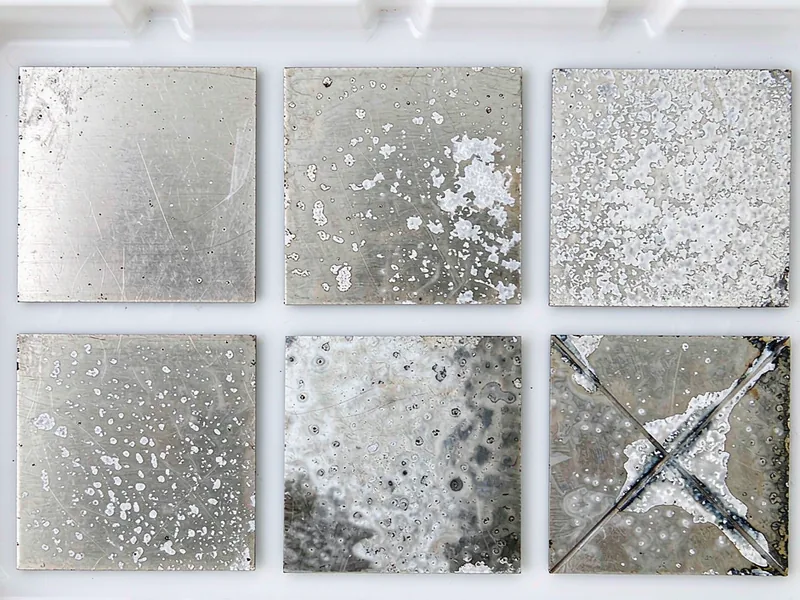
Substrate condition is the hidden variable. A casting with die-release residue, a cold shut, or gas porosity exposed by machining will fail earlier than a sound part with identical coating. Casting skin behaves differently from a machined surface because the skin carries a different silicon distribution and a thin oxide from the shot. Pretreatment time, rinse conductivity and the interval between coating and topcoat all move the number, which is why a supplier should quote a range rather than a single figure.
Reading the Result the Same Way Twice
Two inspectors can disagree about salt spray test aluminum panels that have been in the chamber for 480 h, and both can be right under different rating rules. Fixing the rule before the test starts removes the argument.
White corrosion, not rust
Aluminum does not rust. It forms white or grey hydroxide deposits at pits and edges, and on a coated part the first sign is often a ring of white product at a scribe or a damaged edge rather than a general bloom. Red rust only appears when steel is present, such as a cast-in insert or a steel fastener, and that is a different failure with a different fix. Rating an aluminum part against a rust scale designed for steel produces meaningless numbers.
Rating scales that hold up
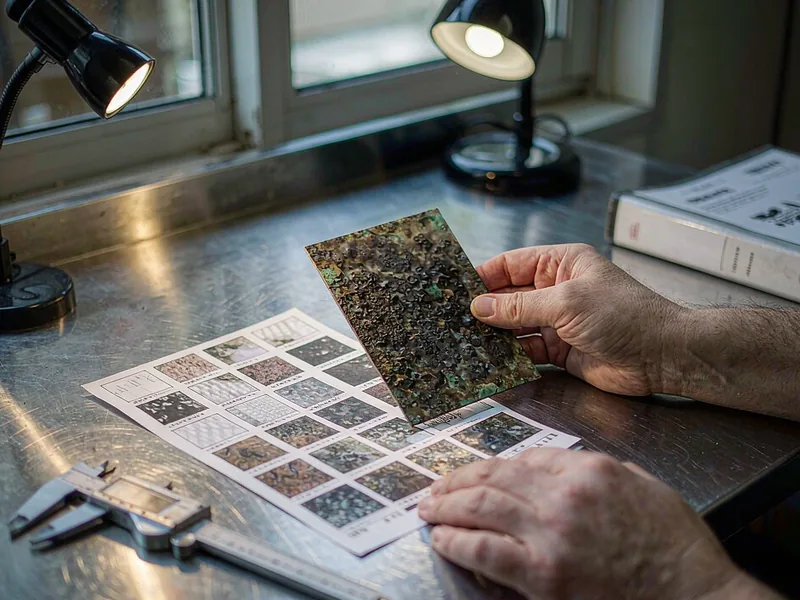
Three methods cover most purchase orders. Hours to first white corrosion is the simplest to audit. Area percentage by visual comparison against a reference chart suits painted parts with general blistering. Scribe creep, measured in millimetres from the scribe line, is the most meaningful for a coated part because it tests the coating’s ability to protect a defect rather than an intact film.
| Criterion | Method | Typical requirement | Where it fits |
|---|---|---|---|
| Hours to first white corrosion | Visual, inspected every 24-168 h | 168 h minimum for painted die castings | Simple purchase order language |
| Scribe creep | ASTM D1654, scribe per method | ≤ 2 mm at 480 h, rating ≥ 7 | Painted and coated parts |
| Blistering | ASTM D714, density and size | No blistering larger than size 8, few | Powder coat and e-coat |
| Corroded area | ISO 10289 rating | Rating ≥ 9 at the specified hours | European drawing sets |
| Adhesion after exposure | ASTM D3359 cross-hatch | 4B or better, dry and after 240 h | Catches pretreatment failures |
Scribe creep deserves the extra attention because it is the number that tracks field performance on painted aluminum. A coating that passes 720 h unscribed but shows 5 mm of creep from a scribe is failing where real parts fail: at cut edges, drilled holes and assembly damage. Specify a creep limit, not just an hour count, and state whether the scribe goes through to substrate.
Why Hours Do Not Predict Field Life
The salt spray test aluminum buyers rely on produces hours, not a warranty, and treating hours as a warranty is how coating specifications become legal disputes. B117 holds one condition constant for the whole run, while a real part sees wet and dry cycles, UV, temperature swings, chloride deposition that varies by site, and mechanical damage during assembly.
The relationship between hours and years depends on the environment far more than on the coating. A part under a roof in an inland city may see a fraction of the chloride load of the same part mounted 200 m from a coastline, and no constant-fog test can reproduce that difference. Cyclic tests were developed for exactly this reason: they add wet-dry transitions that drive corrosion products into a different, more realistic pattern. Where field data exists, correlate it against both B117 and a cyclic method, then specify the method that predicts the field result rather than the larger number.
Five mistakes that move the number
Coupons cut from a different lot than production, tested without the production pretreatment, are the most common. Chamber overload is second: too many panels shield each other and cut the effective fog deposit. A third is testing before a coating has cured, which understates powder and e-coat performance. A fourth is neglecting pH drift, which quietly acidifies the fog and accelerates attack. The fifth is inconsistent cleaning after exposure, which changes how much product is removed before rating.
Setting the Requirement on a Drawing
A useful requirement names four things in one line: the standard, the hours, the scribe condition and the rating. “Salt spray 480 h per ASTM B117, scribed per D1654, creep ≤ 2 mm, no base metal corrosion” is enforceable. “Salt spray tested” is not.
In the salt spray test aluminum callout, the hours should match the environment rather than a competitor’s datasheet. An indoor enclosure that never sees condensation beyond a factory wall needs far less than a lamp head on a coastal highway, and over-specifying drives cost into a coating the part does not need. The surface finishes page lists which routes reach which band, and the mechanism behind the numbers is covered in corrosion behavior of cast aluminum alloys.
| Application | Environment | Reasonable B117 target | Finish that reaches it |
|---|---|---|---|
| Indoor electronic enclosure | Dry, conditioned air | 96-168 h | Trivalent chromate, or e-coat |
| Industrial control cabinet | Humid, occasional condensate | 240-336 h | E-coat 20-25 µm |
| Outdoor lighting housing | Rain, UV, temperature cycling | 480-720 h | Powder coat 60-80 µm over chromate |
| Street lamp head and cast post | Urban and coastal outdoor | 720-1,000 h | E-coat plus powder, or PVDF |
| Automotive underhood part | Salt, heat, vibration | 480-720 h, cyclic preferred | E-coat plus powder over trivalent |
| EV battery enclosure | Road splash, stone damage | 720-1,000 h, scribed | Two-layer coating with creep limit |
For automotive programs, expect the OEM specification to override the generic number. Most vehicle makers now validate with cyclic methods such as ISO 11997-1 or their own internal cycle, and use B117 only as an incoming screen. A supplier that can run both, and report which one produced which number, is easier to qualify than one that can only quote a single figure.
How HKX Runs Salt Spray Testing
At HKX, salt spray test aluminum coupons are cut from the production shot, so the test works as a production control instrument rather than a certificate service. Three chambers run continuously, and every load is logged with the lot number, the finish route, the coating thickness measured on the same parts, and the date the load went in. Daily verification covers the variables that drift. Brine concentration is checked with a salinometer against the 5% target, the pH of collected fog is measured at 25 °C and held at 6.5-7.2, and both collectors are read against the 1-2 mL/h per 80 cm² band. Chamber temperature is recorded at 35 ±1 °C, and the saturator temperature is logged with it, because a cold saturator produces a dry fog that under-tests the parts. Panels are racked at 20° from vertical with at least 25 mm between them, and the rack positions are rotated between loads so no part is permanently in a shadow.
Each coupon comes from the same shot as the parts it represents, is coated on the same line in the same basket, and is scribed with a carbide tool to a fixed depth where the drawing calls for one. Inspection happens at 168 h intervals with photographs each time, so the report shows when corrosion started rather than whether it had by the end. The report records hours to first white corrosion, the ASTM D1654 rating and creep measurement, and the coating thickness of the tested parts. Coupons are retained for 12 months with the lot number, which is what makes a field question about a specific shipment answerable with data from that shipment.
Frequently Asked Questions
How many hours of salt spray does aluminum need?
It depends on the finish and the environment. Bare die cast aluminum reaches 24-72 h, trivalent chromate 96-240 h, anodize 168-336 h and powder coat 500-1,000 h. For a painted outdoor part, 480-720 h is a common target, and for an indoor enclosure 168 h is usually enough.
Is 500 hours of salt spray good?
For a coated aluminum part, yes, provided the test was scribed and the creep limit is stated. Unscribed hours flatter any coating, because the film is intact everywhere. A 500 h result with 2 mm creep at a scribe is a stronger claim than 1,000 h with no scribe at all.
Does salt spray testing predict real service life?
Not directly. B117 holds one condition for the entire run, while field exposure adds wet-dry cycles, UV and varying chloride load. Use it to compare candidate finishes on the same substrate, not to convert hours into years. Where field data exists, correlate it against a cyclic method as well.
Why do salt spray test aluminum panels fail after a coating change?
The coating is usually not the cause. Thinner film, a skipped conversion layer, a colder cure, or a rinse that was not monitored will all shorten the time to first corrosion. Compare coating thickness and pretreatment records from the failing lot against the last good one before changing suppliers.
Should the test panel be scribed?
For painted and coated parts, yes. A scribe exposes the substrate and measures how far corrosion creeps under the film, which is how real parts fail at cut edges and drilled holes. Specify the scribe method and the creep limit, because an unscribed test on a coated part mostly proves the coating is continuous.
How often should the chamber be verified?
Daily for brine concentration, collected fog pH, collection rate and temperature, with a full calibration against a reference instrument at least annually. Most disputes about a failing result trace back to a chamber that was out of band for weeks before anyone noticed.
Author: HKX Engineering Team
HKX — Ningbo Hexin Mould Co., Ltd., an aluminum die casting manufacturer in Ningbo, China, with 30+ years of tooling experience, in-house machining and finishing, ISO 9001 and IATF 16949 certification, and customers in more than 20 countries.
Talk to the HKX Engineering Team
Send the drawing with the finish callout, the exposure environment and the annual volume, and HKX will confirm which finish reaches the hours you need on your alloy, and what the test report will contain. Deliverables include salt spray data on coupons cut from the production lot, coating thickness records, scribe creep measurements, and photographs taken at each inspection interval so the failure sequence is visible rather than summarized. For outdoor programs such as aluminum street lamp heads, HKX will also compare a single-layer and a two-layer coating on the same casting before the drawing is fixed. To start that review, contact our engineering team with the target hours and the market the product ships to.